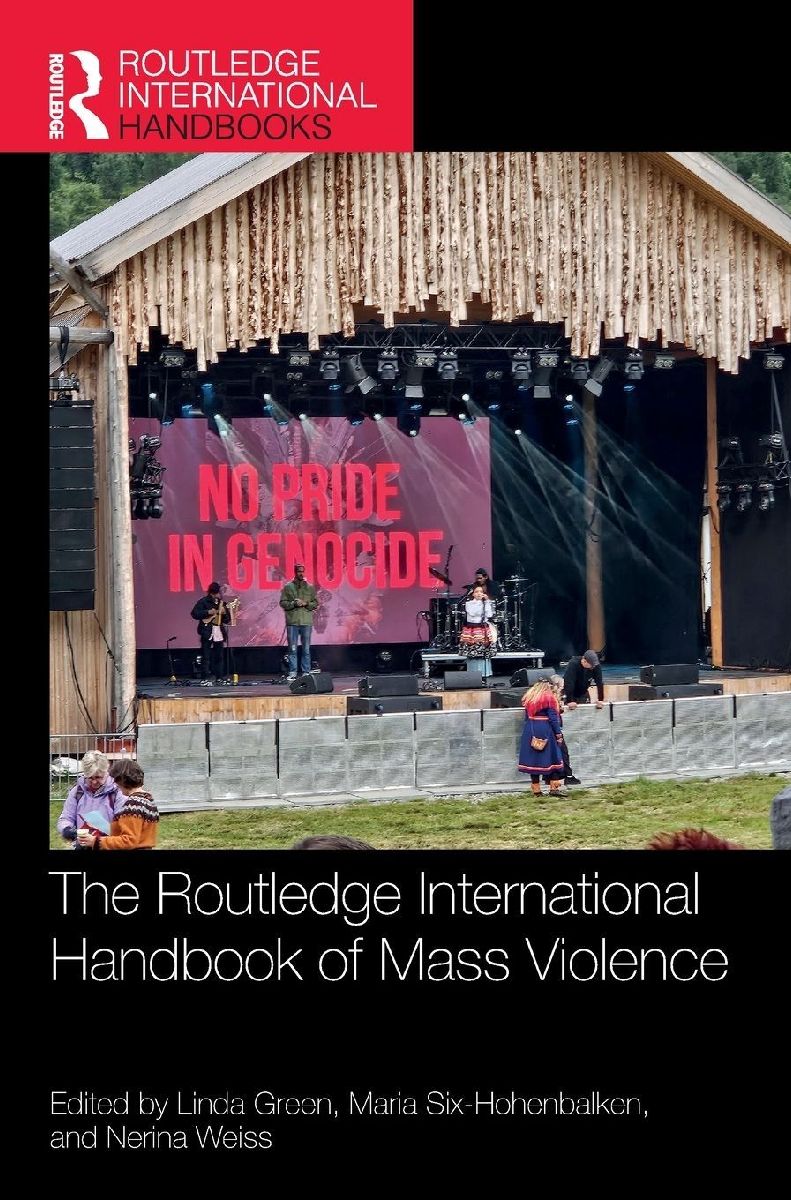
Interrogating the complexities of mass violence in contemporary society, this handbook reconceptualizes the accumulation, intensity, and temporality of mass violence - rather than depending on numbers alone - to develop a critique of mass violence adequate for our times.
The Routledge International Handbook of Mass Violence critically engages with classic political, sociological, psychological, and strategic paradigms to ask how violence operates when it is temporally diffuse, socially obscured, and institutionally normalized. This volume is thematically organised to explore the theories, strategies, legacies, memories, perpetrators of mass violence, and investigates topics that were previously considered to lie beyond the scope of studies of mass violence such as the carceral system and environmental damage. Contending with questions of justice and reconciliation, and issues surrounding burials and exhumations after mass violence, this book explores an extensive range of international case studies to determine the boundaries of the concept of mass violence and how instances of mass violence are categorized.
This volume promotes an intellectual interchange that broadens our understanding of mass violence beyond the instrumental and orchestrated violence perpetrated by political and state actors, and will appeal to scholars and students of sociology, anthropology, law and politics with interests in mass violence.
Inhaltsverzeichnis
1. A Contemporary Critique of Mass Violence
Section I: Theories of Mass Violence
2. The Snake - Trump's White Genocide, Great Replacement Parable
3. Necropolitics: Mass Violence and European Mobility Regimes in the Mediterranean
4. Four Hundred Years of Strategic Mass Violence: The European Conquest of North America
Section II: Strategies of Mass Violence
5. Landscapes of Disappearance
6. A Brief History of Turkey's Mass Violence and Paramilitary Forces in Northern Kurdistan
7. The Continuum of Mass Violence in Palestine/Israel: From Genocidal War to Street Shootings
8. Distancing the Other: Theories of Mass Violence and their Applications to Exterminatory Genocides
Section III: Border Regimes
9. Migration and the Legacy of Social Violence in Central America
10. A Critical Forensic Anthropology of Low-Intensity Conflict at the US-Mexico border
11. Less-than-deadly Borders: Mass Injuries along the Balkan Route
12. Ghetto Laws in Denmark-An Analysis of State and Political Violence
Section IV: The Carceral System
13. The Mass Violence of Prison
14. The Gendered Harms of Mass Carceral Violence
15. Building Socialism through the Building of Prisons: Mass Violence and the Carceral System during the Cambodian Genocide
Section V: Ecology and Mass Violence
16. Extractivism
17. Extractivism and Climate Change as Mass Violence: The Impact of Large-scale Industrial Development, Territory Fragmentation and Unstable Climate on Indigenous Homelands in Canada and Sápmi
18. Win but not Win: The Paradox of Resistance and Violence Against Indigenous Communities in the Zapotec Mountains of Oaxaca, Mexico.
19. De-occupying as Planetary Politics: On the Damages of Russia's Full-scale Invasion of Ukraine
Section VI: Legacies and Memories of Mass Violence
20. Human Remains and the Moral and Semiotic Limits of Mass Violence on Display in Cambodia
21. Memory of Mass Violence and the Subjunctive Space of Palestinianness
22. From Vietnam to Iraq: Empire's Law, the People's Court, Genocide and Delayed Justice
23. Forging a Common Humanity: The Last 30 Years Since the Genocide Against the Tutsi in Rwanda in 1994
Section VII: Justice and Reconciliation
24. International Criminal Justice and Victims' Demand for Justice
25. Legacies of Mass Violence: Indian Residential Schools in Canada
26. Human Security Law in Post-2003 Iraq: Deconstructing Transitional Criminal "Justice"
27. Interdisciplinary Aspects of Dealing with Situations of Mass Violence
Section VIII: Researching Mass Violence
28. What Noises Say About Mass Violence
29. Slavery and Human Trafficking as Components of Mass Violence
30. Collecting Testimonies in an Ongoing War: Precarity, Solidarity and the Glass Ceiling in International Academia
Section IX - Afterword
31. Afterword