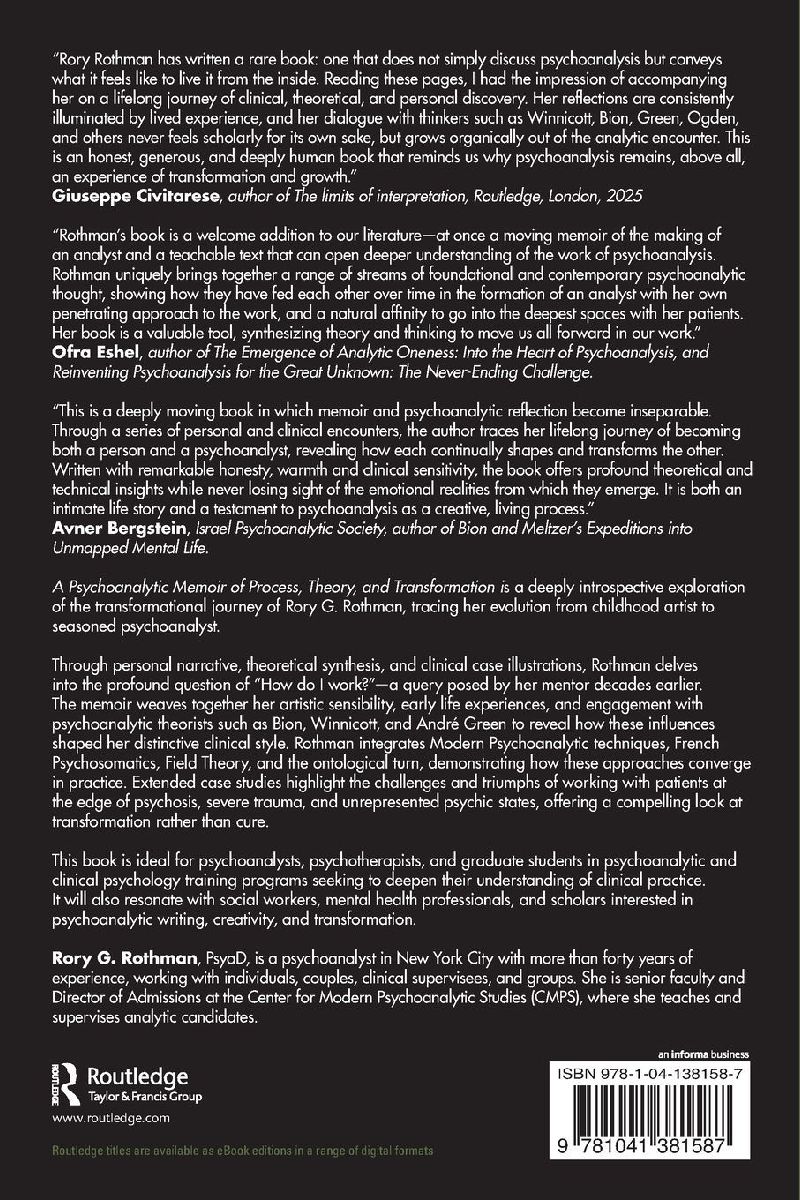
A Psychoanalytic Memoir of Process, Theory, and Transformation is a deeply introspective exploration of the transformational journey of Rory G. Rothman, tracing her evolution from childhood artist to seasoned psychoanalyst.
Through personal narrative, theoretical synthesis, and clinical case illustrations, Rothman delves into the profound question of "How do I work?"-a query posed by her mentor decades earlier. The memoir weaves together her artistic sensibility, early life experiences, and engagement with psychoanalytic theorists such as Bion, Winnicott, and André Green to reveal how these influences shaped her distinctive clinical style. Rothman integrates Modern Psychoanalytic techniques, French Psychosomatics, Field Theory, and the ontological turn, demonstrating how these approaches converge in practice. Extended case studies highlight the challenges and triumphs of working with patients at the edge of psychosis, severe trauma, and unrepresented psychic states, offering a compelling look at transformation rather than cure.
This book is ideal for psychoanalysts, psychotherapists, and graduate students in psychoanalytic and clinical psychology training programs seeking to deepen their understanding of clinical practice. It will also resonate with social workers, mental health professionals, and scholars interested in psychoanalytic writing, creativity, and transformation.
Inhaltsverzeichnis
Introduction: "What Was That?"
Part I: My Foundations
Chapter 1: From Early Life to Analytic Training
Chapter 2: Early Training and New Influences
My Work with Phyllis Meadow
Eugenio Gaddini: On Early Psychic Life
Joyce McDougall: On Archaic Psychic Structures
Chapter 3: Phyllis Meadow's Contribution to Modern Psychoanalysis
Chapter 4: Doctoral Studies: Opening My Theoretical Range
Part II: Deepening Theoretical Influences Chapter 5: André Green's Influence on My Process
Chapter 6: My Encounter with the French Psychosomatic School... and Related Theorists
Clinical Case: RF, The Case of a Severely Somatizing Woman
Marilia Aisenstein: Psychoanalysis Is Inherently Psychosomatic
Riccardo Lombardi: Expanding Views of the Body-Mind Link
Chapter 7: Perspectives on "Trauma"
Clinical Cases: SP, "I don't need you"; DG, "I want to take up residence, but can't"
Chapter 8: The Wide Influence of Winnicott's "Fear of Breakdown"
Thomas Ogden: An Invaluable Take on "Fear of Breakdown"
Adam Phillips: Other Insights
Chapter 9: Ofra Eshel on Breakdown and Deadness
Clinical Case: MZ, A Case of Many Colors/"Space-Womb"
Part III: Opening to Wider Aesthetic Dimensions
Chapter 10: Echoes of Bion
Joseph Aguayo: On Bion, Projective Identification, and Countertransference
Avner Bergstein: On the Importance of Intuition in the "Art" of Psychoanalysis
Clinical Case: AR, Working in "Nothingness" and "Missed Magic Moments"
Meg Harris Williams: On the Romantic Poets, Bion, Meltzer, and More
Chapter 11: Ferro & Civitarese on "Field Theory"
Clinical Case: LW, "A Transformation, Not a Cure"
On Psychoanalytic Writing: Bringing the Work to Life
Rachel Peltz: The Psychoanalyst as "Artist"
Chapter 12: Ogden on Ontological Psychoanalysis and More
Conclusion: "What Is This?"
Postscript: An Opportunity for Patients to Process Their Own Clinical Story
Subject/Author Index