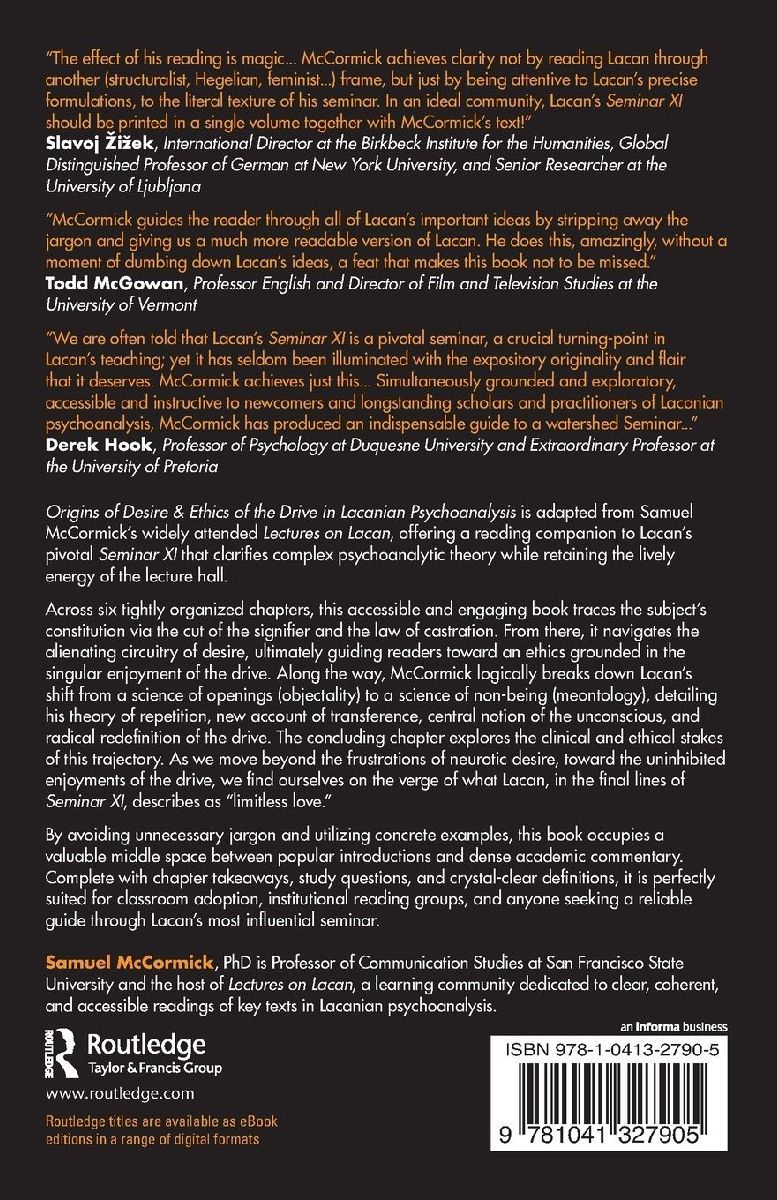
Origins of Desire & Ethics of the Drive in Lacanian Psychoanalysis is adapted from Samuel McCormick's widely attended Lectures on Lacan, offering a reading companion to Lacan's pivotal Seminar XI that clarifies complex psychoanalytic theory while retaining the lively energy of the lecture hall.
Across six tightly organized chapters, this accessible and engaging book traces the subject's constitution via the cut of the signifier and the law of castration. From there, it navigates the alienating circuitry of desire, ultimately guiding readers toward an ethics grounded in the singular enjoyment of the drive. Along the way, McCormick logically breaks down Lacan's shift from a science of openings (objectality) to a science of non-being (meontology), detailing his theory of repetition, new account of transference, central notion of the unconscious, and radical redefinition of the drive. The concluding chapter explores the clinical and ethical stakes of this trajectory. As we move beyond the frustrations of neurotic desire, toward the uninhibited enjoyments of the drive, we find ourselves on the verge of what Lacan, in the final lines of Seminar XI, describes as "limitless love."
By avoiding unnecessary jargon and utilizing concrete examples, this book occupies a valuable middle space between popular introductions and dense academic commentary. Complete with chapter takeaways, study questions, and crystal-clear definitions, it is perfectly suited for classroom adoption, institutional reading groups, and anyone seeking a reliable guide through Lacan's most influential seminar.
Inhaltsverzeichnis
Acknowledgements
Preface
Introduction: The Subject's Cause
Chapter 1: A Science of Openings: Lack, Causality, and the Subject in Seminar XI
- Key Concepts
- Introduction
- Part I: The Contested Scientificity of Psychoanalysis
- 1.1 The Epistemological Break: Seeking versus Finding
- 1.2 The Ontological Distinction: Objectivity and Objectality
- 1.3 A Science of Structural Causality
- Part II: The Differential Logic of Lack and Desire
- 2.1 Desire as the Metonymy of Lack
- 2.2 The Constituted Lack: Absence versus Experience
- 2.3 The Differential Structure of Being: Lacan's Saussure
- 2.4 From Two to Three: The Emergence of Objet a
- Part III: The Genetic Logic of the Subject and the Object
- 3.1 The Primordial Prohibition: Castration and the Name-of-the-Father
- 3.2 Alienation and the Split Subject ($)
- 3.3 The Algebraic Formulation of Lack: (-¿) and (a)
- 3.4 The Oedipal Drama as Structural Logic
- Part IV: Beyond Interpretation: Hermeneutics, History, and the Real
- 4.1 Psychoanalysis: A Hermeneutics of Faith or a Science of the Letter?
- 4.2 "Wo es war, soll Ich werden": From Past to History
- 4.3 The Limits of Interpretation: The Sinthome and the Real
- Conclusion
- Key Takeaways
- Discussion Questions
Chapter 2: The Repetition of the Cut: Trauma, Representation, and the Split Subject
- Key Concepts
- Introduction
- Part I: The Architecture of the Split Subject
- 1.1 The Retroactive Constitution of a Lost Origin
- 1.2 The "No" of the Father and the Production of "No-Things"
- 1.3 The Set of Castration: { -¿, a }
- Part II: The Logic of Repetition: Tuché and Automaton
- 2.1 Repression and the Return of the Repressed: The Logic of Retroaction
- 2.2 An Encounter with the Real (Tuché)
- 2.3 The Insistence of the Signifier (Automaton)
- Part III: The Three-Tiered Structure of Repetition and Representation
- 3.1 Case Study I: The Fort-Da Game
- 3.2 Case Study II: "Father, Can't You See I'm Burning?"
- 3.3 The Retroactive Logic of the Real
- Part IV: The Scopic Field: The Gaze as Objet a
- 4.1 The Split Between the Eye and the Gaze
- 4.2 The Stain and the Annihilation of the Subject
- 4.3 Love and the Deception of the Eye
- Conclusion
- Key Takeaways
- Discussion Questions
Chapter 3: The Signifier of the Says-No: Meontology, Transference, and the Primordial Cut
- Key Concepts
- Introduction
- Part I: The Primordial Signifier and Its Effects
- 1.1 The Quadrilateral of the Subject
- 1.2 Identifying The Signifier: The Unary Trait
- 1.3 The "One" of the Split
- Part II: A Science of Non-Being: The Meontology of Psychoanalysis
- 2.1 The "Says-No" as Primordial Utterance
- 2.2 From Ontology to Meontology
- 2.3 Human Existence as a Subtracted State
- 2.4 The Death Drive and the Fantasy of Oneness
- Part III: The Clinic of the Orifice: A New Theory of Transference
- 3.1 The Hoop Net and the Temporal Pulsations of the Unconscious
- 3.2 Transference as Closure
- 3.3 The Objet a as Obturator
- 3.4 The Analyst's Strategy
- Conclusion
- Key Takeaways
- Discussion Questions
Chapter 4: The Lamella and the Lost Cause of Life: A New Theory of the Drive
- Key Concepts
- Introduction
- Part I: The Sexed Organism and the Real Lack
- 1.1 The Interface of Organism and Subject
- 1.2 The Symbolic Imposition of Sexual Bipolarity
- 1.3 The Lost Cause of Life: Redefining Libido
- 1.4 The Lamella: An Organ without a Body
- Part II: The Overlapping of the Two Lacks
- 2.1 A Network of Loss
- 2.2 The Symbolic Veiling the Real
- 2.3 Sex, Death, and the Species
- Part III: The Grammar and Topology of the Drive
- 3.1 Deconstructing the Drive: The Four-Part Montage
- 3.2 The Topology of the Circuit
- 3.3 The Three Voices of the Drive
- Part IV: The Ethics of the Drive: Traversing the Fantasy
- 4.1 Beyond the Pleasure Principle
- 4.2 Traversing the Fundamental Fantasy
- 4.3 Living Out the Drive
- Conclusion
- Key Takeaways
- Discussion Questions
Chapter 5: The Libidinal Economy: Sublimation, Desublimation, and the Object of the Drive
- Key Concepts
- Introduction
- Part I: The Libidinal Economy: Sublimation vs. Desublimation
- 1.1 The Direction of Desire: The Sublimatory Path
- 1.2 The Reversal of the Drive: The Desublimatory Path
- 1.3 A Hierarchy of Loss
- Part II: An Ontology of the Drive: Having versus Being
- 2.1 The Imaginary Logic of Having
- 2.2 The Real Logic of Being
- 2.3 The Drive as a Portal between Meaning and Being
- Part III: The Object as Opening
- 3.1 From Object to Objectality
- 3.2 The Indifference and Constraints of the Object
- 3.3 The Object as Portal: Revisiting the Hoop Net
- Part IV: The In-Out Logic of the Drive
- 4.1 The Primacy of the Circuit
- 4.2 The Respiratory Drive as a Paradigm
- 4.3 The Incorporeal Organ
- Conclusion
- Key Takeaways
- Discussion Questions
Chapter 6: The Unreal Organ: A Myth of the Drive's Origin
- Key Concepts
- Introduction
- Part I: The Topology of the Unconscious: The Pulsating Cave
- 1.1 The "Position" of the Unconscious
- 1.2 The Cave, the Rim, and the Flow
- 1.3 The Opening and Closing
- Part II: The Myth of the Egg: A New Origin Story
- 2.1 From Aristophanes to the Egg
- 2.2 Humpty Dumpty and the Broken Subject
- Part III: Placenta, Breath, and Cry
- 3.1 The First Loss: The Placenta as Anatomical Complement
- 3.2 The First Pulsation: The Respiratory Drive
- 3.3 The First Demand: The Prohibition of the Cry
- Part IV: The Incorporeal Organ and the Activity of the Drive
- 4.1 The Ectopic Chain
- 4.2 Libido as Unreal Organ
- 4.3 The Activity of the Drive as Recovery
- Conclusion
- Key Takeaways
- Discussion Questions
Conclusion: Love Beyond the Fantasy
- Introduction
- Part I: The Dead End of Desire
- 1.1 Desire's Servitude to the Law
- 1.2 The Jouissance of the Symptom
- 1.3 Desire as a Defense
- Part II: The Path of Separation
- 2.1 Alienation and the Subject Supposed to Know
- 2.2 Separation and the Desire of the Other
- 2.3 Traversing the Fundamental Fantasy
- Part III: The Interior Eight and the Liberation of the Drive
- 3.1 The Regressive Loop of Identification
- 3.2 The Progressive Loop of Separation
- 3.3 The Fall of the Analyst
- Part IV: The Ethics of the Drive
- 4.1 The Evil God of Anxiety
- 4.2 Alcibiades's Shortcut: The Path of Pure Desire
- 4.3 The Potential for Limitless Love
- Conclusion
Works Cited