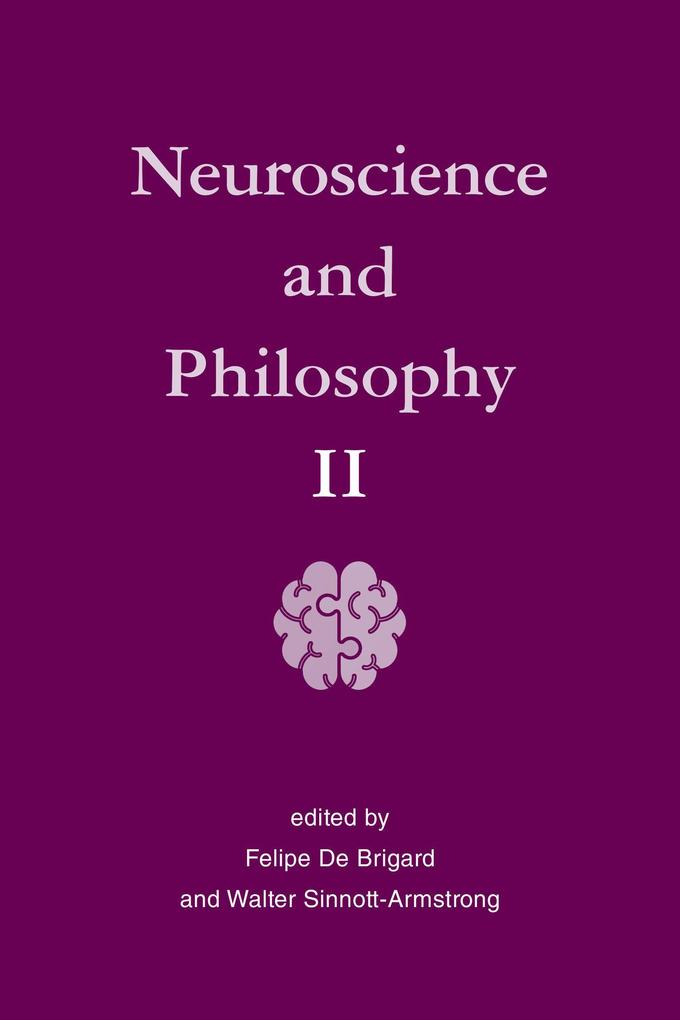
An interdisciplinary volume exploring the intersection of neuroscience and philosophy as applied to morality, agency, mental imagery, consciousness, and representation.
Neuroscience and Philosophy II, edited by Felipe De Brigard and Walter Sinnott-Armstrong, continues the interdisciplinary mission of its predecessor by bringing together new work from alumni of the Summer Seminars in Neuroscience and Philosophy at Duke University. This volume uniquely captures the rapidly growing dialogue between philosophy and neuroscience, offering both innovative content and a collaborative model of interdisciplinary research. Written as a key resource for scholars, students, and professionals, Neuroscience and Philosophy II showcases the next generation of neurophilosophers and their innovative approaches to understanding the deep connections between mind, brain, and behavior.
The book features 11 original chapters organized around four major themes: morality, agency and the self, mental imagery and perspective-taking, and foundational concepts in consciousness and representation. Each chapter is coauthored by philosophers and neuroscientists working together to address questions at the intersection of empirical science and philosophical theory. By combining empirical rigor with conceptual clarity, the book addresses both classic and emerging problems—including gendered moral judgment, split-brain agency, aphantasia, and the structure of neural representations.
Inhaltsverzeichnis
Contents
Acknowledgments
Introduction
Felipe De Brigard and Walter Sinnott-Armstrong
I Morality
1 How gender shapes moral judgment: An interdisciplinary sketch
Megha Chawla, Austin A. Baker, and Brian D. Earp
2 Attention and Morality: An Attention Modulation Framework of Moral Cognition
Samantha J. Fede, Marshall Bierson, Ryan T. Daley, and Laura K. Soter
3 Cognitive Conflict in Decision Science: From Resolution to Detection
Aliya Rumana, Corey Allen, and Katherine Boere
II Agency and the Self
4 The Self as a Multilevel System
Akila Kadambi, Wes Skolits, Urte Laukaityte, Laura Kaltwasser, and George Deane
5 What Split-Brain Cases Can Teach Us About Human Agency
Selin Bekir, Jake Gavenas, and Eric Hochstein
III Mental Imagery, Dreams, and Perspective-Taking
6 Lessons from aphantasia: A revised framework for investigating the function of mental imagery
Andrea Blomkvist, Raquel Krempel, Douglas Waddle, Em Walsh, and Anna Ivanova.
7 The debate on the continuity between the waking and the dreaming minds
Marina Trakas and Kaylee Miceli
8 Narrative-Induced Perspective-Taking: Neuroscientific Insights and Philosophical Implications
Fernanda Pérez-Gay Juárez, Katherine Finley, Laura Matthews, and Rodrigo Díaz
IV Representation, Consciousness, and Compositionality
9 Structured Representation
Kevin J. Lande, Douglas Addleman, Denis Buehler, and Nicholas Baker
10 A Roadmap for Connecting Theories of Consciousness and Models of Visual Working Memory
Trey Boone, Gerardo Viera, and Lara Krisst
11 From Frege to ChatGPT: Compositionality in Language, Cognition and Deep Neural Networks
Jacob Russin, Sam Whitman McGrath, and Danielle J. Williams
Glossary
Contributors
Index