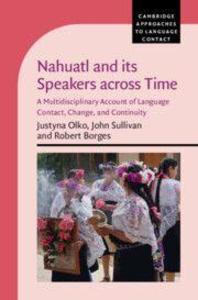
Drawing on an extensive source base spanning five hundred years, from the first half of the sixteenth century to the present, this is the first comprehensive, data-driven study of both historical and modern varieties of Nahuatl, a major Indigenous language spoken in North America. Employing multidisciplinary methods and a diachronic perspective, it identifies the key social, cultural, and linguistic factors that have interacted to motivate language change and the evolution of the social and cultural ecologies of the Indigenous communities in today's multilingual and multiethnic Mexico. It provides a critical enrichment of Western theories of contact-induced language change, continuity, acculturation, and resilience, paving the way for new relational methods of studying these complex phenomena across time and space. It is essential reading for researchers in contact linguistics, historical and synchronic sociolinguistics, Hispanic and Latin American studies, and linguistic typology. This title is also available as open access on Cambridge Core.
Inhaltsverzeichnis
List of tables; List of figures; Conventions for formatting, citations and glossing; Acknowledgements; 1. Introduction; 2. The Nahua world across the centuries: culture, communities, economy and politics; 3. Theoretical framework and methodology; 4. Nahuatl and its speakers: a sociolinguistic history; 5. A complex continuum: the sociolinguistic ecologies of Nahua communities today; 6. Contact-driven changes in the Nahuatl Lexicon; 7. Phonological change and continuity in Nahuatl; 8. The assimilation of Spanish loan matter into the Nahuatl morphological system; 9. Typological change: convergence and system-altering transformations; 10. Language contact, change and socio-cultural evolution across space and time; Archival sources; Audio sources; References.