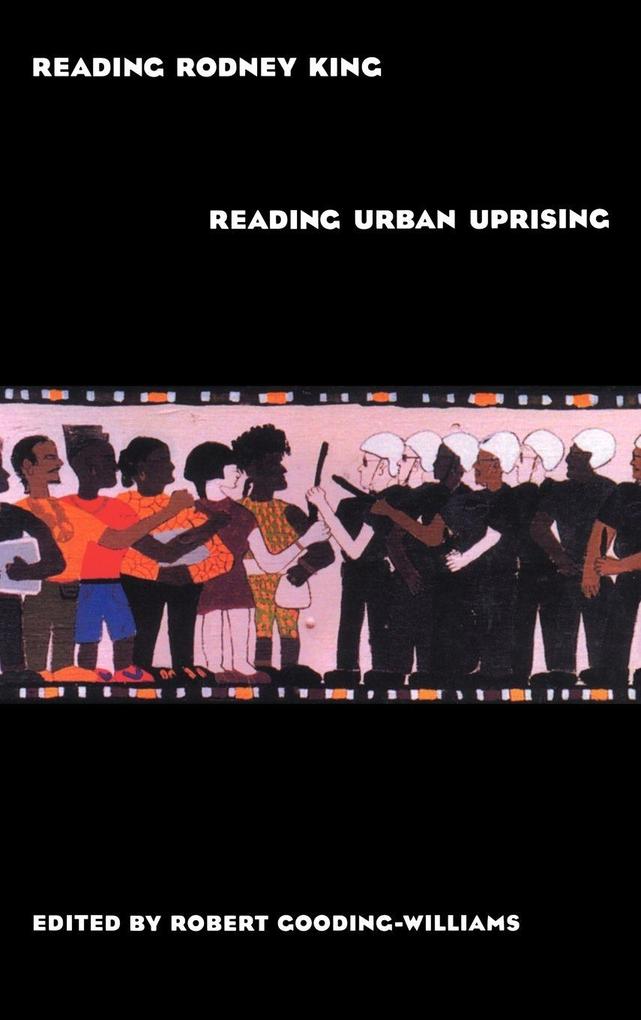
Like so many "news events," the Rodney King incidents the beating, the trial and the uprising that followed have all but disappeared from public dialogue. "Reading Rodney King/Reading Urban Uprising keeps this public debate alive by exploring the connections between the incidents and the ordinary workings of cultural, political, and economic power in contemporary America. Its recurrent theme is the continuing though complicated significance of race in American society.
The Rodney King incidents raised a number of questions regarding the relationships between poverty, racial ideology, economic competition, and the exercise of political power. What is the relationship between the beating of Rodney King and the workings of racism in America? How was it possible for defense attorneys to convince a jury that the videotape it saw did not depict an excessive or unjustified use of violence? In the burning of Koreatown, what role did racial stereotypes of African Americans and Korean Americans play, and what role did various economic factors play? What is the significance of the fact that the L.A. police department, when responding to the uprising, sent its officers to Westwood but not Koreatown? And how, finally, are we to understand the fact that not all of Los Angeles' various Latino communities took part in the uprising?
"Reading Rodney King/Reading Urban Uprising includes essays by prominent philosophers, social scientists, literary critics and legal scholars. They explore these issues from a variety of distinct, theoretical perspectives, offering a nuanced picture of the Rodney King incidents. Avoiding reductionism, they illuminate the complex interplay of ideological, political and economic forces impinging on urban America.
With America's black, Hispanic, and Asian populations continuing to grow, the issue of race has come to dominate political debates on public policy and educational struggles over multicultural curricula. Expressing cynic
Inhaltsverzeichnis
Introduction[Robert Gooding-Williams; partOne Beating Black Bodies; Chapter 1 Endangered/Endangering: Schematic Racism and White Paranoia, Judith Butler; Chapter 2 Terror Austerity Race Gender Excess Theater, Ruth Wilson Gilmore; Chapter 3 Scene ... Not Heard, Houston A. Baker; partTwo Acquitting White Brutality; Chapter 4 The Rules of the Game, Patricia J. Williams; Chapter 5 Reel Time/Real Justice, Kimberlé Crenshaw, Gary Peller; partThree Assaulting America: A Political Economy Begets Ruin; Chapter 6 Race, Capitalism, and the Antidemocracy, Cedric J. Robinson; Chapter 7 Accumulation as Evisceration: Urban Rebellion and the New Growth Dynamics, Rhonda M. Williams; Chapter 8 The Los Angeles ";Race Riot" and Contemporary U.S. Politics, Michael Omi, Howard Winant; partFour On the Streets of Los Angeles; Chapter 9 Anatomy of a Rebellion: A Political-Economic Analysis, Melvin L. Oliver; Chapter 10 Uprising and Repression in L.A., Houston A. Baker; partFive Ideology, Race, and Community; Chapter 11 ";Look, a Negro!", Robert Gooding-Williams; Chapter 12 The New Enclosures: Racism in the Normalized Community, Thomas L. Dumm; Chapter 13 Korean Americans vs. African Americans: Conflict and Construction, Sumi K. Cho; partSix The Fire This Time; Chapter 14 Home is Where the HanIs: A Korean American Perspective on the Los Angeles Upheavals, Elaine H. Kim; Chapter 15 Reflections on the Rodney King Verdict and the Paradoxes of the Black Response, Jerry G. Watts; Chapter 16 Two Nations ... Both Black; Chapter 17 Learning to Talk of Race;