








Das eBook.de Hörbuch Abo - jederzeit, überall, für nur 7,95 € monatlich!
Jetzt entdecken
mehr erfahren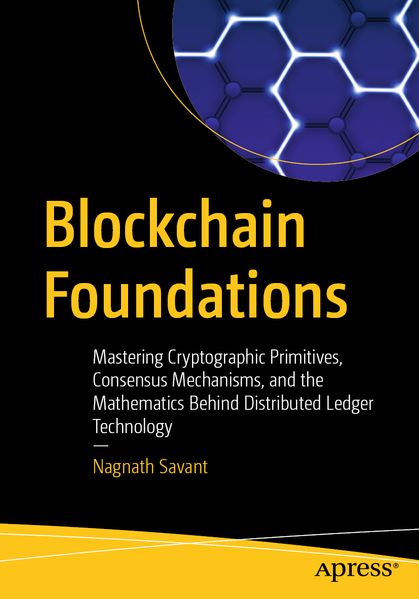
Blockchain Foundations provides a rigorous, technical exploration of the cryptographic and distributed systems principles behind blockchain technology. It is written for professionals who want to understand how and why blockchains work at a mathematical and protocol level, not just how to use them. Rather than offering a high level overview, the book treats blockchain as a serious engineering discipline. Its focus is depth, precision, and long term understanding.
The book begins with the Byzantine Generals Problem and progresses through hash functions, digital signatures, zero knowledge proofs, and consensus mechanisms. Each topic combines mathematical reasoning with practical code examples. This depth is essential because blockchain systems operate in adversarial environments with real economic incentives to attack flaws. True security requires more than intuition-it demands formal understanding.
What distinguishes this book is its integration of cryptography, distributed systems theory, and economic game theory. Chapters build from first principles through protocol design to real world implementation concerns. Instead of teaching specific platforms, it teaches the science common to all blockchains. As the industry matures, this foundation is critical for architects who must evaluate trade offs, identify risks, and design resilient systems.
What You Will Learn
Who This Book is For
This book targets technical professionals who need deep foundational understanding rather than framework-specific tutorials. The primary audience includes: software engineers and blockchain protocol developers, security researchers and auditors, system architects, advanced blockchain developers, researchers in cryptography, distributed systems, or mechanism design.
Inhaltsverzeichnis
Part I Cryptographic Foundations. - Chapter 1: Distributed Trust and the Byzantine Generals Problem. - Chapter 2: Cryptographic Primitives. - Chapter 3: Digital Signatures and Public Key Cryptography. - Chapter 4: Zero-Knowledge Proofs. - Part II Consensus Mechanisms. - Chapter 5: Proof of Work. - Chapter 6: Proof of Stake. - Chapter 7: Byzantine Fault Tolerance. - Chapter 8: Novel Consensus Mechanisms. - Chapter 9: Evaluating Consensus Mechanisms. - Part III Blockchain Architecture and Execution. - Chapter 10: Blockchain Data Structures. - Chapter 11: Virtual Machines and Execution Environments. - Chapter 12: Transaction Models and Maximal Extractable Value. - Chapter 13: Cryptoeconomic Security. - Chapter 14: Formal Verification and Security Analysis. - Part IV Scalability and Advanced Topics. - Chapter 15: Layer-2 Scaling. - Chapter 16: Sharding and Parallel Execution. - Chapter 17: Data Availability and Modular Blockchains. - Chapter 18: Post-Quantum Cryptography. - Chapter 19: Future Directions and Open Problems. - Appendix A: Mathematical Foundations. - Appendix B: Security Best Practices. - Appendix C: Formal Security Definitions. - Appendix D: Exercise Solutions (Selected).
Es wurden noch keine Bewertungen abgegeben. Schreiben Sie die erste Bewertung zu "Blockchain Foundations" und helfen Sie damit anderen bei der Kaufentscheidung.