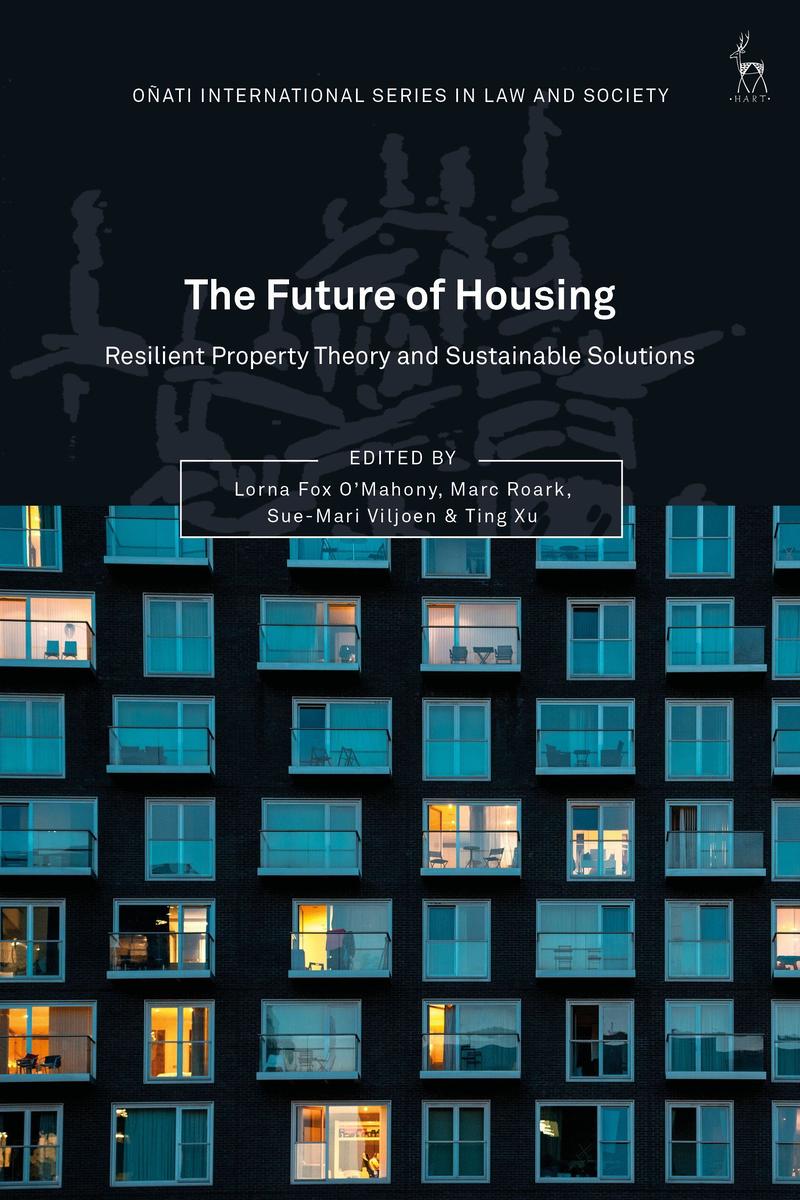
This book applies the approach and methodology of 'Resilient Property Theory' (RPT), bringing together leading scholars to develop and test new approaches to housing and its relationships to private property and environmental sustainability.
RPT analyses problems through multiple lenses, paying attention to the web of intersecting issues and stakeholders involved in contemporary housing studies: individuals (owners, tenants, precariously housed, homeless), aggregated interests (neighborhoods, communities, markets, social movements), and the state itself across its multi-layered actors, agencies and institutions (local/city; regional; national; transnational). It focuses on seeking out solutions that enable the production of resilience for different stakeholders and promote resilience within housing systems.
This book focuses on providing greater synergy amongst a diverse range of perspectives, across disciplines (law, economics, history, political science) across a range of jurisdictions (US and Canada, England and Wales, Scotland, Europe, Australia and South Africa) and sets out to find sustainable solutions.
Inhaltsverzeichnis
Introduction, Lorna Fox O'Mahony (Essex Law School, UK), Marc Roark (Tulsa Law School, USA), Sue-Mari Viljoen (University of the Western Cape, South Africa) and Ting XU (Essex Law School, UK)
1. The Future of Housing: Resilient Property Theory, Systemic Methodology and Sustainable Solutions, Lorna Fox O'Mahony (Essex Law School, UK) and Marc Roark (Tulsa Law School, USA)
2. Resilient Property, Adequate Housing and the Added Value of Human Rights, Koldo Casla (Essex Law School, UK)
3. Tackling 'Wicked' Property Problems through Citizen Deliberation, Rachael Walsh (Trinity College Dublin, Ireland)
4. A Law Reform Perspective on the Human Flourishing and Resilient Property Theories, Samuel Tyrer
5. Obligations in Resilient Property Theory: Using Single-system Analysis to Contrue Positive Obligations, Bram Akkermans (Maastricht University, the Netherlands)
6. Regulating Public Property: A Resilient Property Perspective, Sue-Mari Viljoen (University of the Western Cape, South Africa)
7. Resilient Property Theory and the Silence of Rights: Rethinking Canada's Housing Framework, Alexandra Flynn (The University of British Columbia, Canada)
8. 'Sustainable Development' on Environmentally and Culturally Sensitive Land: A Resilient Property Theory Perspective, Elsabé van der Sijde
9. Searching for the New Housing Nomos in the United States, John Lovett (Louisiana State University Paul M. Hebert Law Center, USA)
10. Resilient Property Servitudes: Using Resilient Property Theory to Protect Environmental Amenities without Leaving Social Values Behind, Jessica Owley (University of Miami, USA)
11. Conclusion, Lorna Fox O'Mahony (Essex Law School, UK), Marc Roark (Tulsa Law School, USA), Sue-Mari Viljoen (University of the Western Cape, South Africa) and Ting XU (Essex Law School, UK)