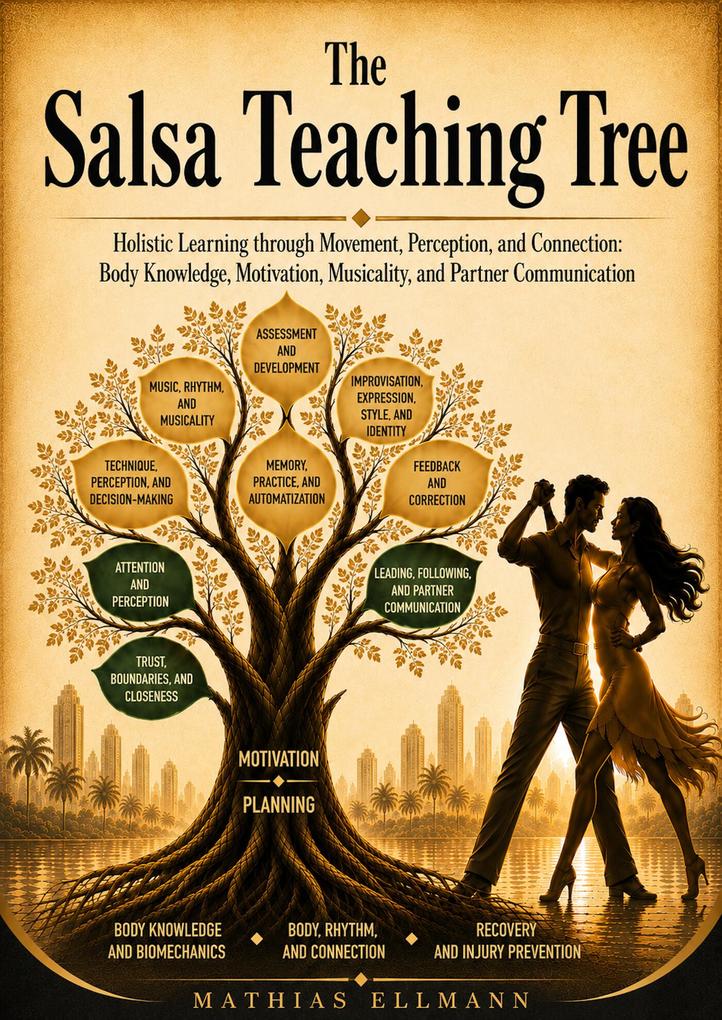
How can salsa be taught and learned so that body knowledge, technique, musicality, motivation, perception, partner communication, self-respect, and development as a dancer work together meaningfully? Salsa is often taught through steps, figures, turns, and counts. Yet sustainable salsa learning involves far more than the correct execution of movement sequences. The Salsa Teaching Tree presents a holistic model for teaching and learning salsa. Building on the Teaching Tree Model, the book connects body knowledge, motor learning, biomechanics, motivation, perception, memory, musicality, partner communication, and dance practice within a systematic approach to conscious, adaptable, and sustainable salsa learning. In this book, you will learn:
- how salsa learning can be planned and structured systematically
- how motivation, attention, and memory influence movement learning
- why body knowledge and biomechanics are important foundations for functional movement
- how physical load, recovery, and injury prevention can be integrated into the learning process
- how feedback and corrections can support learning in an effective and respectful way
- how frustration, uncertainty, and self-overload can be recognized and addressed constructively
- how music, rhythm, and musicality interact with movement and decision-making
- how technique, perception, and decision-making work together in social dancing
- how improvisation, expression, style, and identity can develop
- how leading, following, and partner communication can be understood as a reciprocal process
- why trust, personal boundaries, closeness, consent, and self-determination are part of partner dancing
- how the Salsa Teaching Tree can be applied in learning, practice, and teaching
The book connects salsa learning and teaching, motor learning, body knowledge, biomechanics, motivation, perception, musicality, and partner communication within a comprehensive orientation model for conscious and sustainable salsa learning. In addition to theoretical foundations, the book includes practical examples, checklists, reflection and planning forms, a Salsa Movement and Technique Glossary, and a Salsa Music and Rhythm Glossary. This book is intended for:
- salsa learners at all levels of experience
- salsa dancers
- salsa teachers and instructors
- dance educators
- dance schools and other learning and teaching contexts
- anyone who wants to understand salsa as a physical, musical, and interpersonal path of learning
The Salsa Teaching Tree shows how salsa learning can be shaped so that body knowledge, technique, musicality, motivation, perception, partner communication, self-respect, and development as a dancer become interconnected. It looks beyond steps and figures to the conditions that make movement understandable, musical, adaptable, physically sustainable, and coherent between dance partners.