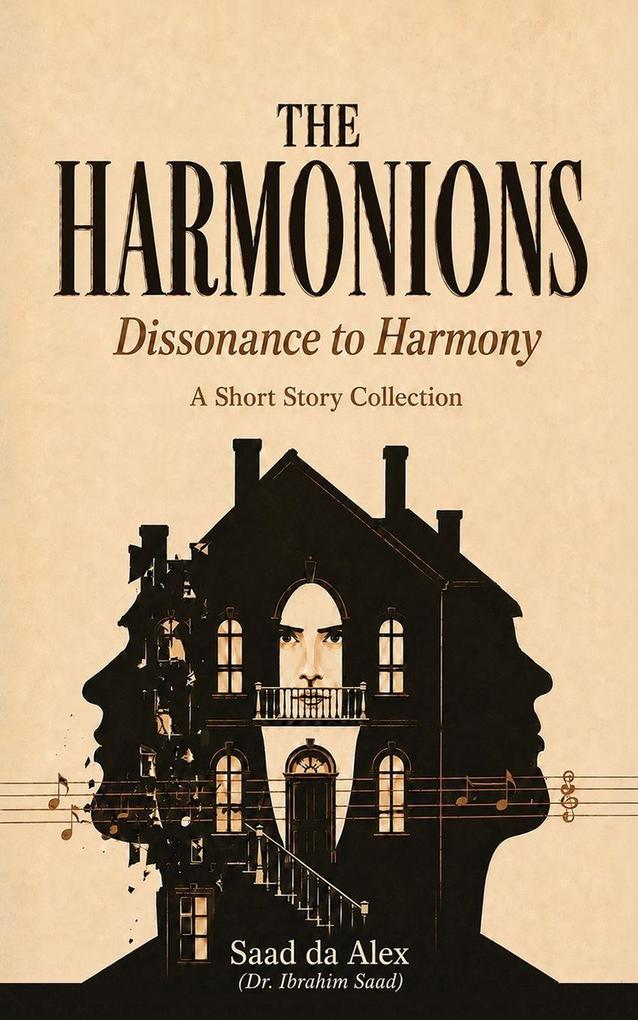
Saad da Alex is the literary name of Dr. Ibrahim Saad, an Egyptian author whose fiction explores consciousness, memory, identity, perception, free will and the shifting boundary between the self and the world. His writing moves through psychological, philosophical and metaphysical territory, examining moments when ordinary reality changes and familiar experiences reveal hidden meanings.His literary work is rooted in a fascination with the act of knowing: how people construct reality, how memory alters the past it attempts to preserve, and how observation transforms both the observer and the observed. Rather than presenting philosophical questions as abstract arguments, he gives them narrative form through characters, mysteries, symbolic encounters and imagined worlds. His stories often begin with a recognizable event before opening into deeper questions about existence and human consciousness.Under the name Saad da Alex, he writes fiction in which meaning is rarely fixed and certainty is never entirely secure. His characters stand at thresholds between what they believe and what they perceive, between inherited identities and emerging selves. They encounter patterns that seem to observe them in return, memories that edit those who examine them, and realities that change according to the position from which they are seen.His writing draws upon philosophical fiction, psychological literature, speculative storytelling, mystery and the contemplative traditions of Arabic narrative. It is also influenced by music and the visual arts, particularly their ability to express experiences that direct language cannot fully contain. Rhythm, repetition, silence, contrast and transformation shape both the structure and emotional movement of his stories.In The Harmonions, seven stories, including a closing novella in four movements, investigate different forms of dissonance: between memory and fact, knowledge and uncertainty, identity and transformation, prediction and choice, and the individual and the surrounding world. Beneath their mysteries lies a shared inquiry into what happens when a person seeking knowledge discovers that no observer can stand completely outside what is being observed.The title introduces the coined word "Harmonions." It refers not merely to harmony as a completed state, but to the people, forces and transformations through which harmony may emerge from dissonance. Harmony is not the elimination of contradiction, but the possibility that apparently conflicting elements belong to a larger order not yet visible. Dissonance is not disorder, but tension awaiting another form of understanding.Saad da Alex approaches fiction as a form of discovery rather than explanation. He allows narrative to test ideas, challenge them and sometimes transform them. His characters are not representatives of philosophical positions, but individuals living through uncertainty and confronting situations in which knowledge carries emotional and personal consequences.His background in architecture, engineering and research contributes a distinctive sensitivity to structure, space and the relationship between separate elements and an emerging whole. In his fiction, architecture becomes a literary language: rooms may retain memories, boundaries may become psychological thresholds, and physical spaces may reflect transformations within consciousness.Through his writing, Saad da Alex invites readers into stories that continue beyond their final pages. His fiction seeks not only to be read, but to shift the position from which the reader sees, leaving behind a question, an unresolved resonance, or the recognition that the eye has always been inside the picture.