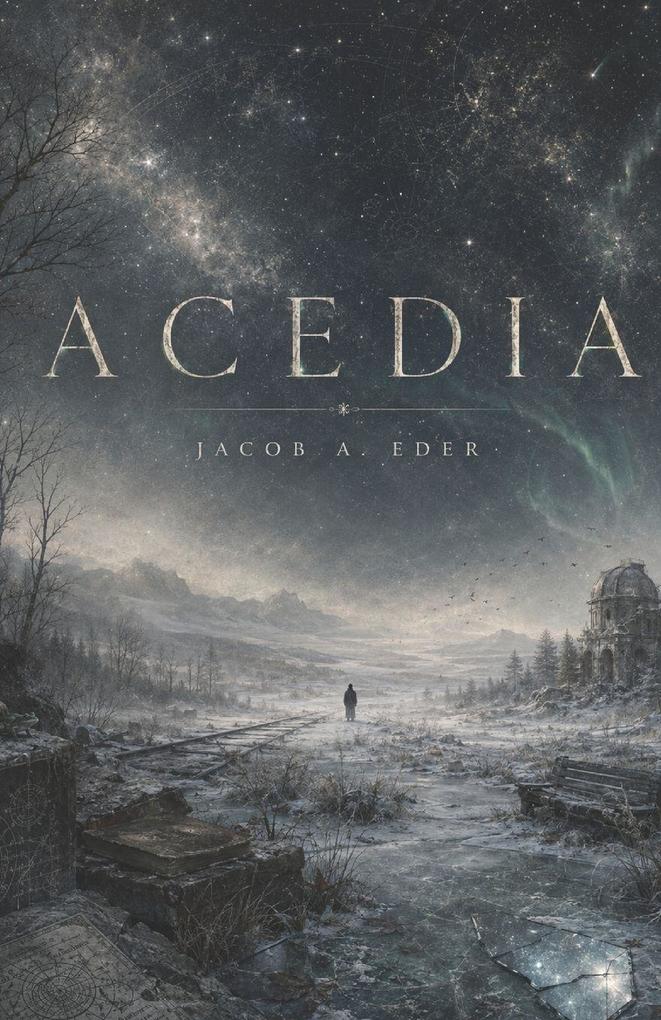
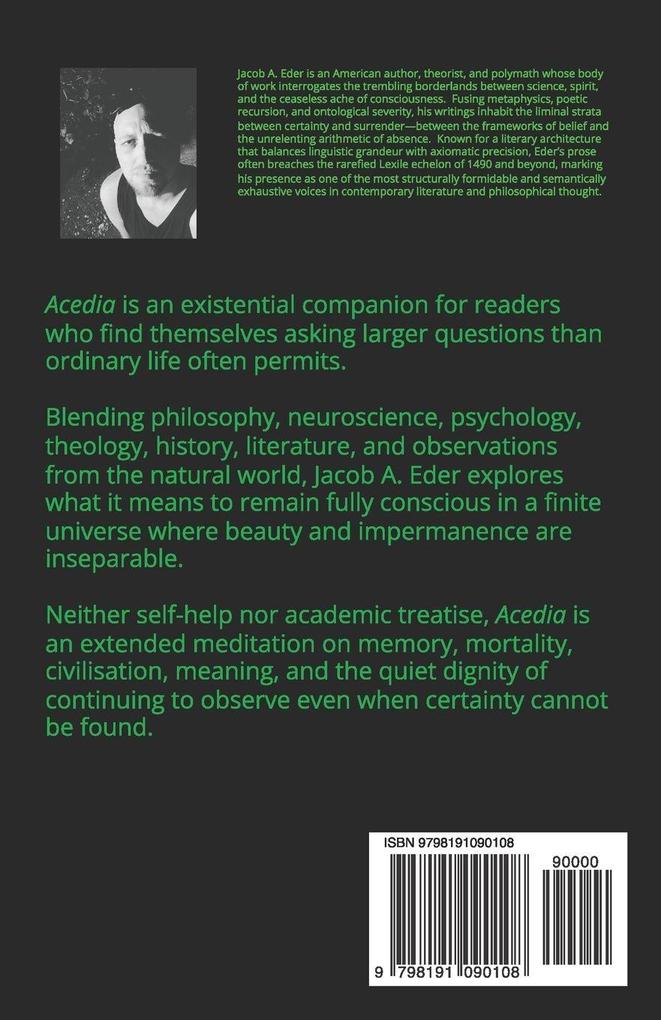
There are books that promise answers.
This is not one of them.
Acedia is a meditation upon existence itself: upon time, mortality, memory, civilisation, beauty, suffering, belief, doubt, history, love, loss, and the strange burden of becoming conscious enough to recognise that everything precious is temporary.
Moving effortlessly between philosophy, psychology, evolutionary thought, neuroscience, politics, literature, theology, and personal reflection, Jacob A. Eder examines the quiet architecture beneath ordinary life. Forests, winter landscapes, forgotten graveyards, ageing cities, migrating birds, collapsing institutions, scientific discovery, ancient scriptures, and human longing become different expressions of the same enduring question:
How should one continue living once permanence has vanished?
Rather than offering consolation, Acedia offers companionship.
Its pages refuse simplistic optimism and equally reject fashionable nihilism. Instead they inhabit the difficult territory between hope and despair, where wonder survives despite uncertainty, where beauty becomes more profound precisely because it cannot last, and where consciousness itself emerges as both humanity's greatest privilege and greatest burden.
Written in a distinctive literary voice that combines philosophical inquiry with poetic prose, Acedia is intended for readers who found themselves lingering over the works of Camus, Cioran, Dostoevsky, Kierkegaard, Frankl, Jung, Ligotti, Becker, and the Romantic tradition-not because they sought darkness, but because they sought honesty.
This is not merely a book about sadness.
It is a book about seeing. <p/>---------------------------------------------------------------------------------------------------------------------------------
The Ederian Corpus is an ongoing interdisciplinary body of work that attempts something different: to examine consciousness from every meaningful perspective available to human inquiry.
Across philosophy, neuroscience, psychology, evolutionary biology, artificial intelligence, history, politics, literature, autobiography, and speculative fiction, each volume investigates a different facet of the same enduring question:
What does it mean to become aware?
Rather than offering disconnected works, the collection is designed as an interconnected framework. Scientific treatises establish formal models of cognition and consciousness. Philosophical volumes explore meaning, mortality, civilisation, and existential inquiry. Memoirs document the developmental experiences that shape identity. Fictional works imagine the future trajectories of intelligence beyond humanity itself.
Although each book stands independently, together they form an expanding architecture whose themes continually intersect: emergence, memory, suffering, adaptation, recursion, agency, love, loss, civilisation, technology, and the evolutionary unfolding of mind.
The result is neither a traditional academic series nor purely literary collection, but an attempt to construct a comprehensive cartography of consciousness-examining its biological origins, psychological development, philosophical implications, technological future, and deeply personal experience.
Every volume contributes another perspective.
Together, they ask a single question.
How does awareness arise, transform, and ultimately understand itself?