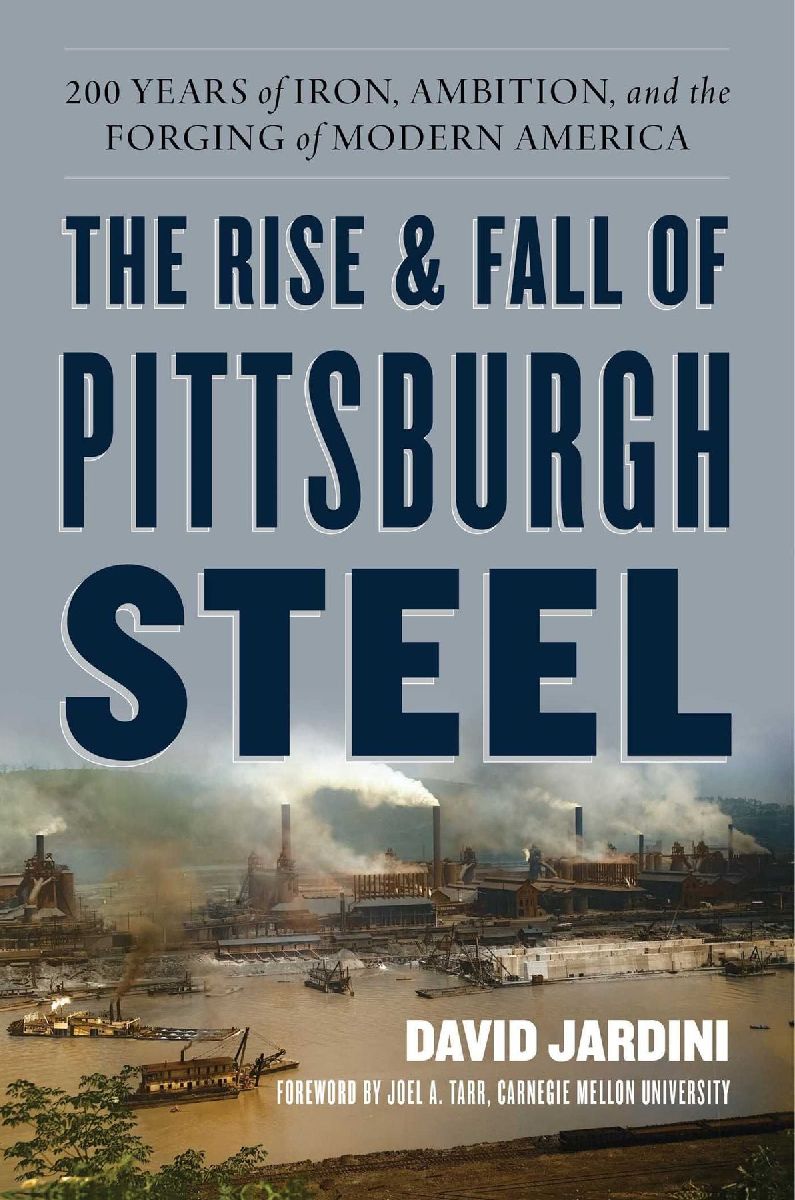
“ Hell with the lid taken off, ” the “ Steel Valley, ” and the “ Valley of the Giants” were phrases that, until the 1980s, rang proudly through Pittsburgh’ s pulsing iron and steel economy. For more than two centuries, the Pittsburgh region was world-renowned for the scale and intensity of its manufacturing complex. Its myriad ovens and furnaces churned fire and soot into the dreary skies, causing the hills to glow with a fiery luminescence. At times, more than one-quarter of the world’ s steel was made there as Pittsburgh’ s men and women forged both the steel for a growing nation and a grimy, blue-collar personality for the region. < BR> < BR> The Rise and Fall of Pittsburgh Steel traces the origins, explosive growth, stagnation, and ultimate collapse of this remarkable industrial complex. Starting as a rough-and-tumble frontier village in the 1790s, Pittsburgh had risen by the end of the American Civil War to stand as the center of the young nation’ s metalworking industries. But this was just the beginning. By 1910, the Steel City’ s population had grown another tenfold, from about 50, 000 in 1860 to over 500, 000. By then, it was the fifth largest city in the United States, producer of well over half the nation’ s steel, and the site of over 3, 000 manufacturing plants employing an astounding 250, 000 workers. During World War II, the Pittsburgh region produced more steel than the Axis powers combined, and vast wartime expansion of the city’ s productive system seemed a harbinger of continued dominance. Within decades, however, the tide had turned on Pittsburgh’ s industrial preeminence and decline slipped into collapse by the 1980s. < BR> < BR> Author David Jardini chronicles this astounding ascendance and breathtaking fall, tracing the underlying factors that drove first the emergence of Pittsburgh steel, then its decline and collapse. The book tells a tale of vast riches, exhilarating achievement, grinding hardship, and environmental degradation— and an industrial legacy now woven into the very DNA of a region.
Inhaltsverzeichnis
Introduction< BR> < BR> Chapter 1: Iron and Steel Technological Heritage< BR> < BR> Chapter 2: The Forks of the Ohio< BR> < BR> Chapter 3: The Trading Village< BR> < BR> Chapter 4: The Early Transportation Revolution, 1800– 1850< BR> < BR> Chapter 5: The Rise of the Iron City, 1810– 1850< BR> < BR> Chapter 6: Technology and Labor in the Iron City, 1810– 1860< BR> < BR> Chapter 7: The Railroad Catalyst, 1850– 1880< BR> < BR> Chapter 8: Bessemer Steelmaking Comes to Pittsburgh, 1875– 1890< BR> < BR> Chapter 9: The Migration of Ironmaking, 1860– 1900< BR> < BR> Chapter 10: The Steel City, 1870– 1910< BR> < BR> Chapter 11: Capturing the Apex Predator< BR> < BR> Chapter 12: Pittsburgh’ s Metropolitan Iron and Steel Complex< BR> < BR> Chapter 13: The Human and Environmental Toll< BR> < BR> Chapter 14: Draining Away— Industry Factors Shift Away from Pittsburgh< BR> < BR> Chapter 15: The Long Decline, 1950– 1980< BR> < BR> Chapter 16: The Collapse< BR> < BR> Epilogue: Remembering Steel < BR> < BR> Bibliography< BR> < BR> Acknowledgments< BR> < BR> Index