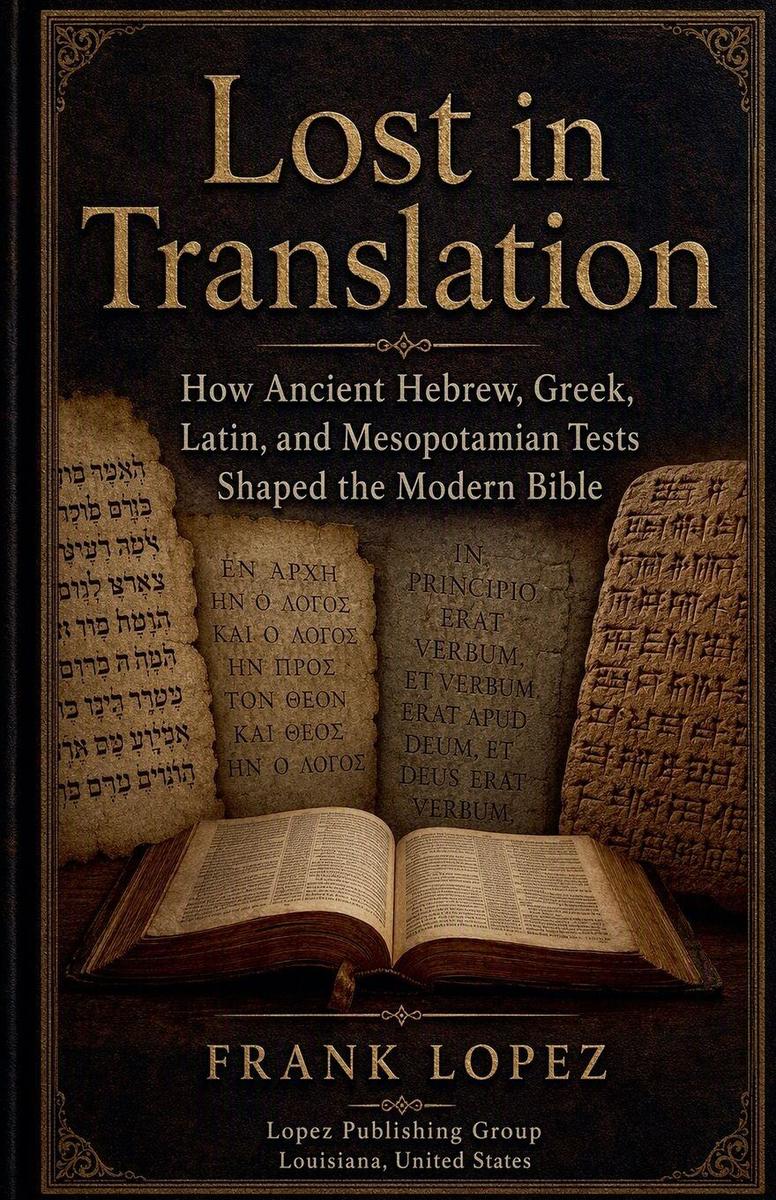
The Bible is among the most translated, read, and influential collections of writings in human history. Its words have inspired faith, shaped civilizations, influenced laws, guided moral thought, and offered hope to countless generations. Yet every translation also involves interpretation. Words must be selected, grammatical structures understood, cultural settings considered, and ancient ideas expressed in languages far removed from Hebrew, Aramaic, and Greek.
This book was written to examine passages in which translation choices have significantly influenced how readers understand the biblical text. Its purpose is not to undermine faith, reject Scripture, or accuse every translator of deliberate distortion. Rather, it invites readers to look more closely at the original words, the historical circumstances in which they were written, and the theological traditions that have shaped their translation.
Throughout these chapters, we will explore questions that have challenged scholars and believers for centuries. What did ancient Hebrew writers mean by words such as Elohim, Torah, nephesh, and Sheol? How should Greek terms such as logos, pneuma, psych¿, and metanoia be understood? Did certain familiar doctrines arise directly from the biblical languages, or were they influenced by later traditions and interpretive decisions?
Not every disagreement examined in this book should automatically be called a mistranslation. Some passages permit more than one reasonable rendering. Others involve textual variants, changes in the meaning of words over time, or concepts for which modern languages have no exact equivalent. For this reason, the reader is encouraged to distinguish among translation, interpretation, theological tradition, and genuine error.
This work does not claim to provide the final answer to every difficult question. Its aim is to encourage careful reading, respectful investigation, and intellectual honesty. Readers are invited to consult multiple translations, examine historical evidence, study ancient languages when possible, and consider conclusions that may differ from those they have previously accepted.
Sacred writings should not be approached with fear of inquiry. If truth is genuine, honest examination cannot destroy it; it can only clarify our understanding. Questioning a translation is not necessarily questioning God. Sometimes it is simply an effort to hear an ancient message more accurately by looking beyond centuries of language, culture, and doctrine.