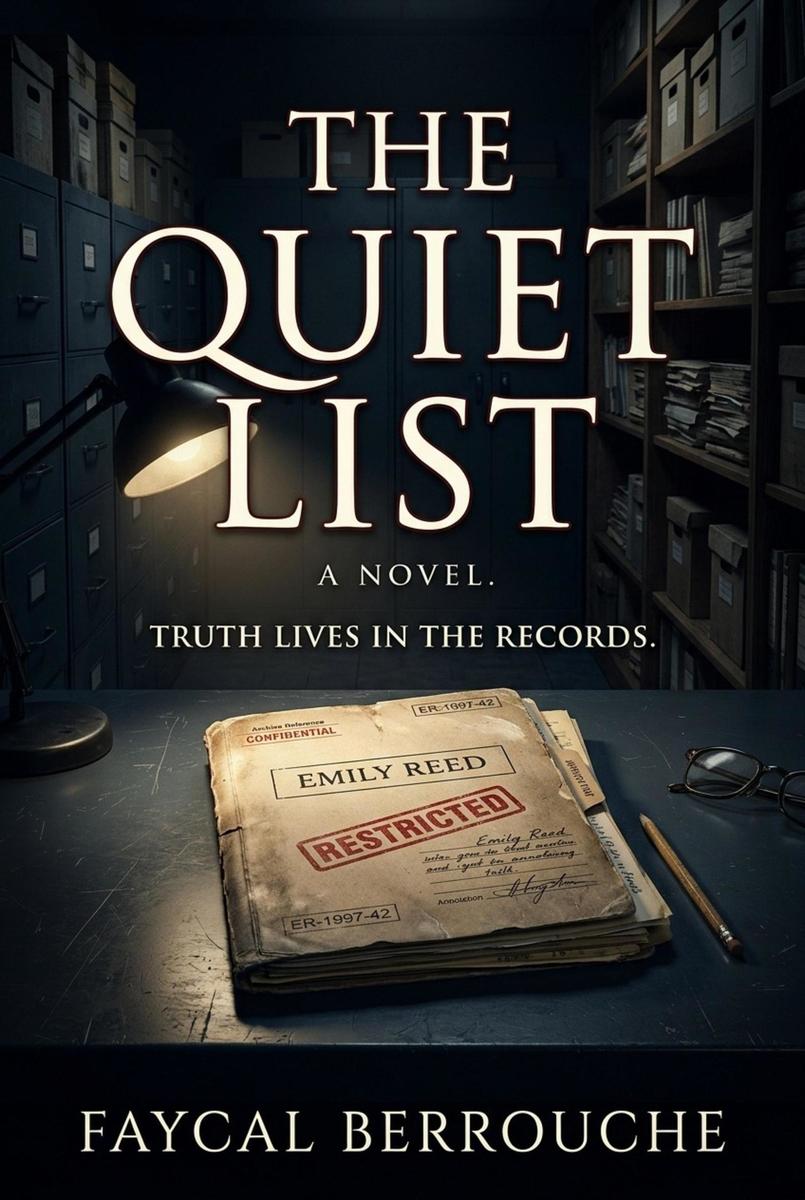
THE QUIET LIST is a literary novel of investigation, memory, and institutional power a story about what happens when the past is not erased, but managed. When journalist Mara begins revisiting the case of Emily Reed, she expects the familiar architecture of buried facts: missing evidence, contradictory testimony, perhaps a single act of concealment waiting to be exposed. Instead, she finds something colder and more enduring. The record was never simply destroyed or hidden. It was narrowed, reorganized, and carried forward in language designed to preserve dispute without allowing dispute to interrupt the system that contained it.
As Mara follows the trail through archived files, internal objections, routing slips, compliance materials, and the people who inherited them, THE QUIET LIST becomes more than an inquiry into one woman's case. It becomes a portrait of an institution that has learned how to survive its own contradictions how to retain troubling material, classify it, contextualize it, and keep it from altering the ordinary story told about itself. What emerges is not a conspiracy in the dramatic sense, but something more plausible and more disturbing: an administrative order in which visibility can be reduced without disappearance, and moral conflict can remain on paper without ever being allowed to change the record.
Tense, intelligent, and formally controlled, THE QUIET LIST asks what it means to tell the truth about a history that still exists in fragments, objections, and restricted files and what remains when the argument itself is finally restored to the archive. It is a novel about language, procedure, and the quiet mechanisms by which institutions teach the future how to read the past.
Es wurden noch keine Bewertungen abgegeben. Schreiben Sie die erste Bewertung zu "THE QUIET LIST" und helfen Sie damit anderen bei der Kaufentscheidung.








