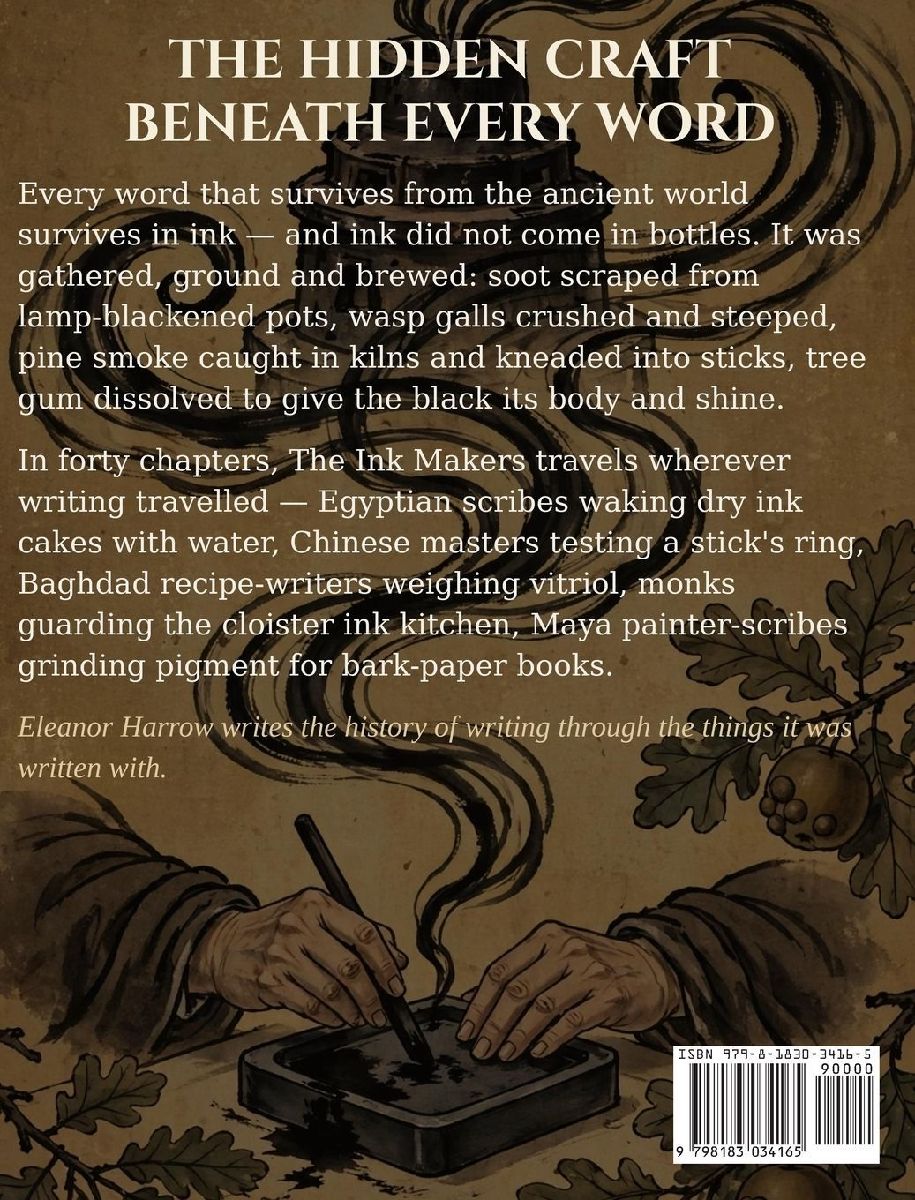
Every empire ran on ink - and somebody had to make it. Before a single law, letter or scripture could survive, a maker had to turn smoke, tree galls and tree gum into a fluid that would hold a thought for a thousand years. The Ink Makers follows that fluid across the ancient and medieval world: out of Egyptian soot pots and Chinese pine-smoke kilns, through Baghdad recipe books and monastic ink kitchens, onto Maya bark paper and the first printing presses. This is a history of writing told through its materials - the ingredients, the trades that supplied them, and the hands that ground, steeped, boiled and tested every batch. Inside you'll discover:- Why Egyptian carbon ink is still legible after four thousand years- How Chinese makers turned pine smoke into solid ink sticks ground fresh on a stone- The chemistry of iron-gall ink - the fluid that wrote Europe's charters, and sometimes ate them- Oak galls, green vitriol and gum arabic: the three traded ingredients behind medieval ink- Islamic qalam craft, gold inks on blue parchment, and the recipe books of Baghdad- Palm-leaf inks of India and Southeast Asia, Maya pigment writing, and Mexica tlilli- How modern science now reads inks that faded, burned or were erased centuries agoWho this book is for: Readers who love the hidden histories of everyday things; calligraphers, pen-and-ink hobbyists and living-history makers who want the craft behind the recipes; and anyone curious about how the written past physically survived to reach us. Eleanor Harrow writes narrative histories of the materials and makers behind the written word. Open the ink pot, and the ancient world starts talking.