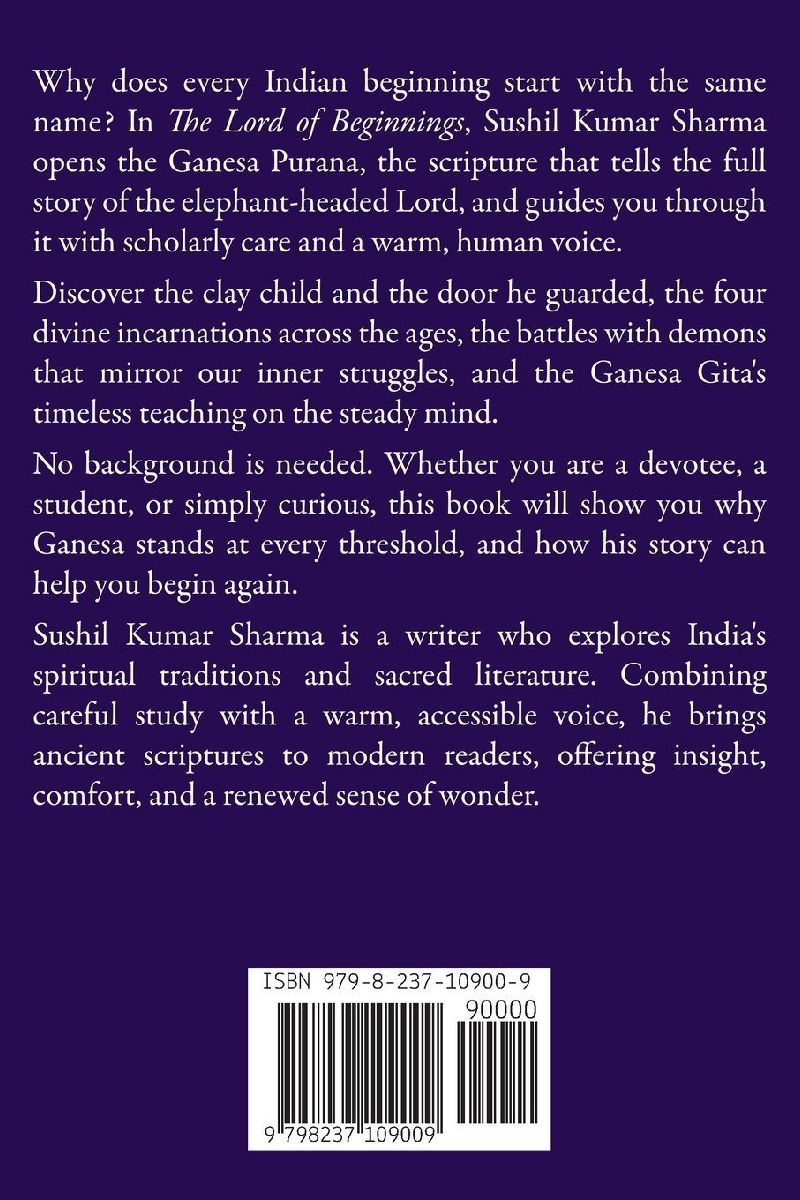
Every journey begins with a small prayer, and for millions of people that prayer is a single name: Ganesa. But who is the elephant-headed Lord, and what does his own scripture say about him? The Lord of Beginnings: Journeys Through the Ganesa Purana is a warm, readable guide to one of the most fascinating scriptures of the Hindu tradition. It is written for curious readers, devoted worshippers, students of religion, and anyone who has ever wondered why a civilization places one deity at the front of every door. The Ganesa Purana is a vast and layered text. It holds cosmology and family drama, philosophy and battle, hymns and practical instruction for worship. In this book, Sushil Kumar Sharma walks through its two great divisions, the Upasana Khanda of devotion and the Krida Khanda of divine play, in nine engaging chapters that follow the scripture's own design. Along the way, the reader discovers:The story of Parvati, the clay child, and the dramatic moment at the door that gave Ganesa his elephant head, and what that story teaches about pride, grief, and grace. The claim, made again and again in the text, that Ganesa is not merely a popular god but the Supreme Reality itself, and how the symbols of the trunk, the tusk, and the mouse express that idea. Why obstacles bow to him, and why wise people in every age begin their work with his name. The four incarnations across the four ages: the lion-riding Vinayaka, the peacock-riding Mayuresvara, the mouse-riding Gajanana, and the horse-riding Dhumraketu who is awaited in the age to come. The great battles with demons, and the way the Purana invites us to read them as pictures of the inner struggle with pride, greed, anger, and delusion. The Ganesa Gita, a profound teaching of knowledge, action, devotion, and yoga, offered to a king who sought peace of mind. The practices of worship, including mantra, vows, offerings, and festivals, explained with care and without pressure. The writing is scholarly in its respect for sources and warmly human in its voice. Where tradition and research differ, the book says so honestly. Where a story is difficult, it faces the difficulty rather than avoiding it. Technical terms are explained once and gently, and a glossary is included for easy reference. You do not need any background in Sanskrit or Indian philosophy to read this book. You need only curiosity and an open heart. By the final page, you will understand the Ganesa Purana as a living scripture that still speaks to the questions people carry today: how to begin again, how to face what stands in our way, and how to find steadiness in a restless world. Whether you keep an image of Ganesa in your home, have visited his temples, celebrate Chaturthi with your family, or are meeting him for the first time, this book offers a thoughtful and moving companion. Open the door. The Lord of Beginnings is waiting at the threshold.