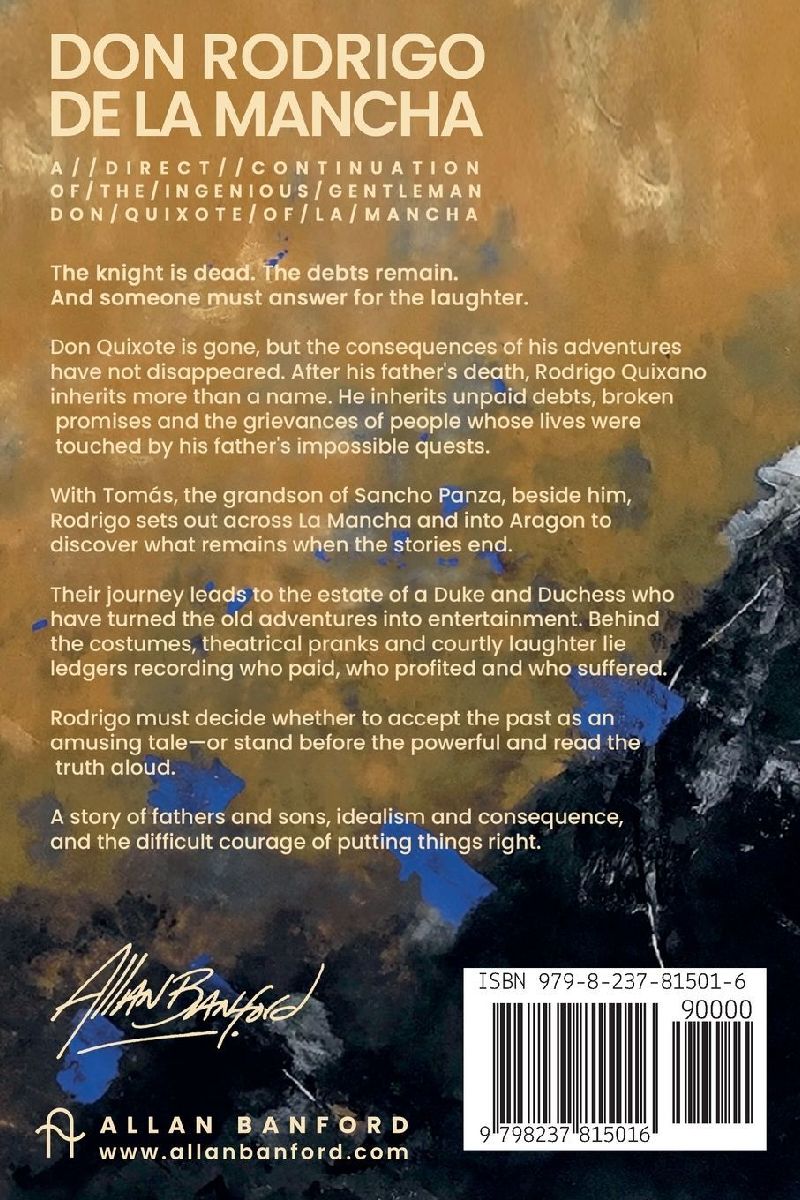
DON RODRIGO DE LA MANCHA A Direct Continuation Of The Ingenious Gentleman Don Quixote of La Mancha Cervantes gave Alonso Quixano no son. In the original Don Quixote, the dying hidalgo leaves his property to his niece, Antonia Quixana, and the book ends with his deathbed, his will, and his friends. Rodrigo, his mother Isabel de la Torre, and the promise-marriage of 1584 are inventions of this continuation, as are the other men and women Rodrigo meets upon the road, and the ledgers he reads at the masquerade. This book is a deliberate imaginative extension of Cervantes's story, not a claim that he left this family history unfinished. It asks a question the original does not ask: what did Don Quixote's idealism cost the people he left behind - the creditors, the villagers, the squire's family, and a son who never knew him? The unsent letters Rodrigo finds in the last chapter are likewise invented, and they prove nothing, by design. Alonso's madness, his kindness, and his contradictions are left here as Cervantes left them: unresolved. The telling is in the same modern English as the companion volume, Don Quixote de la Mancha, Chapters 1-126, so the two books can be read as one story. The knight is dead. The debts remain. And someone must answer for the laughter. Don Quixote is gone, but the consequences of his adventures have not disappeared. After his father's death, Rodrigo Quixano inherits more than a name. He inherits unpaid debts, broken promises and the grievances of people whose lives were touched by his father's impossible quests. With Tomás, the grandson of Sancho Panza, beside him, Rodrigo sets out across La Mancha and into Aragon to discover what remains when the stories end. Their journey leads to the estate of a Duke and Duchess who have turned the old adventures into entertainment. Behind the costumes, theatrical pranks and courtly laughter lie ledgers recording who paid, who profited and who suffered. Rodrigo must decide whether to accept the past as an amusing tale-or stand before the powerful and read the truth aloud. A story of fathers and sons, idealism and consequence, and the difficult courage of putting things right.