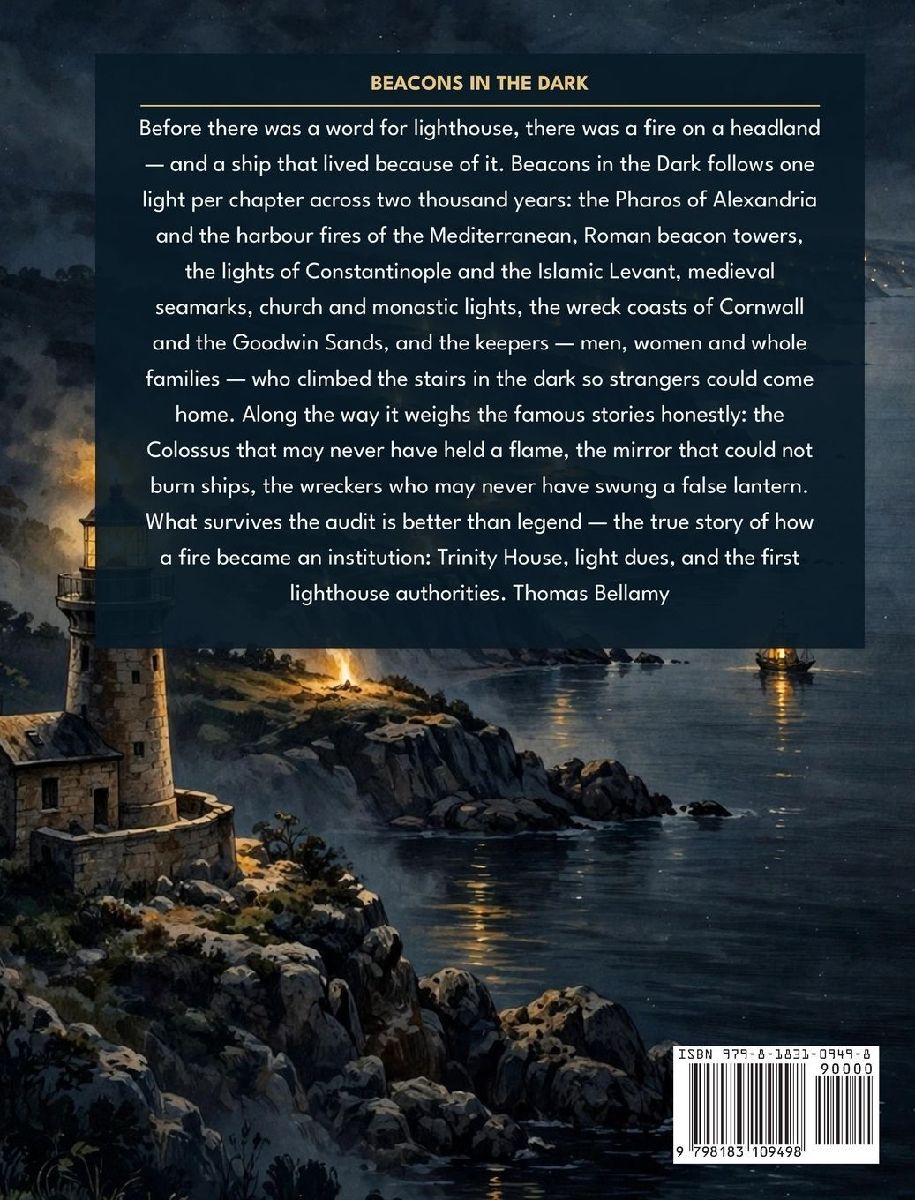
Before there was a word for lighthouse there was a fire on a headland. For thousands of years, the ancient and medieval world lit its coasts to bring ships home - with harbour fires, seamarks, beacon towers and, at last, the great lighthouses that still stand today. This book tells the story of how that light was made, kept and governed. It begins at Alexandria, with the Pharos - the tallest building of the ancient world, a tower of fire that guided ships into the greatest harbour of antiquity and became the very word for lighthouse in a dozen languages. It follows the idea through the Roman world, where harbour fires marked the entrances to ports from Ostia to the Black Sea; through the medieval world, where monks kept lights burning on headlands and hermits tended fires for passing ships; and through the age of the great trading companies, when the first lighthouse authorities - Trinity House in England, the French lighthouse service, the Dutch - began to build and govern a network of lights. It follows the keepers, too: the men and women who lived in the towers, who kept the lamps trimmed and the fires burning through winter storms, who rescued the shipwrecked and buried the drowned. And it follows the engineers - the men who built on rocks that were covered at high tide, who raised towers on the Eddystone and the Bell Rock, and who turned a fire on a headland into a science of optics, of lenses, of rotating beams that could be recognised from twenty miles out to sea. Drawing on harbour records, keepers' logs, the archives of Trinity House and the accounts of the engineers themselves, Beacons in the Dark is a history of the light that brought ships home - the Pharos, the harbour fires, the seamarks, the keepers and the first lighthouse authorities. Who this book is for:Readers who want the real history of the lighthouse - not just the towers, but the fires, the keepers and the authorities who built the first network of lights, from the Pharos of Alexandria to the Eddystone.