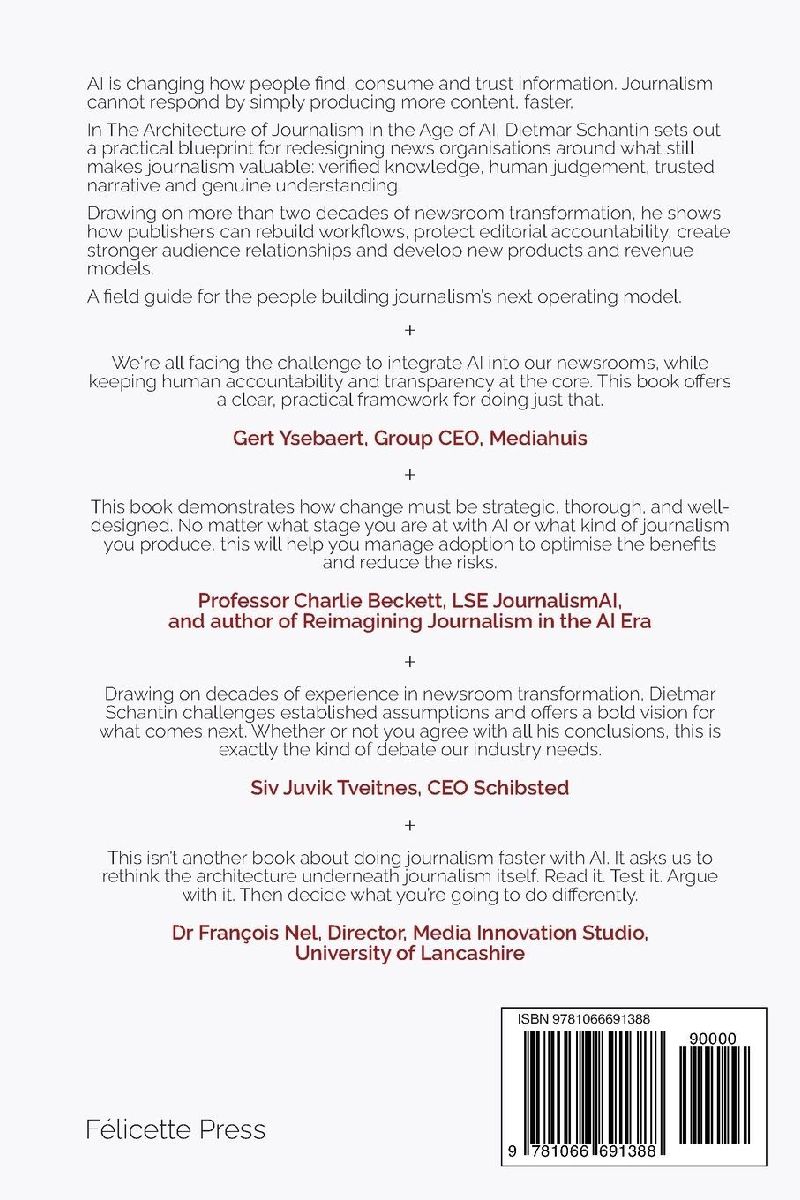
"What can you do, which AI cannot do now, or in ten minutes?"< BR> - Ulrik Haagerup, Founder & CEO, Constructive InstituteAI is not just changing how journalism is produced. It is changing how journalism is found, distributed, consumed and paid for. The Architecture of Journalism in the Age of AI is a practical field guide to redesigning the newsroom for that reality. Drawing on more than two decades of newsroom transformation, Dietmar Schantin sets out Newsroom 5. 0: a new operating model built around what humans must continue to do, what AI can do better and how the two can work together without surrendering editorial judgement. At its heart are five practical frameworks: - DIKNW - Data, Information, Knowledge, Narrative, Wisdom - defining where AI should stop and human judgement must begin- Atoms and molecules - breaking journalism below the level of the finished article- The two-layer newsroom - separating human knowledge creation from AI-assisted distribution through an editorial firewall- Content tribes - rebuilding news products around communities of shared interest rather than the traditional bundle- A five-stream revenue portfolio - showing how this new architecture can create sustainable commercial valueThis is not a book about adding AI tools to existing workflows. Schantin's argument is more radical: the workflow itself is the problem. He shows how news organisations can restructure journalism as reusable knowledge, personalise its delivery without personalising editorial truth and create new products, services and revenue around the journalism they already produce. Written for editors-in-chief, publishers, CEOs, product leaders and revenue leaders, this is a book for the people who have to decide what the next newsroom actually looks like - and how it pays. As Matt Murray, Executive Editor of The Washington Post, writes in his foreword, it is "both an alarm and a call to action."AI is already reshaping journalism. This book is about how news organisations should respond.