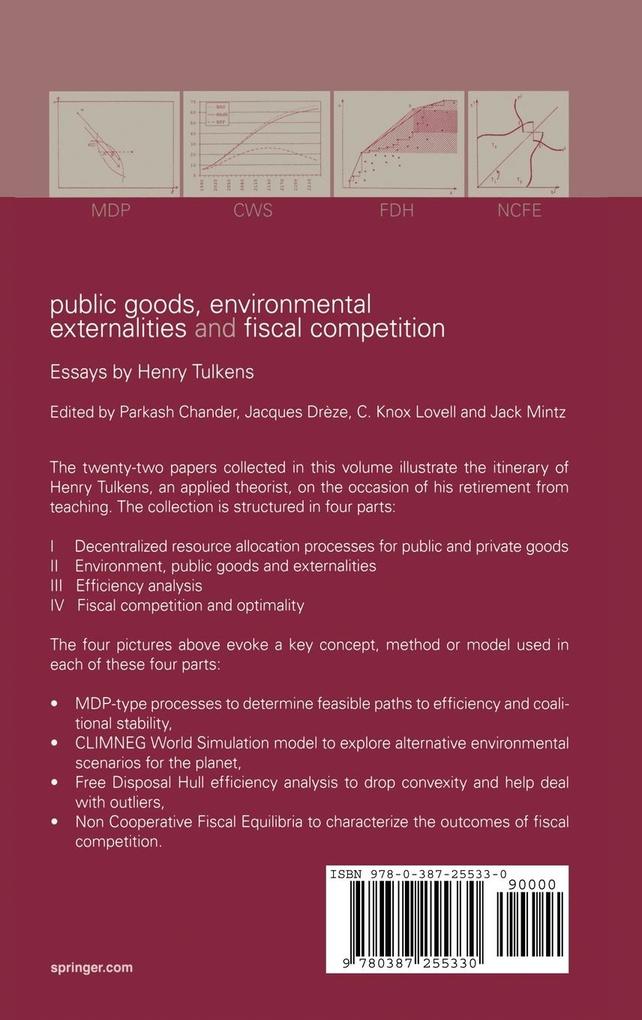
Over the last forty years, the field of public economics has emerged as a modern successor to public finance. It has gained importance on the research agenda of economists and in the curricula of economics depa- ments. It has become a diversified field, rich in theoretical developments and substantive applications. Beyond the traditional concerns with t- ation or public goods, a number of new concerns have entered the scene, concerning for instance public sector pricing, the management of public firms, social security or federalism. A comprehensive presentation of the field extends nowadays beyond the scope of textbooks and requires access to a growing specialised literature. The present volume, collecting 22 papers published by Henry Tulkens over the period 1978-2003, is offered as an illustration of these new developments. The illustration has three dimensions: approach, s- ject matters and methods. Coming from a single author, admittedly assisted by 18 co-authors, the different papers are illustrative of an underlying general approach, which I like to label ''operational public economics''. With these simple words, I mean an approach under which issues in public economics are formulated so as to capture essential elements of actual situations. Ty- cally, this leads to theoretical models more complex than standard te- book formulations. It is then up to the public economist to extend the theory as needed to fit the situation.
Inhaltsverzeichnis
Decentralised Resource Allocation Processes for Public and Private Goods. - Dynamic Processes for Public Goods: An Institution-Oriented Survey. - Surplus-Sharing Local Games in Dynamic Exchange Processes. - Exchange Processes, the Core and Competitive Allocations. - Commodity Exchanges as Gradient Processes. - Environment, Public Goods and Externalities. - An Economic Model of International Negotiations Relating to Transfrontier Pollution. - Theoretical Foundations of Negotiations and Cost Sharing in Transfrontier Pollution Problems. - The Acid Rain Game as a Resource Allocation Process, with Application to Negotiations Between Finland, Russia and Estonia. - The Core of an Economy with Multilateral Environmental Externalities. - A Core-Theoretic Solution for the Design of Cooperative Agreements on Transfrontier Pollution. - The Kyoto Protocol: An Economic and Game Theoretic Interpretation. - Simulating Coalitionally Stable Burden Sharing Agreements for the Climate Change Problem. - Transfers to Sustain Dynamic Core-Theoretic Cooperation in International Stock Pollutant Control. - Efficiency Analysis. - Measuring Labor-Efficiency in Post Offices. - On FDH Efficiency Analysis: Some Methodological Issues and Applications to Retail Banking, Courts and Urban Transit. - Assessing and Explaining the Performance of Public Enterprises: Some Recent Evidence from the Productive Efficiency Viewpoint. - Non-Frontier Measures of Efficiency, Progress and Regress for Time Series Data. - Nonparametric Efficiency, Progress and Regress Measures For Panel Data: Methodological Aspects. - Efficiency Dominance Analysis (EDA): Basic Methodology. - Fiscal Competition And Optimality. - Commodity Tax Competition Between Member States of a Federation: Equilibrium and Efficiency. - On Pareto Improving Commodity Tax Changes Under Fiscal Competition. - Optimality Properties of Alternative Systems of Taxation of Foreign Capital Income. - Tax Interaction Dynamics Among Belgian Municipalities 1984-1997.