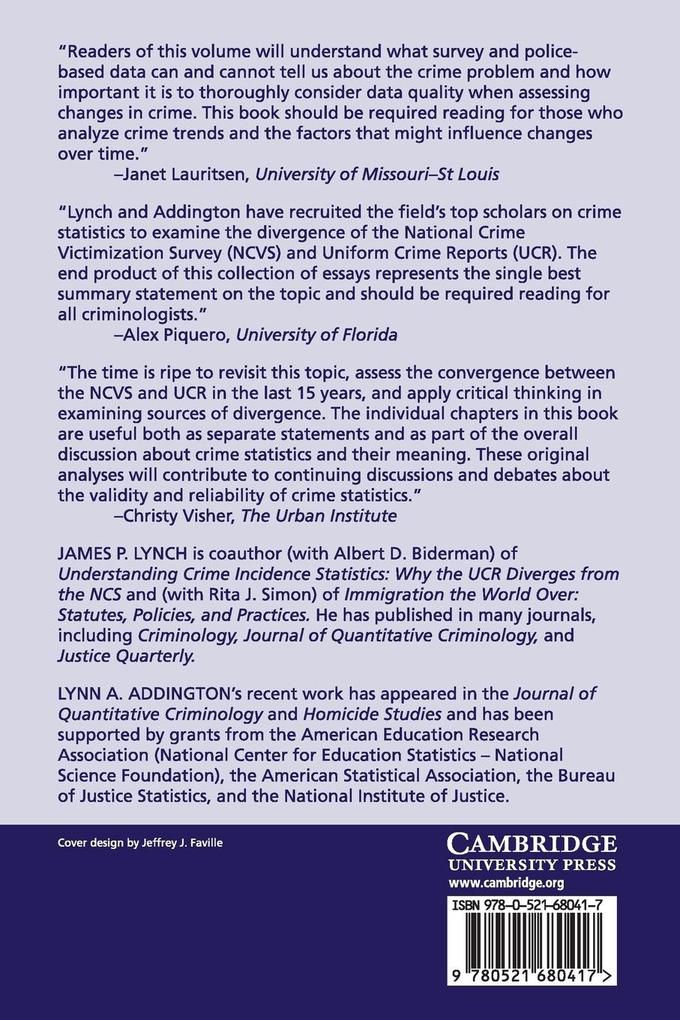
'Readers of this volume will understand what survey and police-based data can and cannot tell us about the crime problem and how important it is to thoroughly consider data quality when assessing changes in crime. This book should be required reading for those who analyze crime trends and the factors that might influence changes over time.' Janet Lauritsen, University of Missouri, St Louis 'Lynch and Addington have recruited the field's top scholars on crime statistics to examine the divergence of the National Crime Victimization Survey (NCVS) and Uniform Crime Reports (UCR). The end product of this collection of essays represents the single best summary statement on the topic and should be required reading for all criminologists.' Alex Piquero, University of Florida 'Crime trends are big news - the decline in crime which began in the early 1990s was one of the most significant social facts of the late 20th century. This book explains why and how researchers have worked to address our understanding of crime trends. The book concludes with sensible suggestions for improving the measurement of crime, a necessary step in advancing what we know about why it goes up and down in the first place.' Wesley Skogan, Northwestern University 'The time is ripe to revisit this topic, assess the convergence between the NCVS and UCR in the last 15 years, and apply critical thinking in examining sources of divergence. The individual chapters in this book are useful both as separate statements and as part of the overall discussion about crime statistics and their meaning. These original analyses will contribute to continuing discussions and debates about the validity and reliability of crime statistics.' Christy Visher, The Urban Institute