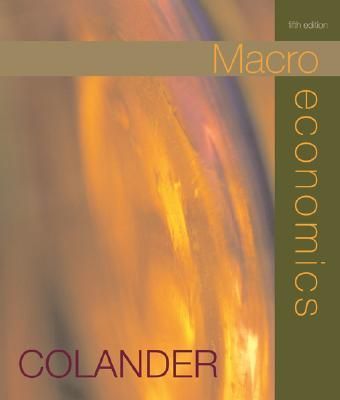
Emphasizes the intellectual and historical context to which the economic models are applied. Written in an informal colloquial style, this student-friendly principles of economics textbook aims to instill economic sensibility in the student.
Inhaltsverzeichnis
< BR> < BR> < BR> I: Introduction < BR> < BR> Chapter 1: Economics and Economic Reasoning < BR> < BR> Chapter 2: Trade and Tradeoffs < BR> < BR> Chapter 3: The Evolving U. S. Economy in Perspective < BR> < BR> Chapter 4: Supply and Demand < BR> < BR> Chapter 5: Applying Supply and Demand < BR> < BR> II: Macroeconomics < BR> < BR> I: Macroeconomic Problems < BR> < BR> Chapter 6: Economic Growth, Business Cycles, Unemployment, and Inflation < BR> < BR> Chapter 7: National Income Accounting < BR> < BR> II: The Macroeconomic Framework < BR> < BR> Chapter 8: Growth, Productivity, and the Wealth of Nations < BR> < BR> Chapter 9: Aggregate Demand, Aggregate Supply, and Modern Macroeconomics < BR> < BR> Chapter 10: The Multiplier Model < BR> < BR> III: Money and Monetary Policy < BR> < BR> Chapter 11: Money, Banking, and the Financial Sector < BR> < BR> Chapter 12: Monetary Policy and the Debate about Macro Policy < BR> < BR> Chapter 13: Inflation and Its Relationship to Unemployment and Growth < BR> < BR> IV: Policy Issues in Depth < BR> < BR> Chapter 14: Aggregate Demand Policy in Perspective < BR> < BR> Chapter 15: Politics, Surpluses, Deficits, and Debt < BR> < BR> Chapter 16: Macro Policies in Developing Countries < BR> < BR> V: International Policy Issues < BR> < BR> Chapter 17: International Trade Policy < BR> < BR> Chapter 18: International Finance < BR> < BR> Chapter 19: Monetary and Fiscal Policy in a Global Setting < BR>