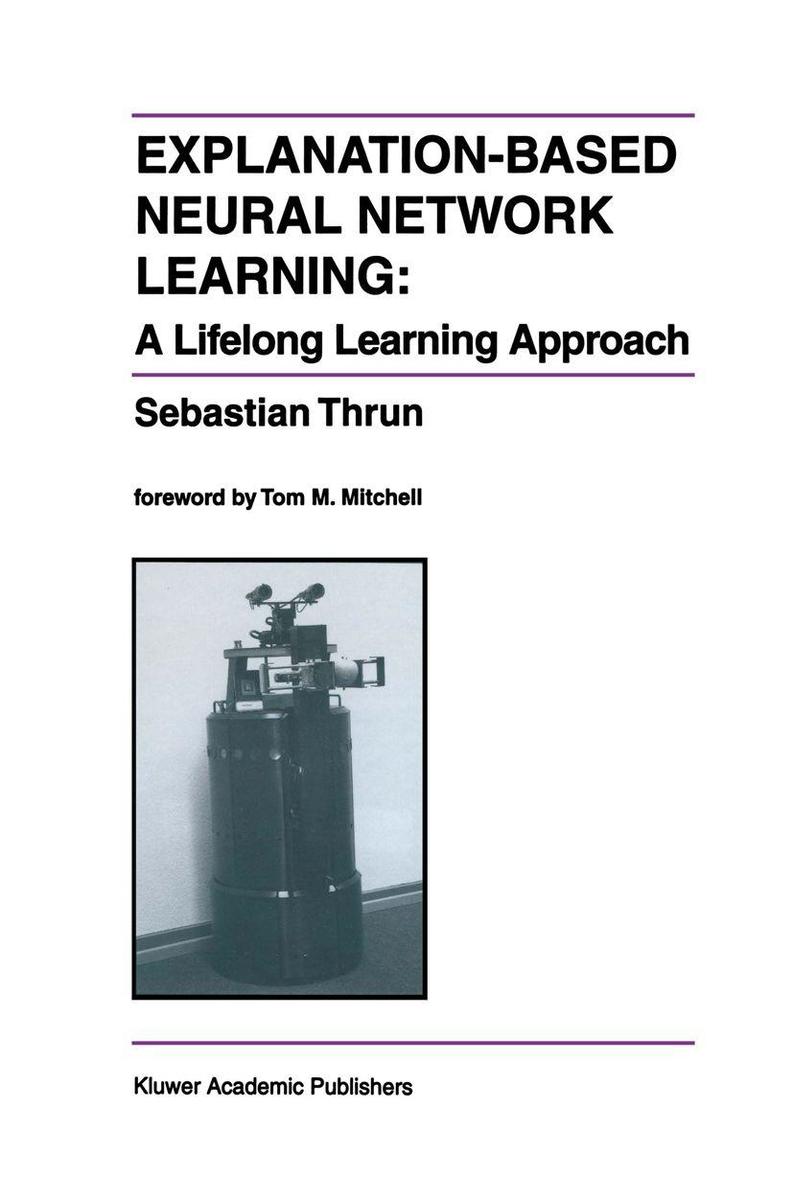
Lifelong learning addresses situations in which a learner faces a series of different learning tasks providing the opportunity for synergy among them. Explanation-based neural network learning (EBNN) is a machine learning algorithm that transfers knowledge across multiple learning tasks. When faced with a new learning task, EBNN exploits domain knowledge accumulated in previous learning tasks to guide generalization in the new one. As a result, EBNN generalizes more accurately from less data than comparable methods. Explanation-Based Neural Network Learning: A Lifelong Learning Approach describes the basic EBNN paradigm and investigates it in the context of supervised learning, reinforcement learning, robotics, and chess.
`The paradigm of lifelong learning - using earlier learned knowledge to improve subsequent learning - is a promising direction for a new generation of machine learning algorithms. Given the need for more accurate learning methods, it is difficult to imagine a future for machine learning that does not include this paradigm. '
From the Foreword by Tom M. Mitchell.
Inhaltsverzeichnis
1 Introduction. - 1. 1 Motivation. - 1. 2 Lifelong Learning. - 1. 3 A Simple Complexity Consideration. - 1. 4 The EBNN Approach to Lifelong Learning. - 1. 5 Overview. - 2 Explanation-Based Neural Network Learning. - 2. 1 Inductive Neural Network Learning. - 2. 2 Analytical Learning. - 2. 3 Why Integrate Induction and Analysis? . - 2. 4 The EBNN Learning Algorithm. - 2. 5 A Simple Example. - 2. 6 The Relation of Neural and Symbolic Explanation-Based Learning. - 2. 7 Other Approaches that Combine Induction and Analysis. - 2. 8 EBNN and Lifelong Learning. - 3 The Invariance Approach. - 3. 1 Introduction. - 3. 2 Lifelong Supervised Learning. - 3. 3 The Invariance Approach. - 3. 4 Example: Learning to Recognize Objects. - 3. 5 Alternative Methods. - 3. 6 Remarks. - 4 Reinforcement Learning. - 4. 1 Learning Control. - 4. 2 Lifelong Control Learning. - 4. 3 Q-Learning. - 4. 4 Generalizing Function Approximators and Q-Learning. - 4. 5 Remarks. - 5 Empirical Results. - 5. 1 Learning Robot Control. - 5. 2 Navigation. - 5. 3 Simulation. - 5. 4 Approaching and Grasping a Cup. - 5. 5 NeuroChess. - 5. 6 Remarks. - 6 Discussion. - 6. 1 Summary. - 6. 2 Open Problems. - 6. 3 Related Work. - 6. 4 Concluding Remarks. - A An Algorithm for Approximating Values and Slopes with Artificial Neural Networks. - A. 1 Definitions. - A. 2 Network Forward Propagation. - A. 3 Forward Propagation of Auxiliary Gradients. - A. 4 Error Functions. - A. 5 Minimizing the Value Error. - A. 6 Minimizing the Slope Error. - A. 7 The Squashing Function and its Derivatives. - A. 8 Updating the Network Weights and Biases. - B Proofs of the Theorems. - C Example Chess Games. - C. 1 Game 1. - C. 2 Game 2. - References. - List of Symbols.