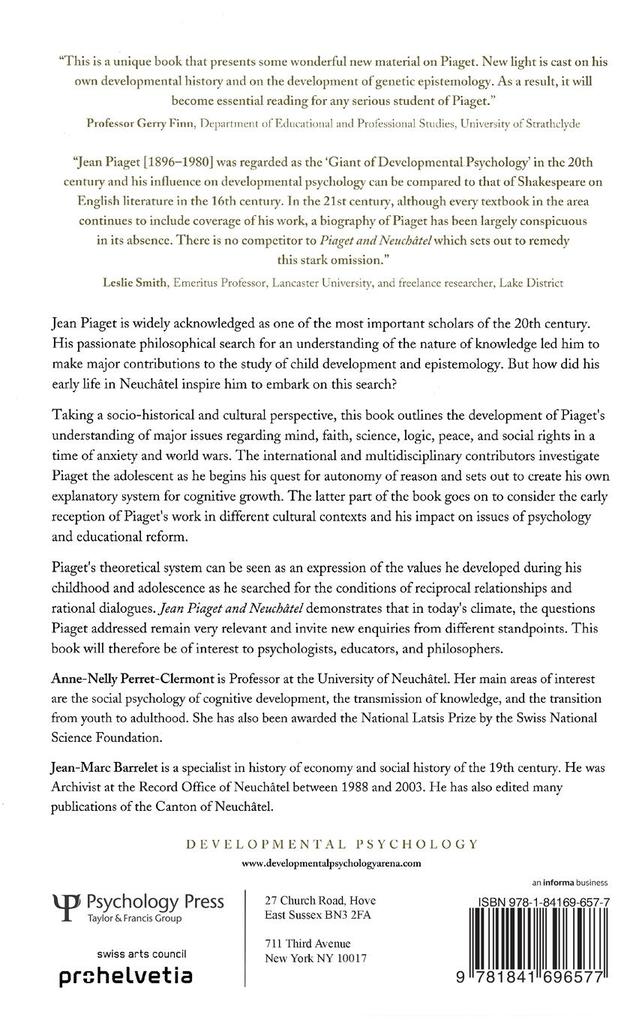
Taking a socio-historical and cultural perspective, this book looks at Jean Piaget's own growth from childhood to scientific life. The international and multidisciplinary contributors examine the milieu in which Piaget was born and educated, and search for traces of the experiences, social relationships, commitments and debates that peppered his childhood and adolescence, and informed his future academic career.
Inhaltsverzeichnis
A.-N. Perret-Clermont, J.-M. Barrelet, Foreword. Part 1: Growing Up in Neuchâtel. J.-M. Barrelet, Neuchâtel. J.-P. Jermini, Neuchâtel, Jean Piaget's Hometown. M. de Tribolet, Arthur Piaget (1865-1952): Background of Jean Piaget's Father. A.-F. Schaller-Jeanneret, Early Schooling. J.-P. Schaer, Studies at the University of Neuchâtel. M.-J. Liengme Bessire, S. Béguelin, Did Jean Piaget's 'Conversion' From Malacology to Psychology Happen in the Faculty of Arts? F. Vidal, Jean Piaget, 'Friend of Nature'. C. Thomann, Christian and Social Commitment. C. Robert-Grandpierre, Grandchamp and Pierre Bovet. Part 2: A Savant of his Age. T. Zittoun, A.-N. Perret-Clermont, J.-M. Barrelet,The Socio-intellectual Genealogy of Jean Piaget. J. Rijsman, An Intellectual and Technological Panorama of Piaget's World. J. Oelkers, The New Education. J.-J. Ducret, The Intellectual Journey after the Neuchâtel Period. R. van der Veer, The Reception of Piaget's Early Ideas in the Soviet Union. D. Hameline, The Great Images of Jean Piaget. A.-N. Perret-Clermont, Epilogue: Piaget, His Elders and His Peers.