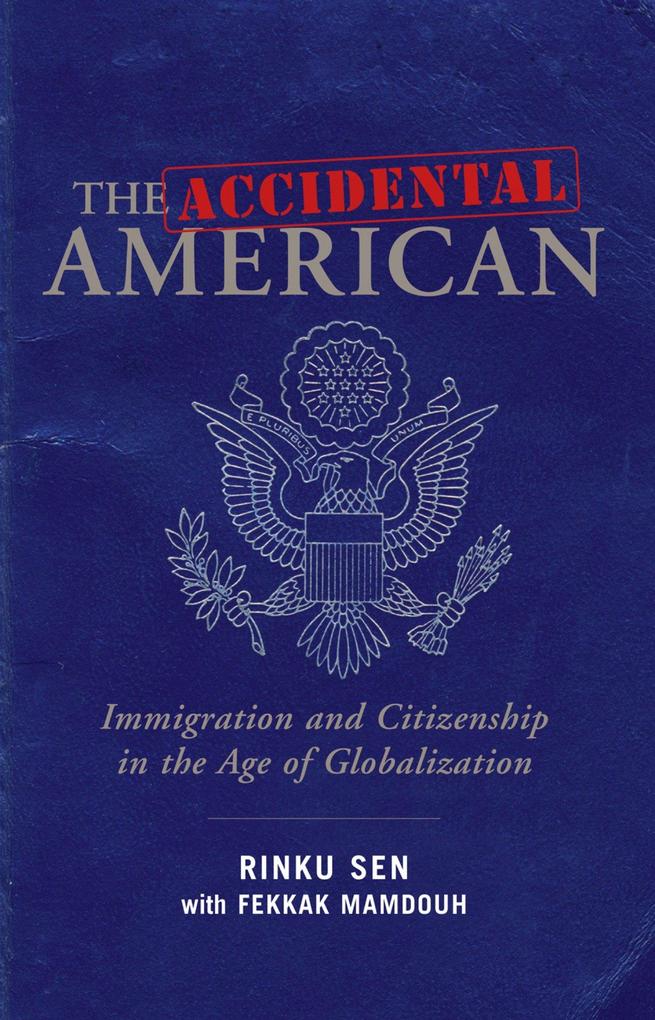
The Accidental American calls for a bold new approach to immigration: a free international flow of labor to match globalization's free flow of capital. After all, corporations are encouraged to move anywhere in the world they can maximize their earnings. People shouldn't have to risk exploitation, abuse, and even imprisonment when they try to do the same.
Activist, journalist, and immigration expert Rinku Sen and organizer Fekkak Mamdouh examine the consequences of this injustice through Mamdouh's own story. Born in Morocco, he was a waiter and union leader at Windows on the World, a restaurant in the World Trade Center. In the aftermath of September 11th, facing a rising tide of anti-immigrant bias, Mamdouh and others formed the Restaurant Opportunities Center of New York (ROC-NY) to help their colleagues fight for decent jobs and fair treatment. ROC-NY was able to unite native-born and immigrant workers, helping each group realize they were involved in a common struggle for better working conditions. The organization is now expanding nationwide.
Since 9/11, immigrants have increasingly been treated as presumptive criminals. As a counterpoint to these regressive, fundamentally un-American practices, the authors forcefully advocate more humane policies that would ease rather than restrict people's movements, coupled with proposals for reforming globalization so that both sending and receiving countries can more equitably benefit from a more mobile international labor force.
Immigrants enthusiastically contribute much more to our country than their labor. They ought to be welcomed, not marginalized. Citizenship should ultimately be determined by how willing people are to become a part of the social, civic, and political fabric of the country they live in, not by an accident of birth.
Inhaltsverzeichnis
Introduction: Coming to Citizenship in a Near-Global Age
Chapter One: Leaving Home
Chapter Two: Us and Them After 9/11
Chapter Three: Crimmigration
Chapter Four: Learning to Organize
Chapter Five: Building a Cooperative Restaurant
Chapter Six: Scaling Up Throughout the Industry
Chapter Seven: Framing the Immigration Debate
Chapter Eight: Growing a Movement
Chapter Nine: Dreaming Globally
Chapter Ten: Everybody Means Everybody
Notes
Acknowledgments
Index
About the Authors