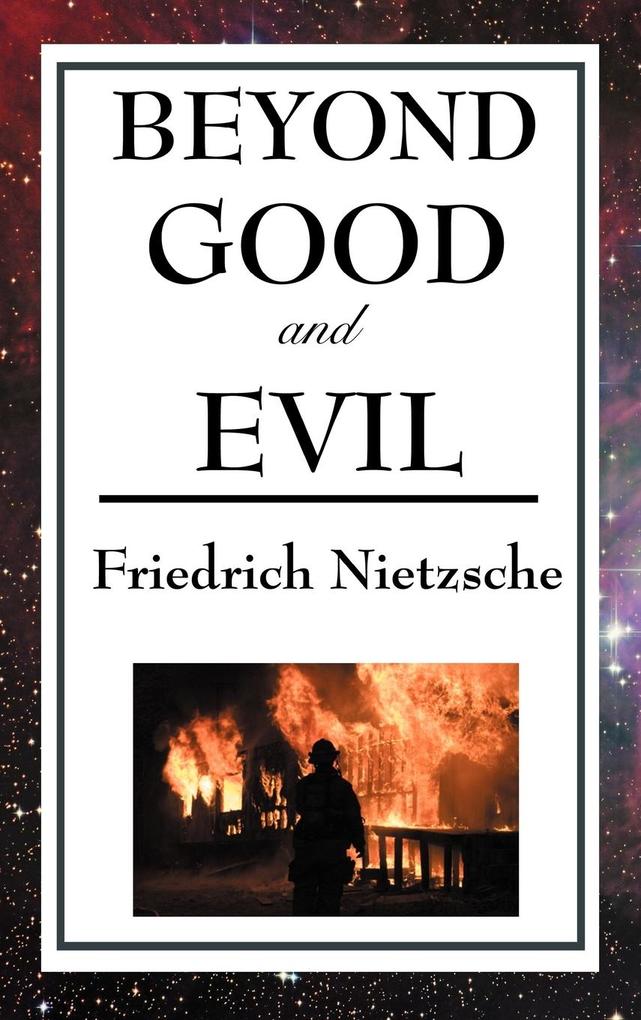
One of Friedrich Nietzsche's most influential philosophical works, challenging conventional ideas about morality, truth, and human nature.
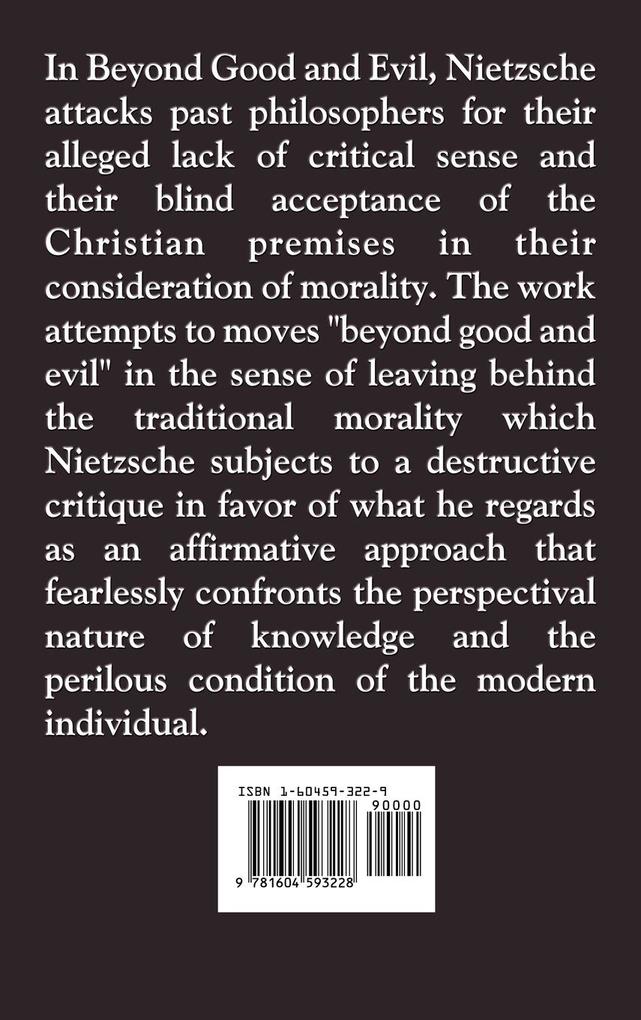
Beyond Good and Evil is Nietzsche's powerful critique of traditional philosophy and morality, questioning the assumptions that have shaped Western thought for centuries. Through a series of penetrating observations and arguments, Nietzsche examines the nature of knowledge, religion, ethics, culture, and the forces that influence human beliefs and values.
In this groundbreaking work, Nietzsche challenges philosophers who he believed accepted inherited moral systems without sufficient examination. He explores the relationship between truth and perspective, the role of instinct and reason, the psychology of morality, and the possibility of creating new values beyond traditional concepts of good and evil.
A cornerstone of modern philosophy, Beyond Good and Evil has influenced existentialism, psychology, literature, and cultural criticism. Both controversial and deeply thought-provoking, it remains an essential work for readers seeking to understand Nietzsche's challenge to conventional thinking and his vision of human transformation.