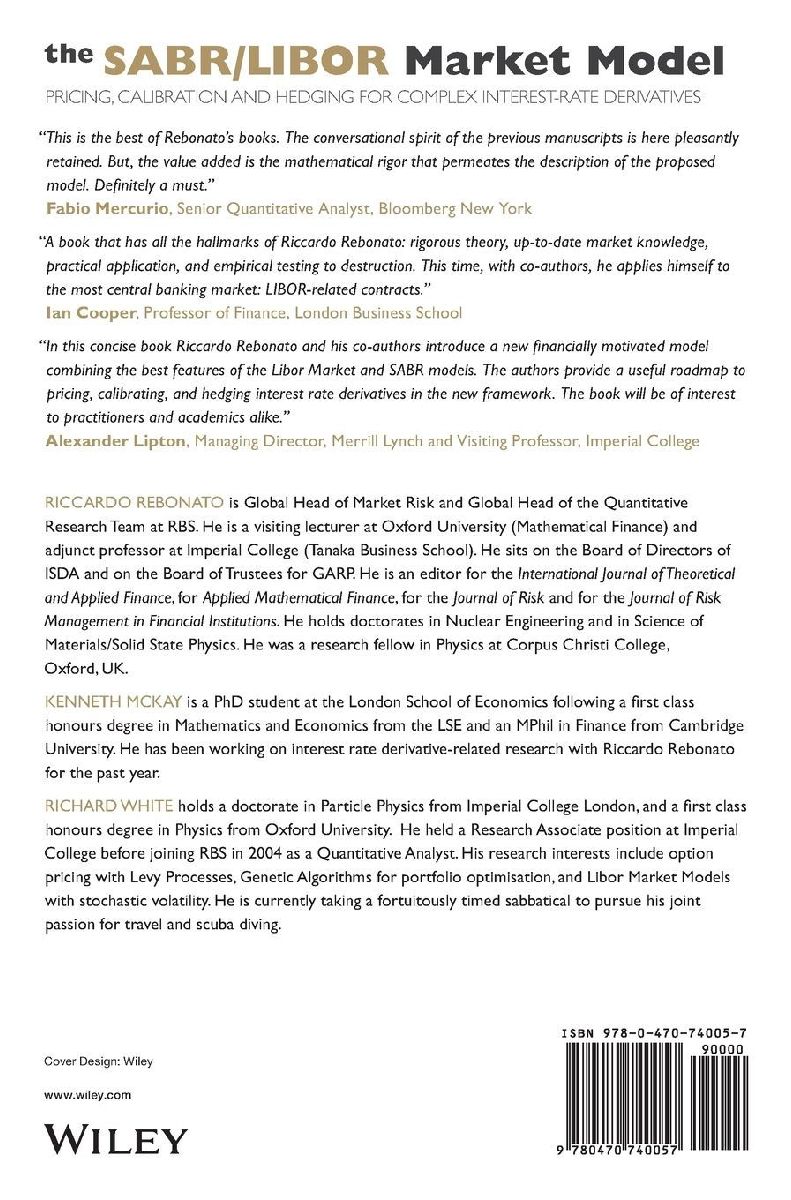
The authors take two market standards, the SABR and the LIBOR Market Model (LMM) and produce a coherent synthesis for the pricing of complex interest rate derivatives. The SABR model has become the market standard to recover the price of European options. Its main strengths are its financial justifiability, and its ability to recover the dynamics of the smile evolution when the underlying changes. However, the SABR model treats each European option in isolation. The processes for forward rates and swap rates cannot easily be combined to create coherent dynamics for the entire yield curve.
With their new model, the authors bring the dynamics of the various forward rates and stochastic volatilities under a single measure, and derive 'drift adjustments' to ensure the absence of arbitrage and to allow for the pricing of complex derivatives. The credible evolution of future smiles generated by the model is essential to complex derivatives pricing as it determines future prices for caplets and swaptions and therefore plausible re-hedging costs.
The authors calibrate their model to hedging instruments in a way that is both accurate and extremely simple. They also propose a pragmatic hedging approach, inspired by work done with the two-state Markov-chain approach which relies on the empirical regularities of the dynamics of the smile surface and the robustness of the fits proposed. The final chapter considers 'survival' hedging in times of market turmoil. It does so by providing a set of transactions that can protect the value of a complex derivatives book in a stressed market.
The extension of the LMM model provides a valid description of the financial reality while retaining tractability, computational speed and ease of calibration. The goal for the new model is to offer the ability to reduce uncertainty in market prices to an acceptable minimum by making as judicious a use as possible of the econometric information available. The grounding in empirical information of the modelling approach utilised by the authors differentiates this title from the stochastic-calculus-heavy, but empirically light, work of others.
The title will be of interest to quantitative analysts, quantitative developers, risk managers and traders in complex derivatives.
Inhaltsverzeichnis
Acknowledgements xi
1 Introduction 1
I The Theoretical Set-Up 7
2 The LIBOR Market Model 9
3 The SABR Model 25
4 The LMM-SABR Model 51
II Implementation and Calibration 79
5 Calibrating the LMM-SABR Model to Market Caplet Prices 81
6 Calibrating the LMM-SABR Model to Market Swaption Prices 101
7 Calibrating the Correlation Structure 125
III Empirical Evidence 141
8 The Empirical Problem 143
9 Estimating the Volatility of the Forward Rates 159
10 Estimating the Correlation Structure 181
IV Hedging 203
11 Various Types of Hedging 205
12 Hedging against Moves in the Forward Rate and in the Volatility 221
13 (LMM)-SABR Hedging in Practice: Evidence from Market Data 231
14 Hedging the Correlation Structure 247
15 Hedging in Conditions of Market Stress 257
References 271
Index 275