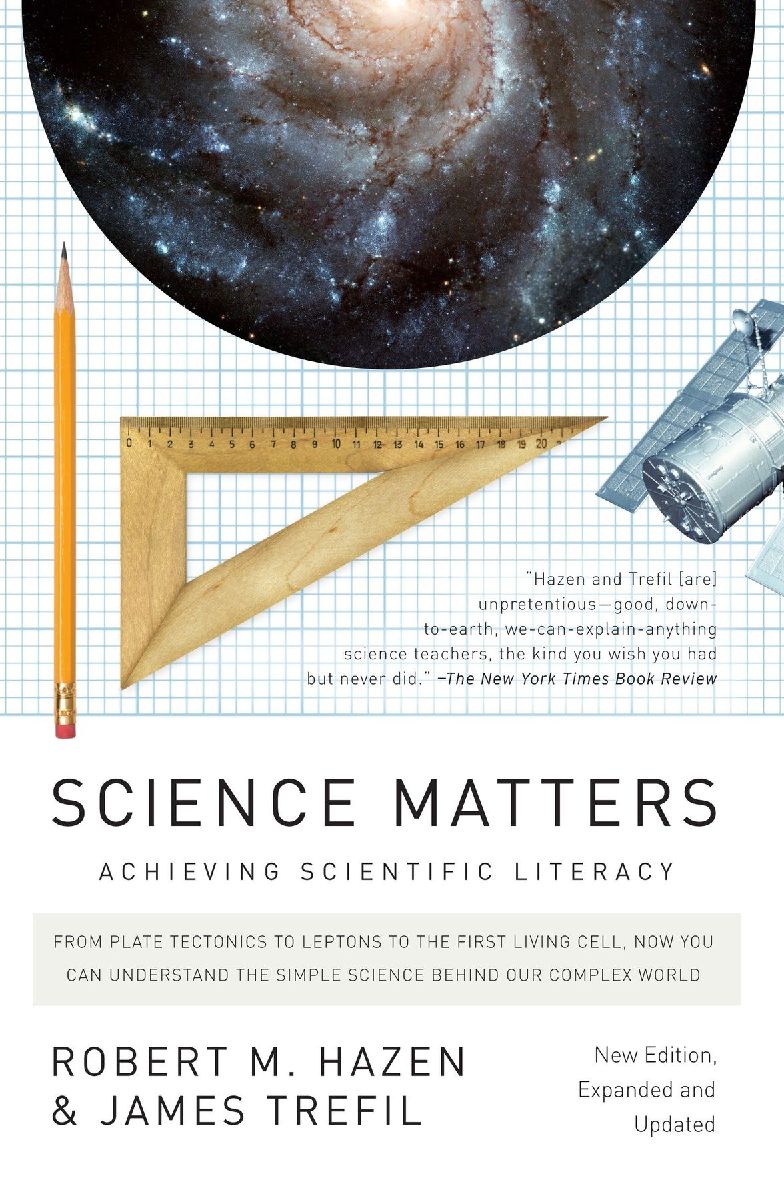
Knowledge of the basic ideas and principles of science is fundamental to cultural literacy. But most books on science are often too obscure or too specialized to do the general reader much good.
Science Matters is a rare exception-a science book for the general reader that is informative enough to be a popular textbook for introductory courses in high school and college, and yet well-written enough to appeal to general readers uncomfortable with scientific jargon and complicated mathematics. And now, revised and expanded for the first time in nearly two decades, it is up-to-date, so that readers can enjoy Hazen and Trefil's refreshingly accessible explanations of the most recent developments in science, from particle physics to biotechnology.
Inhaltsverzeichnis
CONTENTS< BR> < BR> INTRODUCTION< BR> < BR> Scientific Literacy: What It Is, Why It’ s Important, and Why We Don’ t Have It< BR> < BR> ONE. Knowing < BR> The universe is regular and predictable. < BR> < BR> TWO. Energy < BR> Energy is conserved and always goes from more useful< BR> to less useful forms. < BR> < BR> THREE. Electricity and Magnetism < BR> Electricity and magnetism are two aspects of the same force. < BR> < BR> FOUR. The Atom < BR> All matter is made of atoms. < BR> < BR> FIVE. The World of the Quantum < BR> Everything comes in discrete units and you can’ t measure anything without changing it. < BR> < BR> SIX. Chemical Bonding < BR> Atoms are bound by electron glue. < BR> < BR> SEVEN. Atomic Architecture< BR> The way a material behaves depends on how its atoms are arranged. < BR> < BR> EIGHT. Nuclear Physics< BR> Nuclear energy comes from the conversion of mass. < BR> < BR> NINE. The Fundamental Structure of Matter < BR> All matter is really made of quarks and leptons. < BR> < BR> TEN. Astronomy < BR> Stars experience a cycle of birth and death. < BR> < BR> ELEVEN. The Cosmos < BR> The universe was born at a specific time in the past, and it has been expanding ever since. < BR> TWELVE. Relativity < BR> Every observer sees the same laws of nature. < BR> < BR> THIRTEEN. The Restless Earth < BR> Earth’ s surface is constantly changing, and no feature on Earth is permanent. < BR> < BR> FOURTEEN. Earth Cycles< BR> Earth operates in cycles. < BR> FIFTEEN. The Ladder of Life < BR> All living things are made from cells, the chemical factories of life. < BR> < BR> SIXTEEN. The Code of Life < BR> All life is based on the same genetic code. < BR> < BR> SEVENTEEN. Biotechnology < BR> All life is based on the same chemistry and genetic code. < BR> < BR> EIGHTEEN. Evolution < BR> All forms of life evolved by natural selection. < BR> < BR> NINETEEN. Ecosystems < BR> All life is connected. < BR> < BR> Epilogue < BR> < BR> The Role of Science< BR> < BR> Index