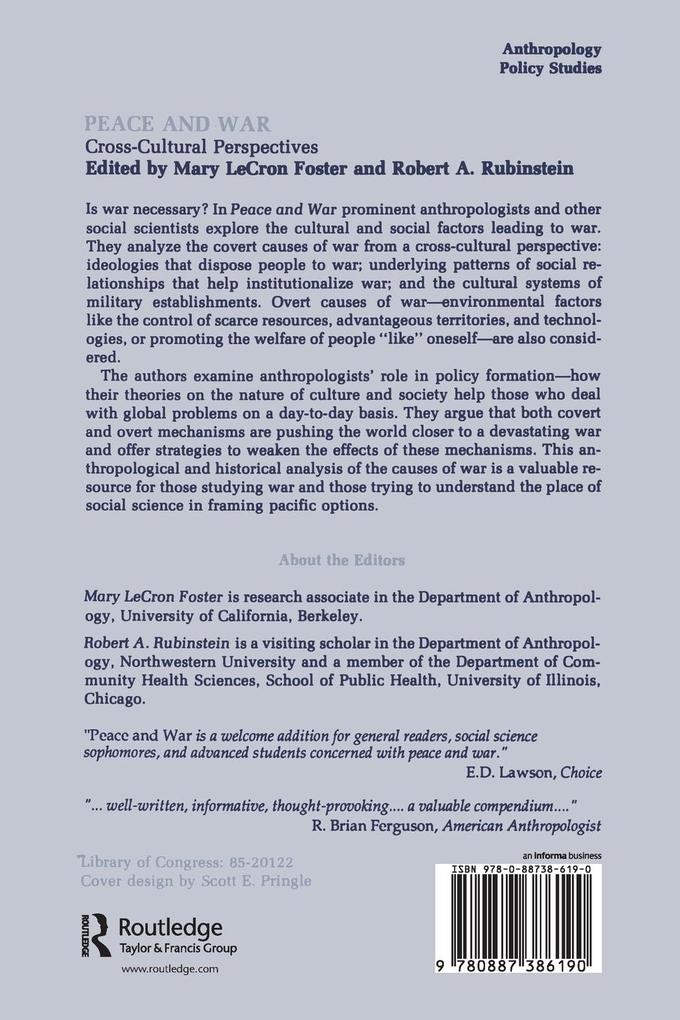
Is war necessary? In Peace and War prominent anthropologists and other social scientists explore the cultural and social factors leading to war. They analyze the covert causes of war from a cross-cultural perspective: ideologies that dispose people to war; underlying patterns of social relationships that help institutionalize war; and the cultural systems of military establishments. Overt causes of war-environmental factors like the control of scarce resources, advantageous territories, and technologies, or promoting the wel-fare of people "like" oneself-are also considered.
The authors examine anthropologists' role in policy formation-how their theories on the nature of culture and society help those who deal with global problems on a day-to-day basis. They argue that both covert and overt mechanisms are pushing the world closer to a devastating war and offer strategies to weaken the effects of these mechanisms. This anthropological and historical analysis of the causes of war is a valuable resource for those studying war and those trying to understand the place of social science in framing pacific options.
Inhaltsverzeichnis
Acknowledgments < BR> Preface < BR> Introduction < BR> Part I The Individual, Community, and Conflict < BR> 1. Personal Motivation and Institutionalized Conflict < BR> 2. The Uses of Fear: Porro Gangs in Mexico < BR> 3. Toward a Structural Model of Violence: < BR> Male Initiation Rituals and Tribal Warfare < BR> 4. Fighting for Peace < BR> 5. The Culture of United States Military Enclaves < BR> 6. Is War Necessary? < BR> 7. The Cultural Patterning of Risk-Seeking Behavior: < BR> Implications for Armed Conflict < BR> Part II The Dynamics of Conflict < BR> 8. Land Disputes and the Gods in the Prehispanic Mixteca < BR> 9. Directed Change and the Hope for Peace < BR> 10. Ethnic Targeting as a Defense Strategy < BR> 11. Conflict in the Horn of Africa < BR> 12. Christianity and War < BR> Part III Social Scientists React < BR> 13. Sociopsychological Aspects of the Prevention of Nuclear War < BR> 14. The Drift to War < BR> 15. The War-Making Institutions < BR> 16. The Nature of War and the American Military Profession < BR> 17. War and Peace: The View of a Soviet Scholar < BR> Part IV Conflict and the Nation-State < BR> 18. Ideology and Institutions in Peace and War < BR> 19. War and War Proneness in Pre- and Postindustrial States < BR> 20. The Developmental Dynamics of Peace < BR> 21. The Anthropology of Global Integration: < BR> Some Grounds for Optimism about World Peace < BR> 22. The Superpowers and the Tribes < BR> Part V Anthropology and Policy < BR> 23. Anthropology for the Second Stage of the Nuclear Age 24. Anthropology as a Nonpolicy Science < BR> 25. Global Policy and Revolution in Social Sciences < BR> 26. Conflict and Belief in American Foreign Policy < BR> 27. The Collapse of Strategy: Understanding < BR> Ideological Bias in Policy Decisions < BR> Conclusion: Toward an Anthropology of Peace and War < BR> About the Contributors