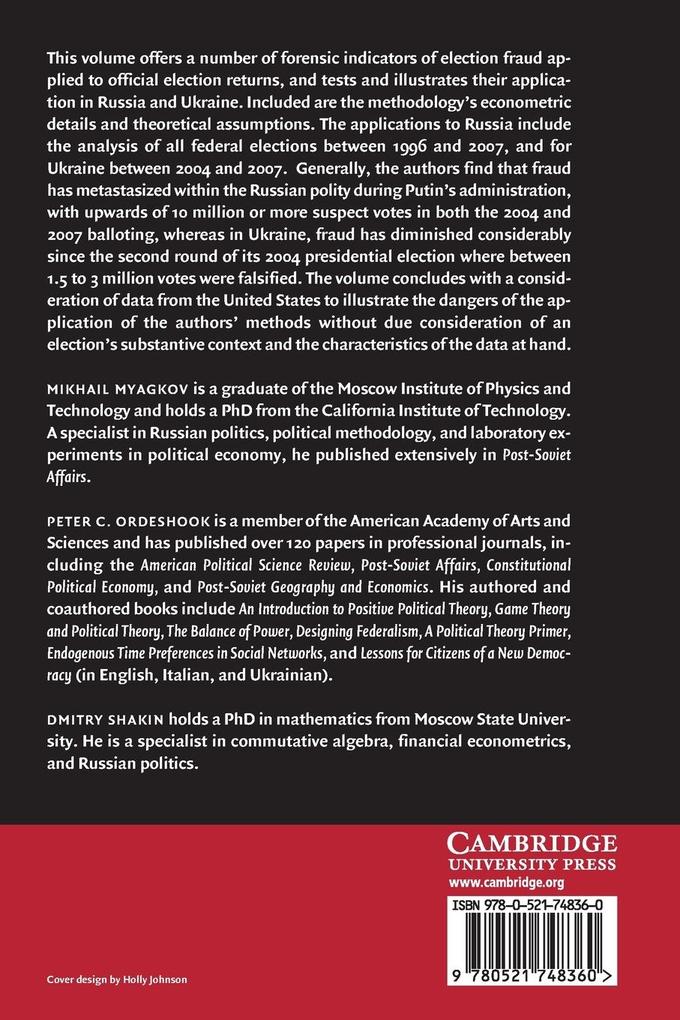
"The Forensics of Election Fraud by Myagkov, Ordeshook and Shakin presents a novel, creative and powerful methodology to detect the possibility of vote fraud using aggregate precinct data from several elections. Their approach is to detect patterns that flag vote fraud. They do not use standard statistical methodology because it is not appropriate for their problem but instead their method presents evidence that may be due to fraud. I consider this book to be one of the best three book manuscripts in political methodology that I have ever read. I believe that it will be considered to be a masterpiece in the field." -Melvin J. Hinich, University of Texas at Austin "This book is a milestone accomplishment: original, compelling and of utmost and immediate policy relevance. It brings the latest in social science theory and methodology to bear on the detection of electoral fraud in post-communist states. As a control, it then applies the techniques to US elections. The result is a seminal forensics toolkit for methodologists and policy makers alike." -George Breslauer, University of California at Berkeley "The Forensics of Election Fraud is powerful, persuasive, and vigorously written. The book is important, not only for its substantive findings about Russia and Ukraine, but, perhaps even more, for the ingenious methodology its authors have devised for uncovering large-scale vote fraud. One of their major findings is that in recent years in Russia, the practice of vote fraud has spread from a relatively small number of ethnic republics, which are dominated by authoritarian leaders, to a much larger number of regions. So by the time of the 2004 presidential election and the 2007 Duma election, fraud was widespread. They also argue that the 2008 presidential election was so heavily manipulated that it is not worth applying their methods to it. Myagkov, Ordeshook and Shakin also analyze fraud in the famous 2004 Ukrainian presidential election, where massive falsifications provoked the 'Orange Revolution.' They show the very different patterns of voting from the (corrupted) run-off election in November 2004 to the (largely free and fair) new run-off in December, which followed the massive popular protest over election falsification and the world-wide condemnation of the attempt to steal the election. This book makes a major contribution to the literature on the methods by which authoritarian rulers manipulate election outcomes, and offers an ingenious set of tools for detecting them." -Thomas Remington, Emory University