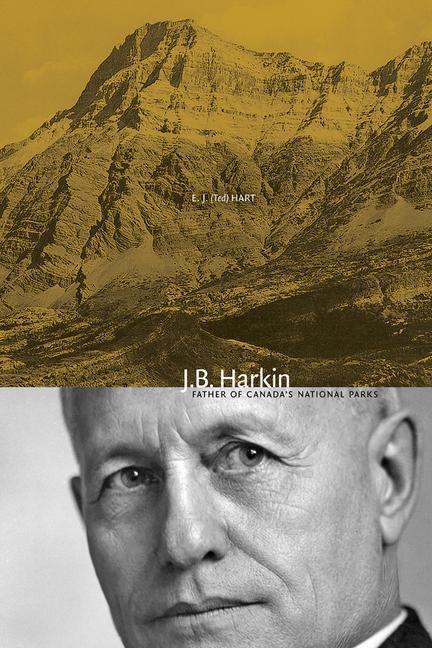
"Ted Hart is no stranger to mountain slopes or national parks. The former executive director or Banff's Whyte Museum of the Canadian Rockies has been an archivist, a historian and a proponent of national park history for nearly four decades. Reading his remarkably well-researched biography of Canada's first commissioner of national parks, one could easily imagine Harkin's reaction to these recent developments [via ferrate and ziplining]. Throughout his career, Harkin worried about the increased demands for more and more roads, cheaper forms of amusement and commercial exploitation in national parks." Ed Struzik, Canadian Geographic, April 2011 "In taking on this biography, Hart, like the historians who preceded him, faced a formidable obstacle. Harkin left no personal papers shedding light on his private life and thoughts. Consequently, this book is a biography of Harkin as public servant, and from that perspective, it is a very good one." - Gerald Killan, King's University College at The University of Western Ontario. May 2011 "In 1920, Prime Minister Arthur Meighen described James B. Harkin, director of the Dominion Parks Branch, as 'one of the most competent officers in the Government Service' (p. 336). It strikes me as a most Canadian of compliments, for a man who emerges from E. J. Hart's lengthy biography as a deft and dedicated bureaucrat who consistently and effectively championed national parks to the Canadian government and the Canadian public throughout the first half of the twentieth century...Harkin deserves a biography of this magnitude. He succeeded in transforming the Canadian landscape by creating a national parks system, but more importantly, he grappled with many of the same issues-political, public, and ecological-facing Parks Canada at the beginning of its second century. We can learn much from studying the life and times of one of our 'most competent' historical figures." Claire Campbell, Environmental History the minutiae are one of the works great strengths. Hart has written a very thorough piece of administrative history. By catching the cadence of bureaucratic life, he has imparted a sense of Harkins reality. This provides the context in which Harkin can be fairly assessed.- Peter E. Rider, Social History/Histoire Sociale, November 2011