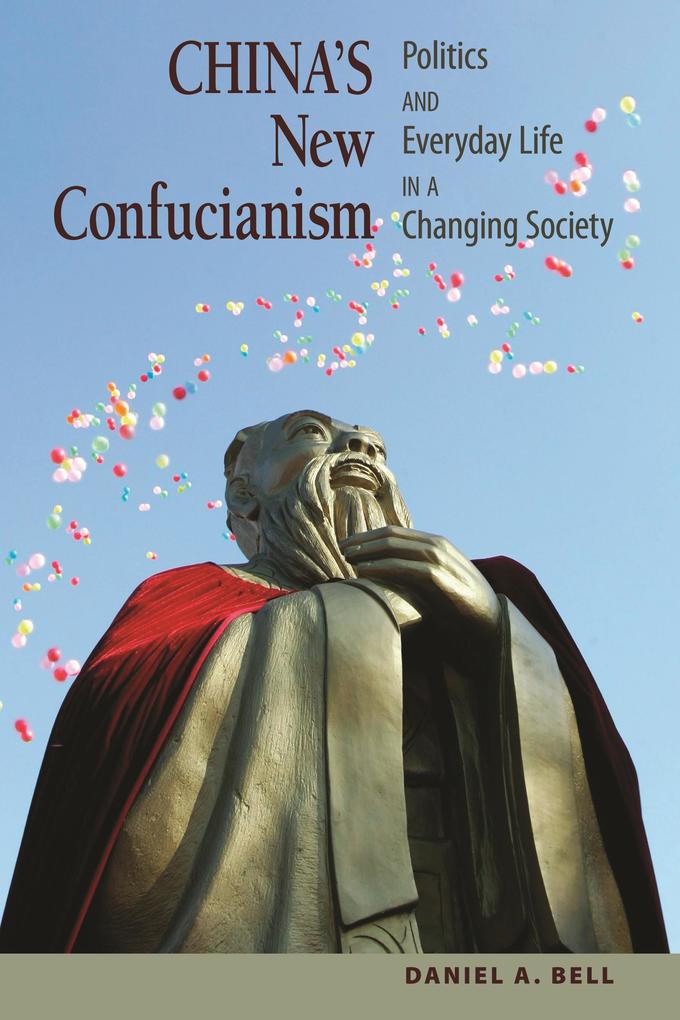
"China's New Confucianism is a lively, informed, and very insightful look at modern China. Daniel A. Bell has an established reputation as an academic analyst. With this book he has accomplished something rarer and more impressive: combining his scholarship in an effortless way with keen observations of daily life, from the sports field to the karaoke bar to the classroom. He is the first to say that no one book, nor even a lifetime's experience, equips an observer to 'understand' China fully. But his book will give almost any reader a better understanding of the energy and contradictions of this country."--James Fallows, correspondent for Atlantic Monthly
"As the first Western scholar to become full-time faculty in political philosophy at one of China's most prestigious universities, Daniel Bell has a unique, insightful, and rich perspective on the Confucian values in contemporary Chinese politics and people's daily lives. The groundbreaking yet effective arguments in this book will elicit much discussion. I enthusiastically support and endorse this book without reservation."--Chen Lai, Peking University
"Daniel Bell is a Westerner who lives in China, speaks Chinese, and teaches in a Chinese university. He writes about his adopted country with exactly the right mix of appreciation and critical distance. His accounts of academic and domestic life, sex and sport, equality and hierarchy, and Marx and Confucius are, all of them, wonderfully illuminating."--Michael Walzer, Institute for Advanced Study
"Daniel Bell has written a broadly accessible book that shows another side of the complex reality that is contemporary China. China's New Confucianism is a book that anyone with a deep interest in China can sink their teeth into, learn from, be challenged by, and thoroughly enjoy."--Stephen C. Angle, Wesleyan University
"Daniel Bell is without peer among contemporary political and social philosophers working on traditional and contemporary China. Full of insight, his new book will stimulate significant discussion. Blending theoretical sophistication, broad command of the best literature, keen observation of contemporary events, and candid personal anecdote, it deserves a great deal of attention, not only in Western countries, but throughout East Asia as well."--Philip J. Ivanhoe, City University of Hong Kong
Inhaltsverzeichnis
Preface to the Paperback Edition ix Acknowledgments xxiii Introduction xxvii Part One: Politics 1 Part 1: From Communism to Confucianism: Changing Discourses on China's Political Future 3 Part 2: War, Peace, and China's Soft Power 19 Part 3: Hierarchical Rituals for Egalitarian Societies 38 Part Two: Society 57 Part 4: Sex, Singing, and Civility: The Costs and Benefits of the Karaoke Trade 59 Part 5: How Should Employers Treat Domestic Workers? 75 Part 6: The Politics of Sports: From the 2006 World Cup to the 2008 Olympics 91 Part Three: Education 105 Part 7: A Critique of Critical Thinking 107 Part 8: Teaching Political Theory in Beijing 128 Part 9: On Being Confucian: Why Confucians Needn't Be Old, Serious, and Conservative 148 Appendices Part 1: Depoliticizing the Analects 163 Part 2: Jiang Qing's Politi cal Confucianism 175 Index 231