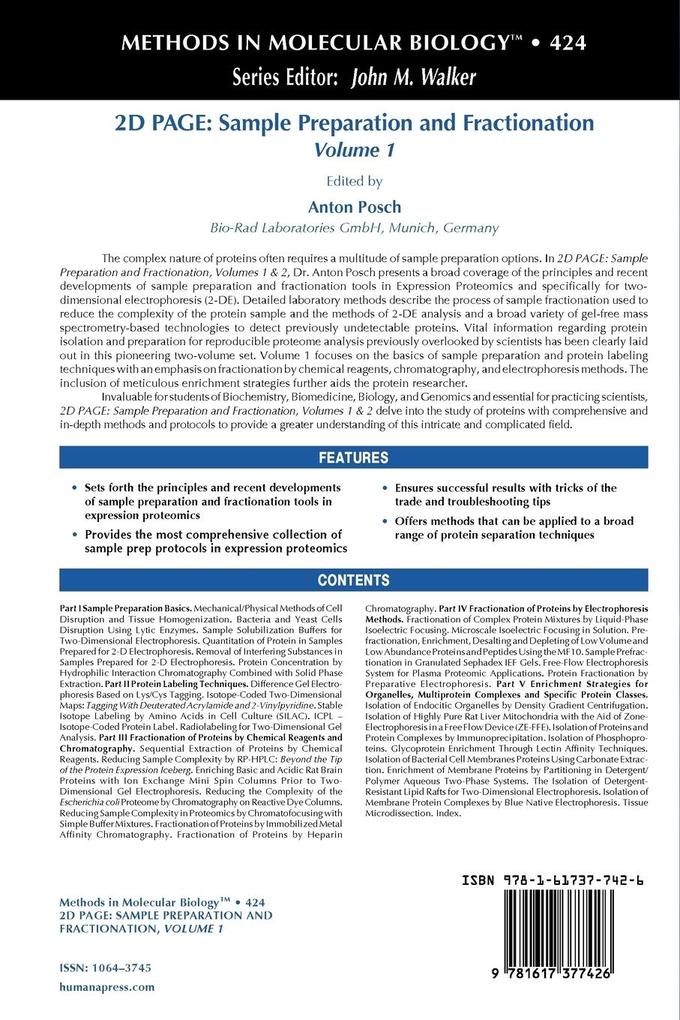
This book, split into two volumes, presents a broad coverage of the principles and recent developments of sample preparation and fractionation tools in Expression Proteomics in general and for two-dimensional electrophoresis (2-DE) in particular. 2-DE, with its unique capacity to resolve thousands of proteins in a single run, is still a fundamental research tool for nearly all protein-related scientific projects. The methods described here in detail are not limited to 2-DE and can also be applied to other protein separation techniques. Because each biological sample is unique, a suited sample preparation strategy has to consider the type of sample as well as the type of biological question being addressed. The complex nature of proteins often requires a multitude of sample preparation options. In addition, sample preparation is not only a prerequisite for a successful and reproducible Proteomics exp- iment, but also the key factor to meaningful data evaluation. Interestingly, not much attention was paid to this area during Proteomics methodology dev- opment and therefore this book is intended to explain in depth how proteins from various sources can be properly isolated and prepared for reproducible Proteome analysis.
Inhaltsverzeichnis
Sample Preparation Basics. - Mechanical/Physical Methods of Cell Disruption and Tissue Homogenization. - Bacteria and Yeast Cell Disruption Using Lytic Enzymes. - Sample Solublization Buffers for Two-Dimensional Electrophoresis. - Quantitation of Protein in Samples Prepared for 2-D Electrophoresis. - Removal of Interfering Substances in Samples Prepared for Two-Dimensional (2-D) Electrophoresis. - Protein Concentration by Hydrophilic Interaction Chromatography Combined with Solid Phase Extraction. - Protein Labeling Techniques. - Difference Gel Electrophoresis Based on Lys/Cys Tagging. - Isotope-Coded Two-Dimensional Maps: Tagging with Deuterated Acrylamide and 2-Vinylpyridine. - Stable Isotope Labeling by Amino Acids in Cell Culture (SILAC). - ICPL Isotope-Coded Protein Label. - Radiolabeling for Two-Dimensional Gel Analysis. - Fractionation of Proteins by Chemical Reagents and Chromatography. - Sequential Extraction of Proteins by Chemical Reagents. - Reducing Sample Complexity by RP-HPLC: Beyond the Tip of the Protein Expression Iceberg. - Enriching Basic and Acidic Rat Brain Proteins with Ion Exchange Mini Spin Columns Before Two-Dimensional Gel Electrophoresis. - Reducing the Complexity of the Escherichia coli Proteome by Chromatography on Reactive Dye Columns. - Reducing Sample Complexity in Proteomics by Chromatofocusing with Simple Buffer Mixtures. - Fractionation of Proteins by Immobilized Metal Affinity Chromatography. - Fractionation of Proteins by Heparin Chromatography. - Fractionation of Proteins by Electrophoresis Methods. - Fractionation of Complex Protein Mixtures by Liquid-Phase Isoelectric Focusing. - Microscale Isoelectric Focusing in Solution. - Prefractionation, Enrichment, Desalting and Depleting of Low Volume and Low Abundance Proteins and Peptides Using the MF10. -Sample Prefractionation in Granulated Sephadex IEF Gels. - Free-Flow Electrophoresis System for Plasma Proteomic Applications. - Protein Fractionation by Preparative Electrophoresis. - Enrichment Strategies for Organelles, Multiprotein Complexes, and Specific Protein Classes. - Isolation of Endocitic Organelles by Density Gradient Centrifugation. - Isolation of Highly Pure Rat Liver Mitochondria with the Aid of Zone-Electrophoresis in a Free Flow Device (ZE-FFE). - Isolation of Proteins and Protein Complexes by Immunoprecipitation. - Isolation of Phosphoproteins. - Glycoprotein Enrichment Through Lectin Affinity Techniques. - Isolation of Bacterial Cell Membranes Proteins Using Carbonate Extraction. - Enrichment of Membrane Proteins by Partitioning in Detergent/Polymer Aqueous Two-Phase Systems. - The Isolation of Detergent-Resistant Lipid Rafts for Two-Dimensional Electrophoresis. - Isolation of Membrane Protein Complexes by Blue Native Electrophoresis. - Tissue Microdissection.