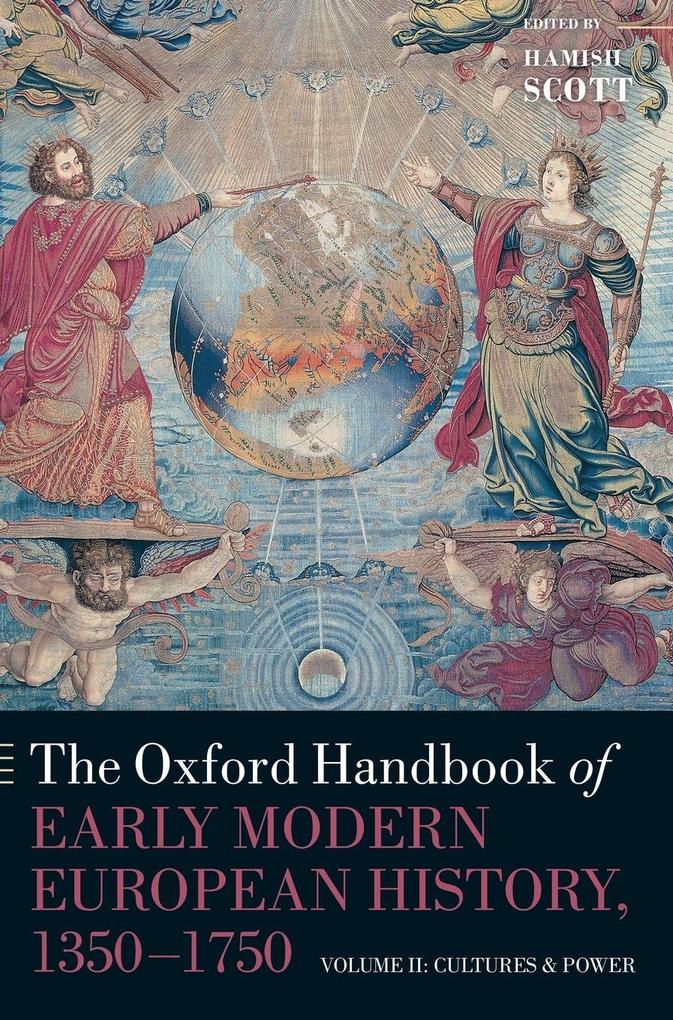
This Handbook re-examines the concept of early modern history in a European and global context. The term 'early modern' has been familiar, especially in Anglophone scholarship, for four decades and is securely established in teaching, research, and scholarly publishing. More recently, however, the unity implied in the notion has fragmented, while the usefulness and even the validity of the term, and the historical periodisation which it incorporates, have been questioned. The Oxford Handbook of Early Modern European History, 1350-1750 provides an account of the development of the subject during the past half-century, but primarily offers an integrated and comprehensive survey of present knowledge, together with some suggestions as to how the field is developing. It aims both to interrogate the notion of 'early modernity' itself and to survey early modern Europe as an established field of study. The overriding aim will be to establish that 'early modern' is not simply a chronological label but possesses a substantive integrity.
Volume II is devoted to 'Cultures and Power', opening with chapters on philosophy, science, art and architecture, music, and the Enlightenment. Subsequent sections examine 'Europe beyond Europe', with the transformation of contact with other continents during the first global age, and military and political developments, notably the expansion of state power.
Inhaltsverzeichnis
- 1: A.S. Brett: Political Thought
- 2: Margaret L. King: A Return to the Ancient World?
- 3: Kathleen Crowther: A Revolution in Natural Philosophy
- 4: T.K. Rabb: Art and Architecture
- 5: Thomas Munck: Music
- 6: John Robertson and Avi Lifschitz: Europe's Enlightenment
- 7: Felipe Fernandez-Armesto: Navigation and Discovery
- 8: J.H. Elliott: Iberian Empires
- 9: Leonard Blussé: Northern European Empires
- 10: Thomas Cohen and Emanuele Colombo: The Role of the Religious Orders
- 11: Gabriel Paquette: Colonial Societies
- 12: Matthew Romaniello: Trade and the 'Global Economy'
- 13: R. Bin Wong: The Unconquered East
- 14: Ronald G. Asch: Western European Monarchies
- 15: Robert Frost: Northern and Eastern Monarchies
- 16: Samuel K. Cohn, Jr.: Authority and Popular Resistance
- 17: Jeroen Duindam: Rulers and Courts
- 18: Carlo Capra: Governance
- 19: James D. Tracy: Taxation and Finance
- 20: Robert von Friedeburg: Republics and Republicanism
- 21: Carol B. Stevens: Warfare on Land
- 22: Louis Sicking: Warfare at Sea
- 23: Gabor Ágoston: The Ottoman Empire and Europe
- 24: Brendan Simms: Europe's Shifting Balance of Power, c.1450-1815
- 25: Paul Dover and Hamish Scott: The Growth of Diplomacy, c.1450-1815