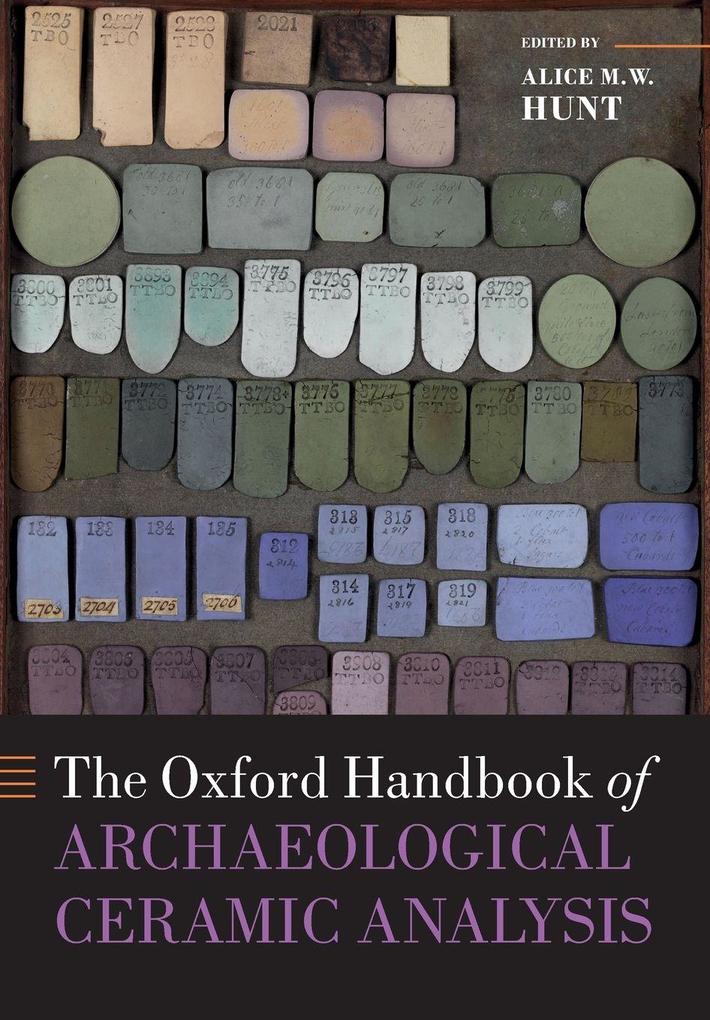
The Oxford Handbook of Archaeological Ceramic Analysis draws together topics and methodologies essential for the socio-cultural, mineralogical, and geochemical analysis of archaeological ceramic. Ceramic is one of the most complex and ubiquitous archaeomaterials in the archaeological record: it occurs around the world and through time in almost every culture and context, from building materials and technological installations to utilitarian wares and votive figurines. For more than 100 years, archaeologists have used ceramic analysis to answer complex questions about economy, subsistence, technological innovation, social organization, and dating. The volume is structured around the themes 'Research design and data analysis', 'Foundational concepts', 'Evaluating ceramic provenance', 'Investigating ceramic manufacture', 'Assessing vessel function', and 'Dating ceramic assemblages'. It provides a common vocabulary and offers practical tools and guidelines for ceramic analysis using techniques and methodologies ranging from network analysis and typology to rehydroxylation dating and inductively coupled plasma mass spectrometry. Each chapter provides the theoretical background and practical guidelines, such as cost and destructiveness of analysis, for each technique, as well as detailed case studies illustrating the application and interpretation of analytical data for answering anthropological questions.
Inhaltsverzeichnis
- Introduction
- 1: Alice M. W. Hunt: Introduction to the Oxford Handbook of Archaeological Ceramic Analysis
- 2: M.S. Tite: History of Scientific Research
- Research Design and Data Analysis
- 3: Jaume Buxeda i Garrigós and Marisol Madrid i Fernández: Designing Rigorous Research: Integrating Science and Archaeology
- 4: Roberto Hazenfratz Marks: Evaluating Data: Uncertainty in Ceramic Analysis
- 5: Gulsebnem Bishop: Statistical Modelling for Ceramic Analysis
- 6: Matthew Boulanger: Data Recycling: Working with Published and Unpublished Ceramic Compositional Data
- Foundational Concepts
- 7: Giuseppe Montana: Ceramic Raw Materials
- 8: Valentine Roux: Ceramic Manufacture: The Chaîne Opératoire Approach
- 9: Kim Duistermaat: The Organization of Pottery Production: Towards a Relational Approach
- 10: Yona Waksman: 'Provenance' Studies: Productions and Compositional Groups
- 11: Gerwulf Schneider: Mineralogical and Chemical Alteration
- 12: Daniel Albero Santacreu, Manuel Calvo Trias, and Jaume García Rosselló: Formal Analysis and Typological Classification in the Study of Ancient Pottery
- 13: Ian Whitbread: Fabric Description of Archaeological Ceramics
- 14: Prabodh Shirvalker: Analytical Drawing
- Evaluating Ceramic Provenance
- 15: Dennis Braekmans and Patrick Degryse: Petrography: Optical Microscopy
- 16: Ian Wilkinson, Patrick Quinn, Mark Williams, Jeremy Taylor, and Ian Whitbread: Ceramic Micropalaeontology
- 17: Corina Ionescu and Volker Höck: Electron Probe Microanalysis (EPMA)
- 18: Bettina Wiegand: Isotope Analysis
- 19: Robert B. Heimann: X-ray Powder Diffraction (XRD)
- 20: Mark Hall: X-ray Fluorescence-Energy Dispersive (ED-XRF) and Wavelength Dispersive (WD-XRF) Spectrometry
- 21: Elisabeth Holmqvist: Handheld Portable Energy-Dispersive X-ray Fluorescence Spectrometry (pXRF)
- 22: Marcia Rizzutto and Manfredo Tabacniks: Proton Induced X-ray Emission (PIXE) and its Applications for Ceramic Analysis
- 23: Mark Golitko and Laure Dussubieux: Inductively Coupled Plasma-Mass Spectrometry (ICP-MS) and Laser Ablation Inductively Coupled Plasma-Mass Spectrometry (LA-ICP-MS)
- 24: Leah D. Minc and Johannes H. Sterba: Instrumental Neutron Activation Analysis (INAA) in the Study of Archaeological Ceramics
- 25: Alan F. Greene: Synchrotron Radiation
- Investigating Ceramic Manufacture
- 26: Kent Fowler: Ethnography
- 27: Malgorzata Daszkiewicz and Lara Maritan: Experimental Firing and Re-firing
- 28: Shlomo Shoval: Fourier Transform Infrared Spectroscopy (FT-IR) in Archaeological Ceramic Analysis
- 29: Jolien Van Pevenage and Peter Vandenabeele: Raman Spectroscopy and the Study of Ceramic Manufacture: Possibilities, Results, and Challenges
- 30: Ina Berg and Janet Ambers: X-radiography of Archaeological Ceramics
- 31: Marta Mariotti Lippi and Pasquino Pallecchi: Organic Inclusions
- Assessing Vessel Function
- 32: Ana L. Martinez-Carillo and Juan Antonio Barcelo: Formal Typology of Iberian Ceramic Vesels by Morphometric Analysis
- 33: Noémi Suzanne Müller: Mechanical and Thermal Properties
- 34: Hans Barnard and Jelmer W. Eerkens: Assessing Vessel Function by Organic Residue Analysis
- Dating Ceramic Assemblages
- 35: Eugenio Bortolini: Typology and Classification
- 36: Sophie Blain and Christopher Hall: Direct Dating Methods