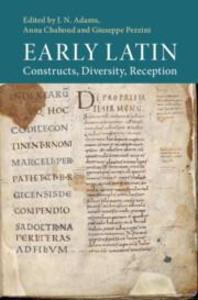
"The most detailed and comprehensive study to date of early Latin language, literary and non-literary, featuring twenty-nine chapters by an international team of scholars. Defines linguistic features of different literary genres, and addresses problems such as the limits of periodisation and the definition of the very concept of 'early Latin'"--
Inhaltsverzeichnis
1. Introduction: What is early Latin? Giuseppe Pezzini and Anna Chahoud; Part I. General (Morphology, Syntax, Lexicon and Metre): 2. Alphabet, epigraphy, and literacy in central Italy in the 7th /5th c. BC Rex Wallace; 3. Identifying Latin in early inscriptions Simona Marchesini; 4. The Egadi Rostra, a linguistic analysis Wolfgang D. C. de Melo; 5. Morphology and syntax in early Latin Wolfgang D. C. de Melo; 6. Early Latin metre Wolfgang D. C. de Melo and Giuseppe Pezzini; 7. Greek Loanwords in early Latin James Clackson; 8. Latin edepol 'by Pollux': background of a Latin aduerbium iuratiuum Brent Vine; 9. Indirect questions in early Latin Peter Barrios-Lech; 10. Ecquis in early Latin: aspects of questions Colette Bodelot; Part II. Authors and Genres: 11. Support verb constructions in Plautus and Terence José Miguel Baños; 12. Early Latin prayers and aspects of coordination James Adams and Veronika Nikitina; 13. 'Early Latin' lexicon in Terence (and Plautus) Giuseppe Pezzini; 14. Early Latin and the fragments of Atellana Comedy Costas Panayotakis; 15. A comparison of the language of comedy and tragedy in early Latin drama Robert Maltby; 16. The language of early Latin epic Sander Goldberg; 17. How 'early Latin' is Lucilius? Anna Chahoud; 18. Repetition in the fragmentary orators: from Cato to C. Gracchus Christa Gray; 19. Greek influences on Cato's Latin Neil O'Sullivan; 20. Some syntactic features of Latin legal texts Olga Spevak; Part III. Reception: 21. Lucretius and early Latin Barnaby Taylor; 22. Cicero and early dramatic Latin Gesine Manuwald; 23. Early Latin texts in Livy John Briscoe; 24. Pliny rewrites Cato Cynthia Damon; 25. Gellius' appreciation and understanding of early Latin Leofranc Holford-Strevens; 26. Views on early Latin in grammatical texts Alessandro Garcea; 27. Nonius Marcellus and the shape of early Latin Jarrett Welsh; 28. Early Latin to Neo-Latin: Festus and Scaliger Anna Chahoud; Conclusions: 29. Early Latin as a Concept James Adams.