








Das eBook.de Hörbuch Abo - jederzeit, überall, für nur 7,95 € monatlich!
Jetzt entdecken
mehr erfahren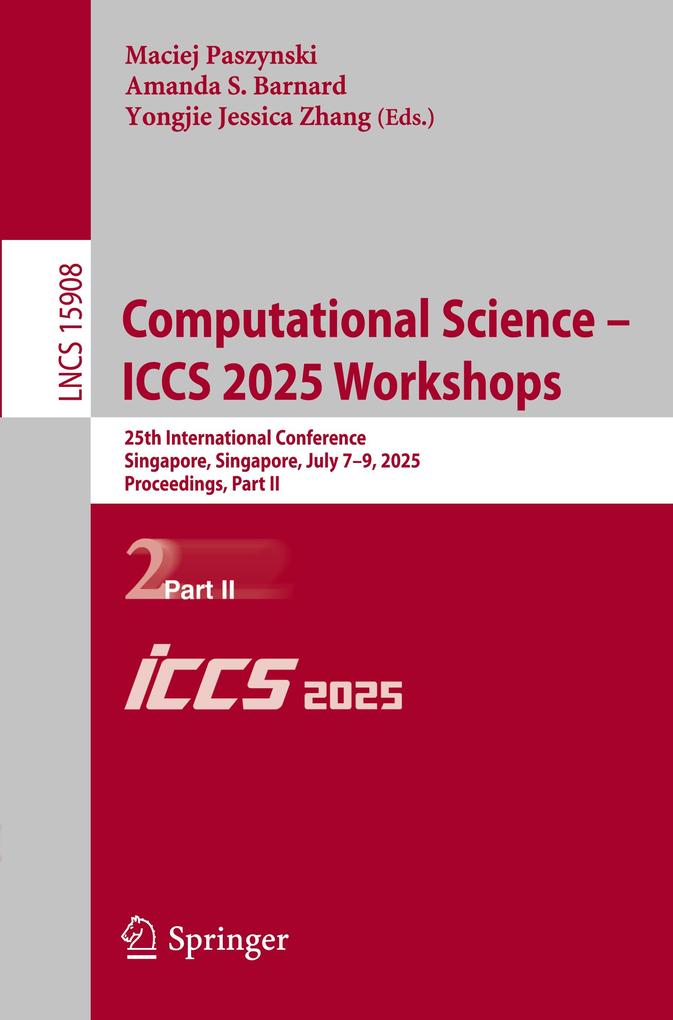
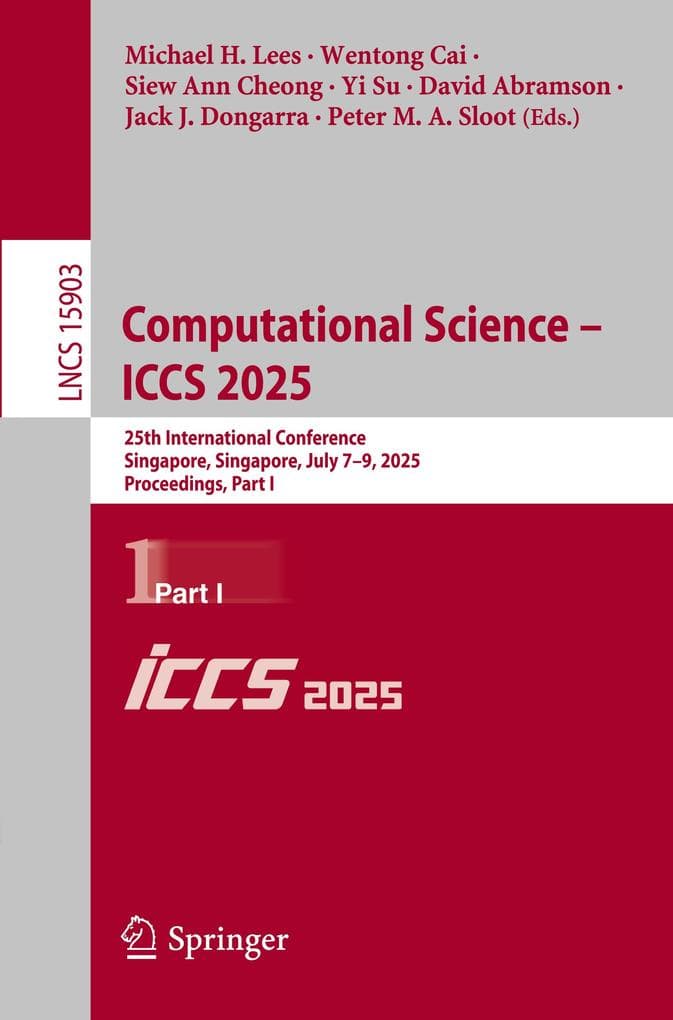
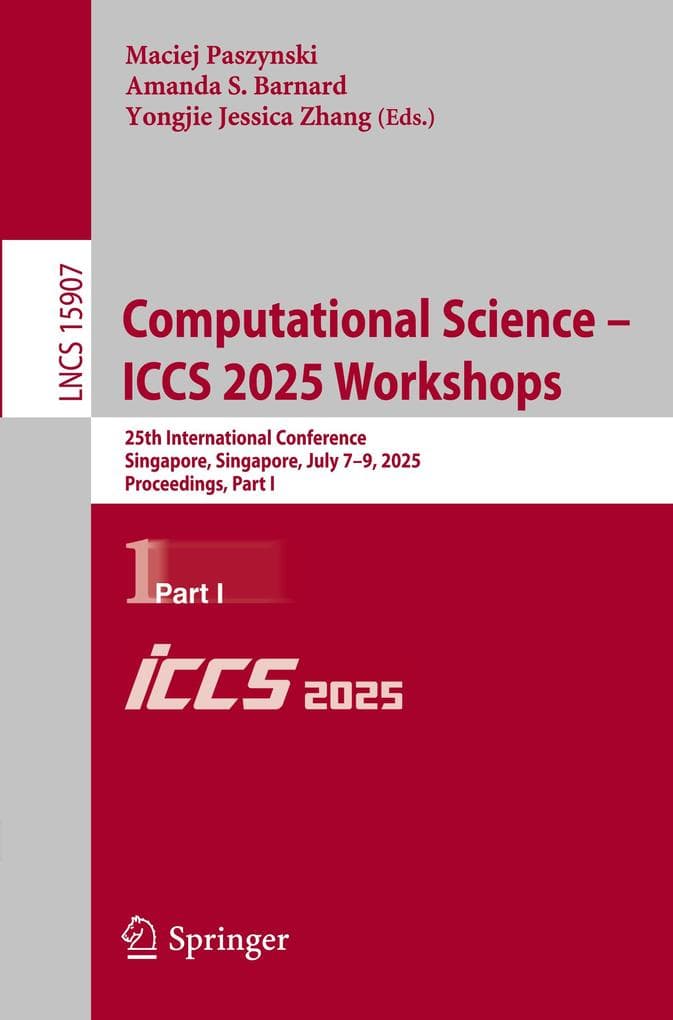
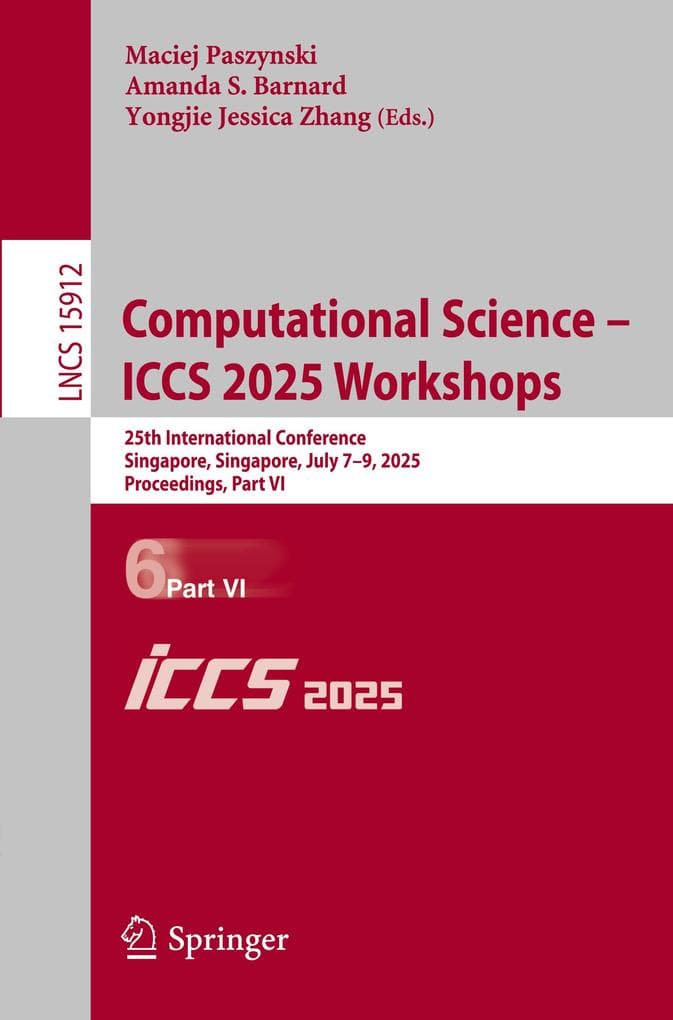
The 6-volume set constitutes the workshop proceedings of the 25th International Conference on Computational Science, ICCS 2025, which took place in Singapore, Singapore, during July 7 9, 2025.
The 137 full papers and 32 short papers presented in these proceedings were carefully reviewed and selected from 322 submissions. The papers are organized in the following topical sections:
Volume I:
Advances in high-performance computational earth sciences: numerical methods, frameworks & applications; artificial intelligence approaches for network analysis; artificial intelligence and high-performance computing for advanced simulations; and biomedical and bioinformatics challenges for computer science.
Volume II:
Computational health; computational modeling and artificial intelligence for social systems; and computational optimization, modelling and simulation.
Volume III:
Computational science and AI for addressing complex and dynamic societal challenges equitably; computer graphics, image processing and artificial intelligence; computing and data science for materials discovery and design; and large language models and intelligent decision-making within the digital economy.
Volume IV:
Machine learning and data assimilation for dynamical systems; and multi-criteria decision-making: methods, applications, and innovations.
Volume V:
(Credible) Multiscale modelling and simulation; numerical algorithms and computer arithmetic for computational science; quantum computing; retrieval-augmented generation; and simulations of flow and transport: modeling, algorithms and computation.
Volume VI:
Smart systems: bringing together computer vision, sensor networks and artificial intelligence; solving problems with uncertainty; and teaching computational science.
Inhaltsverzeichnis
Computational Health. -
Simulation of Blood Flow in the Left Ventricle Considering Purkinje Fibers. - ViT-SE_Res: A Hybrid Vision Transformer and ResNet50V2 with Squeeze-and-Excitation Block for Cervical Cell Classification. - MedCT: A Clinical Terminology Graph for Generative AI Applications in Healthcare. - A Fractional Computation Based Deep Learning Framework for Silicosis Detection. - Combining XAI and Graph Cuts for Skin-lesion Segmentation. - Accelerating Two-Dimensional k-Wave Ultrasound Simulations Through Pruned FFT: A Treatment Planning Optimisation. - A Computational Framework for Modelling Biomechanical Tumour Dynamics and Tissue Interactions: A Proof-of-Concept in Pleural Mesothelioma. - Towards Sensitivity Analysis: 3D Venous Modelling in the Lower Limb. - Cross-Scale Modeling of Healthcare Norms and Patient Features Dynamics with Interpretable Machine Learning. - Automatic Detection and Segmentation of Coronary Artery Stenosis in Coronary Angiography Images. - Explainable Artificial Intelligence for Clinicians Decision Support in Diagnosing Spinal Pathologies. - Predicting Disease Transmission Rates for Hybrid Modeling of Epidemic Outbreaks: Statistical and Machine Learning Approaches. - Lightweight Heterogeneous SEIR Models for Epidemic Surveillance in Russian Cities: Turning Synthetic Populations into Equations. - Is Health Systems Sustainability Measurable? - Operationalizing SDG Targets using SSP-TOPSIS Approach. -
Computational Modeling and Artificial Intelligence for Social Systems. -
Automatic Detection and Identification of Causal Relationships in Polish Legal Texts. - A Parameter-free Model for the Online Spread of Far-right Messages: Combining Agent-Based Models with Large-Language Models. - Accelerated Approximation of Bellman Equation Solutions: Agent Policy Optimization with a Feedforward Neural Network. - Simulation-based Inference in Agent-based Models using Spatio-temporal Summary Statistics. - Emergent Communication in Merging Artificial Agent Populations. - MAVS: An Ensemble-Based Multi-Agent Framework for Fake News Detection. - Evolutionary Game Selection Leads to Emergent Inequality. -
Computational Optimization, Modelling and Simulation. -
Enhancing Gaussian Mixture Model Fitting via Equiprobable Binning and Adaptive Differential Evolution. - Asymptotics in Curve Estimation by Modified Cubic Spline and Exponential Parameterization. - Physics Informed Neural Networks for Non Stationary Material Science Problems. - Adaptive Global Modeling using Neural Networks with Deep Ensembles and Space-filling Sequences. - Automated Antenna Design Using Computational Intelligence and Numerical Optimization. - Near-Optimal Mixed Partial Replications versus Uniform Replication. - Hybrid Subgradient and Simulated Annealing Method for Hemivariational Inequalities. - Reduced-Order Modeling of Compressible Flows Using Supervised Dimensionality Reduction. - Exact and Approximate Methods for Solving the Edge-strength Problem.
Es wurden noch keine Bewertungen abgegeben. Schreiben Sie die erste Bewertung zu "Computational Science - ICCS 2025 Workshops" und helfen Sie damit anderen bei der Kaufentscheidung.