








Das eBook.de Hörbuch Abo - jederzeit, überall, für nur 7,95 € monatlich!
Jetzt entdecken
mehr erfahren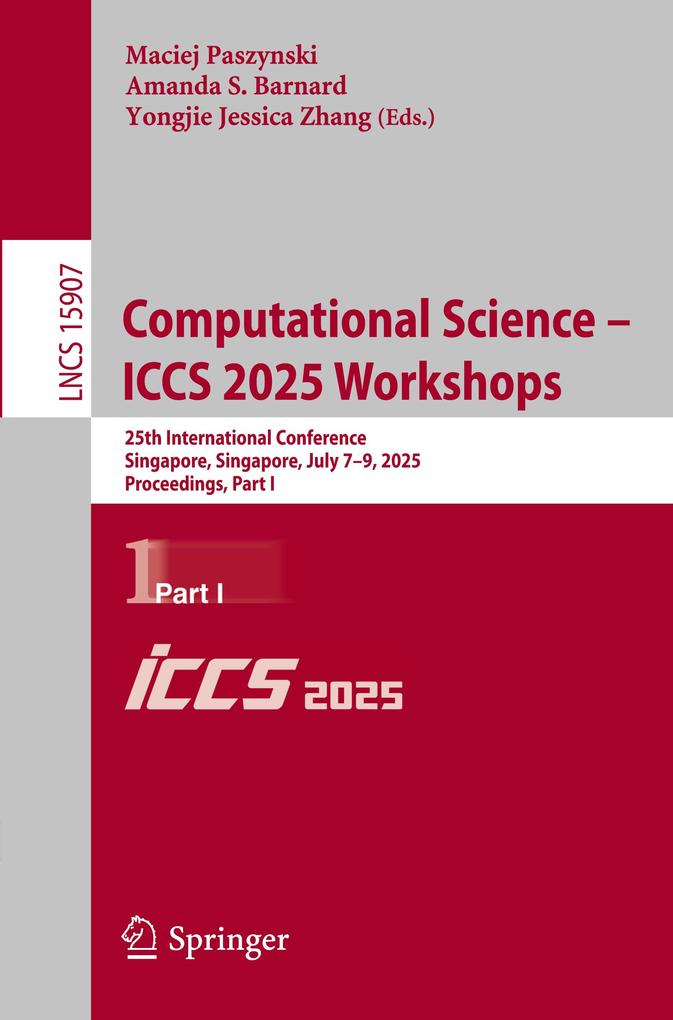
The 6-volume set constitutes the workshop proceedings of the 25th International Conference on Computational Science, ICCS 2025, which took place in Singapore, Singapore, during July 7 9, 2025.
The 137 full papers and 32 short papers presented in these proceedings were carefully reviewed and selected from 322 submissions. The papers are organized in the following topical sections:
Volume I:
Advances in high-performance computational earth sciences: numerical methods, frameworks & applications; artificial intelligence approaches for network analysis; artificial intelligence and high-performance computing for advanced simulations; and biomedical and bioinformatics challenges for computer science.
Volume II:
Computational health; computational modeling and artificial intelligence for social systems; and computational optimization, modelling and simulation.
Volume III:
Computational science and AI for addressing complex and dynamic societal challenges equitably; computer graphics, image processing and artificial intelligence; computing and data science for materials discovery and design; and large language models and intelligent decision-making within the digital economy.
Volume IV:
Machine learning and data assimilation for dynamical systems; and multi-criteria decision-making: methods, applications, and innovations.
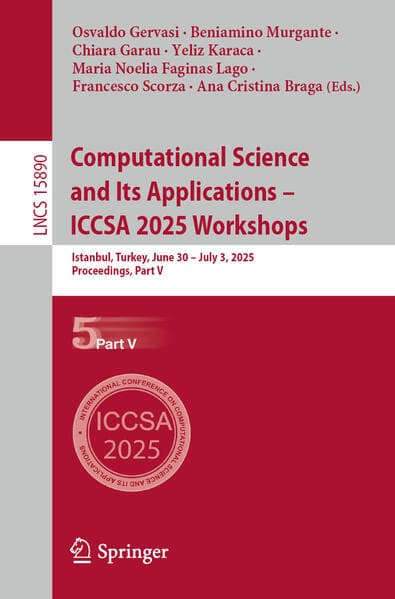
Volume V:
(Credible) Multiscale modelling and simulation; numerical algorithms and computer arithmetic for computational science; quantum computing; retrieval-augmented generation; and simulations of flow and transport: modeling, algorithms and computation.
Volume VI:
Smart systems: bringing together computer vision, sensor networks and artificial intelligence; solving problems with uncertainty; and teaching computational science.
Inhaltsverzeichnis
Advances in High-Performance Computational Earth Sciences: Numerical Methods, Frameworks & Applications. -
Large-scale Nonlinear Viscoelastic Simulation for Crustal Deformation Accelerated by Data-driven Method and Multi-grid Solver. -
Artificial Intelligence Approaches for Network Analysis. -
Informing the Neural Network Activation Function with Graph Centrality Measures: The Case Study of Oscillating Chemical Reaction Simulation. - A Novel Routing Algorithm for Optical Networks Based on ML Methods. - Decision Trees and Machine Learning for Cybersecurity: How Model Settings Affect Attack Detection. - Covering the Online Spectrum of Opinion in Social Context: The Benefit of Network Node Sampling Through an Italian Case Study. - A Multilayer and Temporal Network for Studying the Connections of Cross-listed Stocks. - A Machine Learning-based Framework for Predicting Candidate Drug Side Effects from Biological Networks. -
Artificial Intelligence and High-Performance Computing for Advanced Simulations. -
Introducing B-spline Basis Functions in Neural Network Approximations. - Augmenting Petrov-Galerkin Method with Optimal Test Functions by DNN Learning the Inverse of the Gram Matrix. - EXPBrain: Exponential Integrators for Glioblastoma Brain Tumor Simulations. - Influence of Mixed Precision on Performance and Accuracy of DNN Training for AI-Accelerated CFD Simulations on NVIDIA Multi-GPU System. - Performance-energy Investigation of Selected Applications using a Parallel Multi-GPU Genetic Algorithm under Power Capping. - Discrete Residual Loss Functions for Training Physics-Informed Neural Networks. - Uncertainty-Aware Well Placement: Simulator-Verified Dual-Network Reinforcement Learning Approach meets Particle Filters. - Sequential, Parallel and Consecutive Hybrid Evolutionary-swarm Optimization Metaheuristics. - Graph Grammar Model for h-adaptation for Meshes with Quadrilateral, Pentagon, and Hexagon Elements. - MinRNNs for Lagrangian-Based Simulations of Transient Flow Problems. - Socio-cognitive Agent-oriented Evolutionary Algorithm with Trust-based Optimization. - Structural Limiting Range of Perception in PSO. - Towards Novel Migration Topologies for Parallel Evolutionary Algorithms. -
Biomedical and Bioinformatics Challenges for Computer Science. -
From the Synaptome to the Connectome: Data Bigness Estimation for the Human Connectome at the Nanoscale. - Enzyme Stability Prediction: Advancing with Ensemble Machine Learning and Explainable Artificial Intelligence. - MTL-FECAM: Bridging the stability-plasticity tradeoff in Exemplar-free Continual Learning. - Development of a pH-Responsive Bio-robotics for Targeted Drug Delivery to Lung Cancer in the Vascular System. - Accelerating Super-Resolution Magnetic Resonance Imaging Using Toeplitz k-Space Matrices and Deep Learning Reconstruction. - Logistic Regression with Covariate Clustering in Genome-wide Association Interaction Studies. - Predicting Antibody Responses to Type V GBS-TT Conjugate Vaccine Using Computational Modelling. - A Computational Immune Approach for Modeling Different Levels of Severity in COVID-19 Infections. - Implementation of Convolutional Neural Networks for the Purpose of Five Types of White Blood Cells Automatic Counting. - BioSkel - Towards a Framework for OMICS Applications. - Uncertainty Quantification of Thermal Damage in Hyperthermia as a Cancer Therapy. - Bias in Dermatological Datasets: A Critical Analysis of the Underrepresentation of Dark Skin Tones in Melanoma Classification Images.
Es wurden noch keine Bewertungen abgegeben. Schreiben Sie die erste Bewertung zu "Computational Science - ICCS 2025 Workshops" und helfen Sie damit anderen bei der Kaufentscheidung.