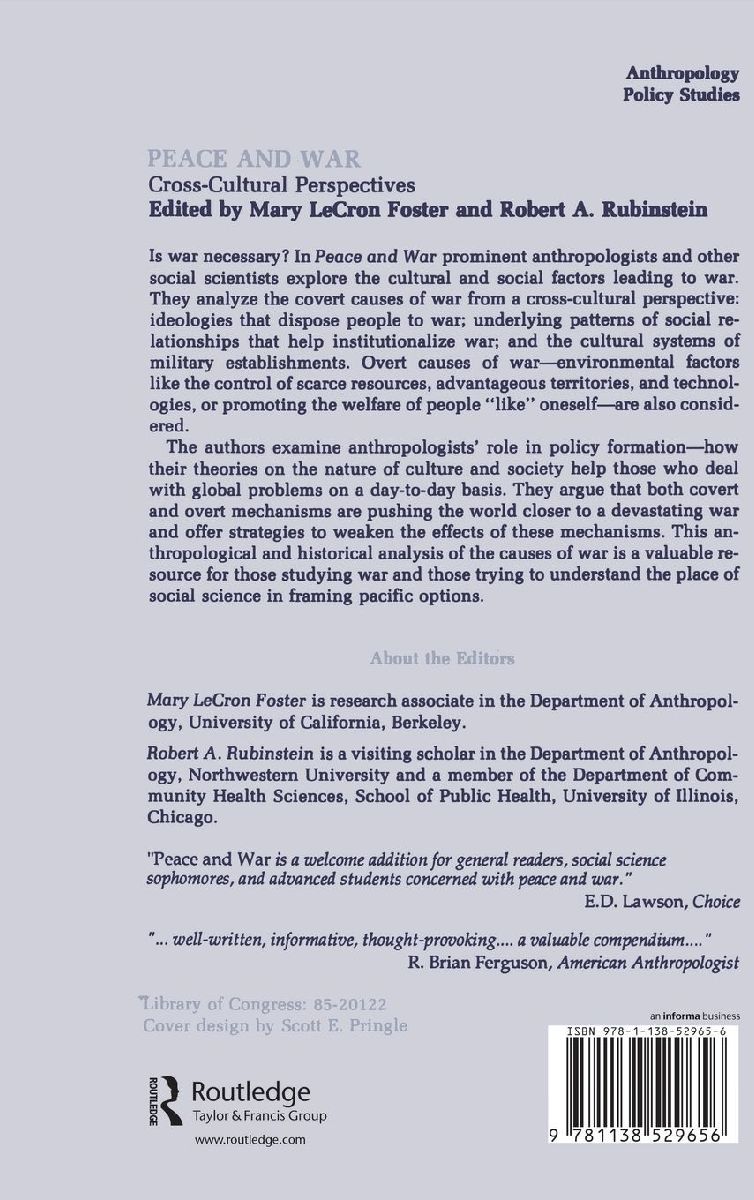
Is war necessary? In Peace and War prominent anthropologists and other social scientists explore the cultural and social factors leading to war. They analyze the covert causes of war from a cross-cultural perspective: ideologies that dispose people to war; underlying patterns of social relationships that help institutionalize war; and the cultural systems of military establishments. Overt causes of war environmental factors like the control of scarce resources, advantageous territories, and technologies, or promoting the wel-fare of people "like" oneself are also considered.
The authors examine anthropologists' role in policy formation how their theories on the nature of culture and society help those who deal with global problems on a day-to-day basis. They argue that both covert and overt mechanisms are pushing the world closer to a devastating war and offer strategies to weaken the effects of these mechanisms. This anthropological and historical analysis of the causes of war is a valuable resource for those studying war and those trying to understand the place of social science in framing pacific options.
Inhaltsverzeichnis
Acknowledgments < BR> Preface < BR> Introduction < BR> Part I The Individual, Community, and Conflict < BR> 1. Personal Motivation and Institutionalized Conflict < BR> 2. The Uses of Fear: Porro Gangs in Mexico < BR> 3. Toward a Structural Model of Violence: < BR> Male Initiation Rituals and Tribal Warfare < BR> 4. Fighting for Peace < BR> 5. The Culture of United States Military Enclaves < BR> 6. Is War Necessary? < BR> 7. The Cultural Patterning of Risk-Seeking Behavior: < BR> Implications for Armed Conflict < BR> Part II The Dynamics of Conflict < BR> 8. Land Disputes and the Gods in the Prehispanic Mixteca < BR> 9. Directed Change and the Hope for Peace < BR> 10. Ethnic Targeting as a Defense Strategy < BR> 11. Conflict in the Horn of Africa < BR> 12. Christianity and War < BR> Part III Social Scientists React < BR> 13. Sociopsychological Aspects of the Prevention of Nuclear War < BR> 14. The Drift to War < BR> 15. The War-Making Institutions < BR> 16. The Nature of War and the American Military Profession < BR> 17. War and Peace: The View of a Soviet Scholar < BR> Part IV Conflict and the Nation-State < BR> 18. Ideology and Institutions in Peace and War < BR> 19. War and War Proneness in Pre- and Postindustrial States < BR> 20. The Developmental Dynamics of Peace < BR> 21. The Anthropology of Global Integration: < BR> Some Grounds for Optimism about World Peace < BR> 22. The Superpowers and the Tribes < BR> Part V Anthropology and Policy < BR> 23. Anthropology for the Second Stage of the Nuclear Age 24. Anthropology as a Nonpolicy Science < BR> 25. Global Policy and Revolution in Social Sciences < BR> 26. Conflict and Belief in American Foreign Policy < BR> 27. The Collapse of Strategy: Understanding < BR> Ideological Bias in Policy Decisions < BR> Conclusion: Toward an Anthropology of Peace and War < BR> About the Contributors