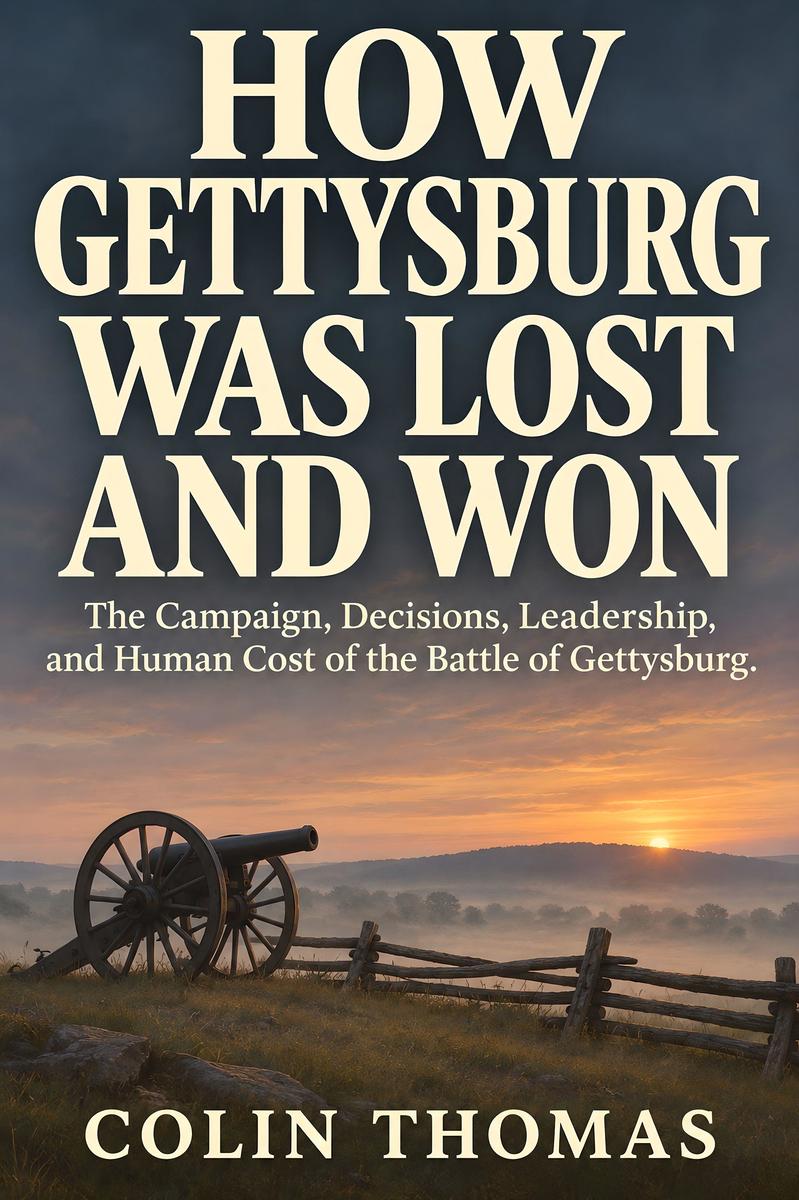
In the summer of 1863, Robert E. Lee carried the Civil War north for the second time, and George Meade, in command of the Union army for only three days, had to stop him. The armies met by accident at a Pennsylvania crossroads town, and over three days they fought the largest battle ever waged in North America. This book explains how that battle was lost and won: not in one heroic moment, but through a chain of decisions, delays, terrain, and command failures that readers can follow step by step.
The account begins before the armies met, with the strategic trap Lee faced after Chancellorsville, the death of Stonewall Jackson, Confederate supply shortages, and the political case for invading the North while Vicksburg starved in the West. It then compares the two armies as organizations: their corps structures, cavalry, artillery, intelligence, and the ridges, roads, and fishhook position that would shape everything that followed.
Inside, you will learn:
Why Lee invaded Pennsylvania, and what he realistically hoped to gain
How Stuart's ride and missing intelligence left Lee fighting nearly blind
Why Buford and Reynolds chose to fight west of town on July 1
What Ewell's 'if practicable' order meant, and why Cemetery Hill was not taken
How Sickles's advance, the Peach Orchard, and Little Round Top decided July 2
Why Lee attacked the Union center on July 3, and how Pickett's Charge failed
What the battle cost soldiers and civilians, in the standard casualty figures
Each day's fighting is reconstructed from the ground up, with the terrain described in words so the reader always knows where units stood and why a ridge or a road mattered. Legends are separated from evidence throughout: the shoe story, the 20th Maine, Armistead at the Angle, and the long argument over Longstreet, Ewell, and Stuart are each weighed against what the record actually shows.
The human cost gets its own full treatment: 23, 049 Union and 28, 063 Confederate casualties in the figures used here, the hospitals and burials, and the civilians caught inside the battle, including Jennie Wade, Elizabeth Thorn, John Burns, and Tillie Pierce. The retreat to the flooded Potomac, Lincoln's frustration with Meade, and the surrender of Vicksburg on July 4 complete the campaign's story.
It closes with what Gettysburg did and did not decide: the end of Lee's last great invasion, the Soldiers' National Cemetery, the Gettysburg Address, and the memory wars that followed. Readers finish with a clear, evidence-based answer to the book's question, and a glossary of the terms the battle made famous.
Es wurden noch keine Bewertungen abgegeben. Schreiben Sie die erste Bewertung zu "How Gettysburg Was Lost and Won" und helfen Sie damit anderen bei der Kaufentscheidung.











