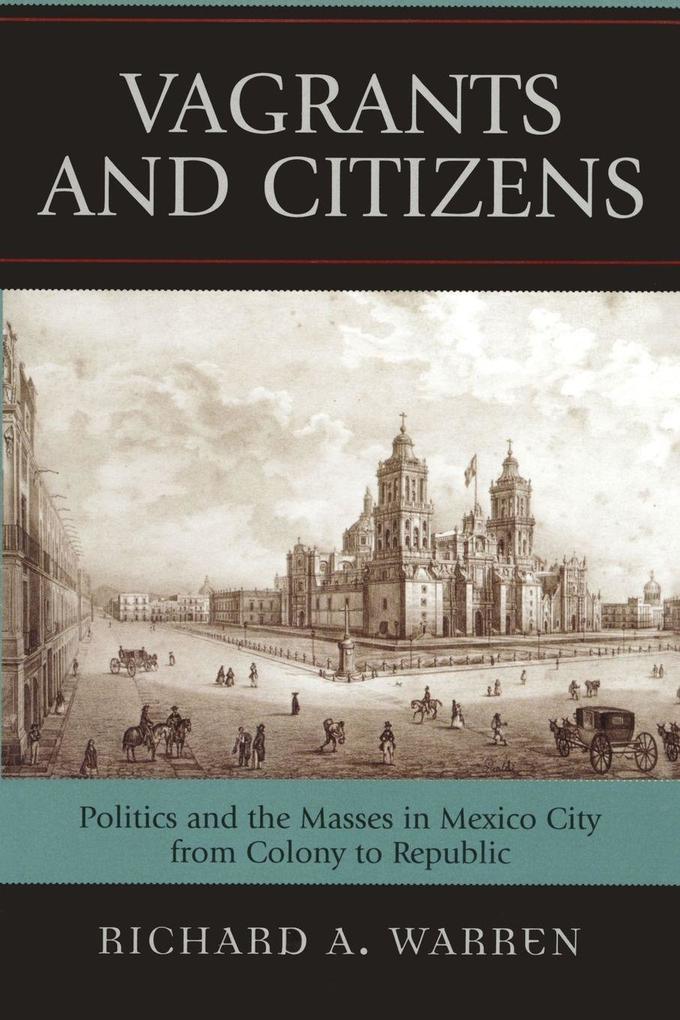
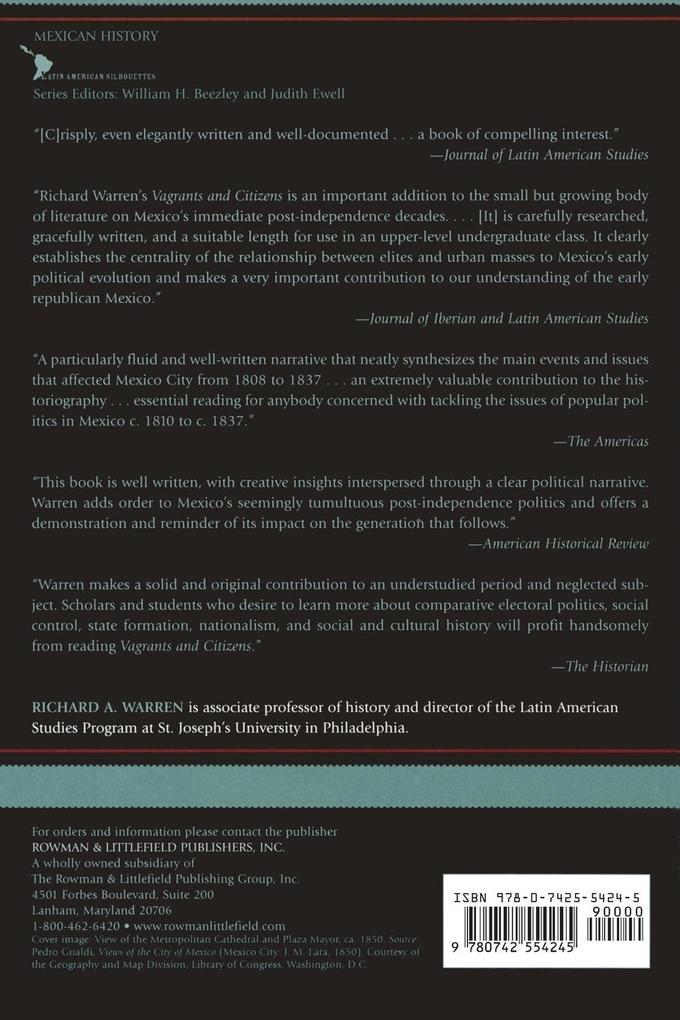
An innovative perspective on the politics of Mexican independence. Focusing on how Mexico City as the seat of the Spanish viceroyalty became Mexico's national capital, Professor Warren details how elites debating an imagined nation engaged, mobilized, yet feared city folk eager to claim the rights they imagined came with proclamations of popular sovereignty. Vagrants and Citizens confirms that the contests of nation building in Mexico were never reserved to elites. It opens questions about the social composition, cultural visions, and political participation of the urban populace that will enlighten and engage a generation of students and scholars. -- John Tutino, Georgetown University Warren makes a solid and original contribution to an understudied period and neglected subject. Scholars and students who desire to learn more about comparative electoral politics, social control, state formation, nationalism, and social and cultural history will profit handsomely from reading Vagrants and Citizens. The Historian This clear, carefully researched monograph shows how the elites and lower classes shaped the early Mexican nation through electoral politics. Highly recommended for advanced undergraduates and above. CHOICE This book is well written, with creative insights interspersed through a clear political narrative. Warren adds order to Mexico's seemingly tumultuous post-independence politics and offers a demonstration and reminder of its impact on the generation that follows. American Historical Review A particularly fluid and well-written narrative that neatly synthesizes the main events and issues that affected Mexico City from 1808 to 1837...an extremely valuable contribution to the historiography...essential reading for anybody concerned with tackling the issues of popular politics in Mexico c. 1810 to c. 1837. The Americas: A Quarterly Review Of Inter-American Cultural A sophisticated, thoroughly up-to-date consideration of the interplay between elites and masses in the early years of independent Mexico. In a subtle approach, Richard A. Warren concentrates primarily on elections and patriotic rituals, examples of elite efforts to obtain the legitimacy provided by public sanction while also directing and limiting mass political participation. In a turbulent setting, with wider suffrage and voter turnout than almost anywhere else in the western world, Mexican elites discovered that universal male suffrage did not automatically prevent a legitimacy crisis, while the common man found there was more to democracy than voting. Professor Warren argues that the franchise alone is no gauge of a political system's responsiveness or health. This is a significant book for the specialist, yet quite accessible for classroom use. -- Timothy E. Anna, University of Manitoba Warren makes a solid and original contribution to an understudied period and neglected subject. Scholars and students who desire to learn more about comparative electoral politics, social control, state formation, nationalism, and social and cultural history will profit handsomely from reading Vagrants and Citizens. The Historian Richard Warren's Vagrants and Citizens is an important addition to the small but growing body of literature on Mexico's immediate post-independence decades...[It] iscarefully researched, gracefully written, and a suitable length for use in an upper-level undergraduate class. It clearly establishes the centrality of the relationship between elites and urban masses to Mexico's early political evolution and makes a very important contribution to our understanding of the early republican Mexico. Journal Of Iberian and Latin American Studies [C]risply, even elegantly written and well-documented... [A] book of compelling interest. Journal Of Latin American Studies