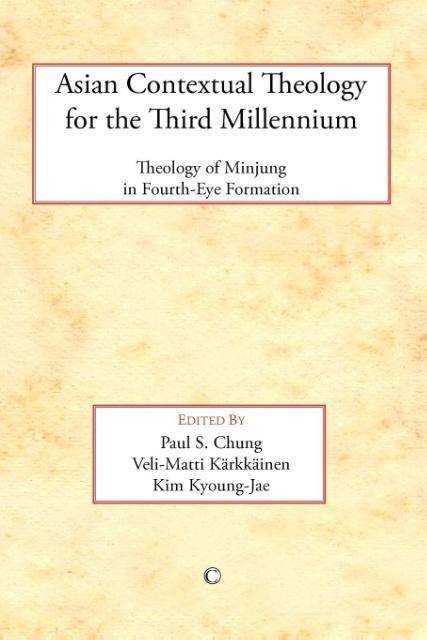
This volume highlights the genesis, progress, and transformation of Asian contextual theology of minjung, introducing its historical point of departure, its development, and its transformation in the light of younger Korean and Korean-American scholars' endeavours. The new Asian contextual theology that is emerging strives to integrate both minjung and the wisdom of World Religions into its own framework and direction, assuming the character of a public theology and remaining humble and open before God's mystery while featuring its association with minjung in a holistic way.
"Beginning in 1973 with the publication of The Theological Declaration of Korean Christians, Minjung theology grasped the attention of the world. Its authors paid a high price for their commitment to the Korean people and especially to the exploited poor.... Minjung theology employed sophisticated scholarly methods learned from Western Christians. But it was a fully contextualized form of theology able to enter into discussion with theologians from other countries as an important expression of global Christian thought.... The heart of the book is made up of the contributions of Korean scholars. However, to add to its international character the editors have included essays by North American and European theologians. Many of us are happy in this way to make any contribution we can to revitalizing discussion between progressive Korean theologians and the West." - John B. Cobb Jr. from the Foreword
"Minjung theology is the first liberation theology to come from Asia, with critical questions put to the First World, and questions too challenging the modernization of South Korea according to Western standards.... Minjung theology is not a theology that has been made culturally indigenous, like 'yellow theology' before it. It is a contextual theology of the suffering people in Korea, and is therefore open for people all over the world, the people of God's kingdom whom Jesus called blessed. Minjung theology is also the first political theology to exist in Korea, inasmuch as it is bound up with the struggle for human and civil rights, and turns Christians from being a 'people of the church' into 'the congregation of the people'." - Jürgen Moltmann,
Professor Emeritus, Tübingen University
Paul S. Chung is Assistant Professor of Lutheran Witness and World Christianity at Wartburg Theological Seminary, Dubuque, Iowa. His other books include 'Karl Barth' and 'Martin Luther and Buddhism'.
Veli-Matti Kärkkäinen is Professor of Systematic Theology at Fuller Theological Smeinary, and also holds a teaching position at the University of Helsinki as Dozent of Ecumenics.
Kim Kyoung-Jae is Professor of Theology at Hanshin University.