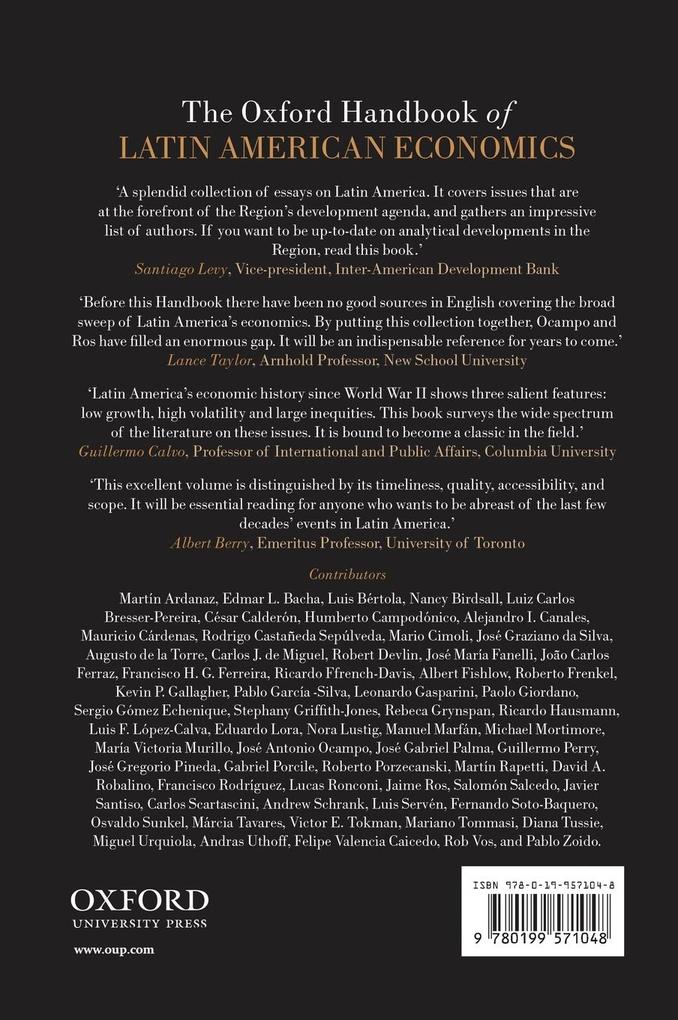
Latin America has been central to the main debates on development economics, ranging from the relationships between income inequality and economic growth, and the importance of geography versus institutions in development, to debates on the effects of trade, trade openness and protection on growth and income distribution. Despite increasing interest in the region there are few English language books on Latin American economics. This Handbook, organized into five
parts, aims to fill this significant gap.
Part I looks at long-term issues, including the institutional roots of Latin America's underdevelopment, the political economy of policy making, the rise, decline and re-emergence of alternative paradigms, and the environmental sustainability of the development pattern. Part II considers macroeconomic topics, including the management of capital account booms and busts, the evolution and performance of exchange rate regimes, the advances and challenges of monetary policies and financial
development, and the major fiscal policy issues confronting the region, including a comparison of Latin American fiscal accounts with those of the OECD. Part III analyzes the region's economies in global context, particularly the role of Latin America in the world trade system and the effects of dependence
on natural resources (characteristic of many countries of the region) on growth and human development. It reviews the trends of foreign direct investment, the opportunities and challenges raised by the emergence of China as buyer of the region's commodities and competitor in the world market, and the transformation of the Latin America from a region of immigration to one of massive emigration. Part IV deals with matters of productive development. At the aggregate level it analyzes issues of
technological catching up and divergence as well as different perspectives on the poor productivity and growth performance of the region during recent decades. At the sectoral level, it looks at agricultural policies and performance, the problems and prospects of the energy sector, and the effects on
growth of lagging infrastructure development. Part V looks at the social dimensions of development; it analyzes the evolution of income inequality, poverty, and economic insecurity in the region, the evolution of labor markets and the performance of the educational sector, as well as the evolution of social assistance programs and social security reforms in the region.
The contributors are leading researchers that belong to different schools of economic thought and most come from countries throughout Latin America, representing a range of views and recognising the diversity of the region. This Handbook is a significant contribution to the field, and will be of interest to academics, graduate students and policy makers interested in economics, political economy, and public policy in Latin America and other developing economies.
Inhaltsverzeichnis
- Part I: Development Paradigms and Long-term Growth Performance
- 1: . José Antonio Ocampo and Jaime Ros: Shifting Paradigms in Latin America's Economic Development
- 2: Luis Bértola: Institutions and the Historical Roots of Latin American Divergence
- 3: Mariano Tommasi, Martín Ardanaz, and Carlos Scartascini: Political Institutions, Policymaking, and Economic Policy in Latin America
- 4: Nancy Birdsall, Augusto de la Torre, and Felipe Valencia Caicedo: The Washington Consensus: Assessing A 'Damaged Brand'
- 5: Luiz Carlos Bresser-Pereira: From Old to New Developmentalism in Latin America
- 6: Carlos de Miguel and Osvaldo Sunkel: Environmental Sustainability
- Part II. Macroeconomics and Finance
- 7: Ricardo Ffrench-Davis and Stephany Griffith-Jones: Taming Capital Account Shocks: Managing Booms and Busts
- 8: Roberto Frenkel and Martin Rapetti: Exchange Rate Regimes in Latin America
- 9: Pablo Garcia and Manuel Marfán: Monetary Policy in Latin America: Performance under Crisis and the Challenges of Exuberance
- 10: José María Fanelli: Domestic Financial Development in Latin America
- 11: Guillermo Perry and Mauricio Cárdenas: Fiscal Policy in Latin America
- 12: Javier Santiso and Pablo Zoido: Fiscal Legitimacy, Inequalities and Democratic Consolidation in Latin America
- Part III: Integration into the World Economy
- 13: Diana Tussie: Latin America in the World Trade System
- 14: Paolo Giordano and Robert Devlin: Regional Integration
- 15: Eduardo Lora: The Effects of Trade Liberalization on Growth, Employment and Wages
- 16: Edmar Bacha and Albert Fishlow: Recent Commodity Price Boom and Latin American Growth: More than New Bottles for an Old Wine?
- 17: Francisco Rodriguez and José Gregorio Pineda: Curse or Blessing? Natural Resources and Human Development
- 18: Joao Carlos Ferraz, Michael Mortimore and Marcia Tavares: Foreign Direct Investment in Latin America.
- 19: Kevin Gallagher and Roberto Porzecanski: China and the Future of Latin American Economic Development
- 20: Alejandro Canales: Latin America in the Recent Wave of International Migration
- Part IV: Productive Sector Development
- 21: Ricardo Hausmann: Structural Transformation and Economic Growth in Latin America
- 22: Mario Cimoli and Gabriel Porcile: Learning, Technological Capabilities and Structural Dynamics
- 23: José Gabriel Palma: Why Has Productivity Growth Stagnated In Most Latin American Countries Since The Neo-Liberal Reforms?
- 24: Salomón Salcedo, Fernando Soto-Baquero, Jose Graziano da Silva, Rodrigo Castañeda, and Sergio Gómez: Agricultural and Rural Development
- 25: Humberto Campodónico: An Energy Panorama of Latin America
- 26: César Calderón and Luis Servén: Infrastructure in Latin America
- Part V: Social Development
- 27: Leonardo Gasparini and Nora Lustig: The Rise and Fall of Income Inequality in Latin America
- 28: Rebeca Grynspan and Luis Felipe Lopez Calva: Multidimensional Poverty in Latin America: Concept, Measurement and Policy
- 29: Robert Vos: Economic Insecurity and Development in Latin America and the Caribbean
- 30: Victor Tokman: Employment: The Dominance of the Informal Economy
- 31: Maria Victoria Murillo, Lucas Ronconi, and Andrew Schrank: Latin American Labor Reforms: Evaluating Risk and Security
- 32: Miguel Urquiola: Education
- 33: Francisco Ferreira and David Robalino: Social Assistance in Latin America: Achievements and Limitations
- 34: Andras Uthoff: Social Security Reforms in Latin America