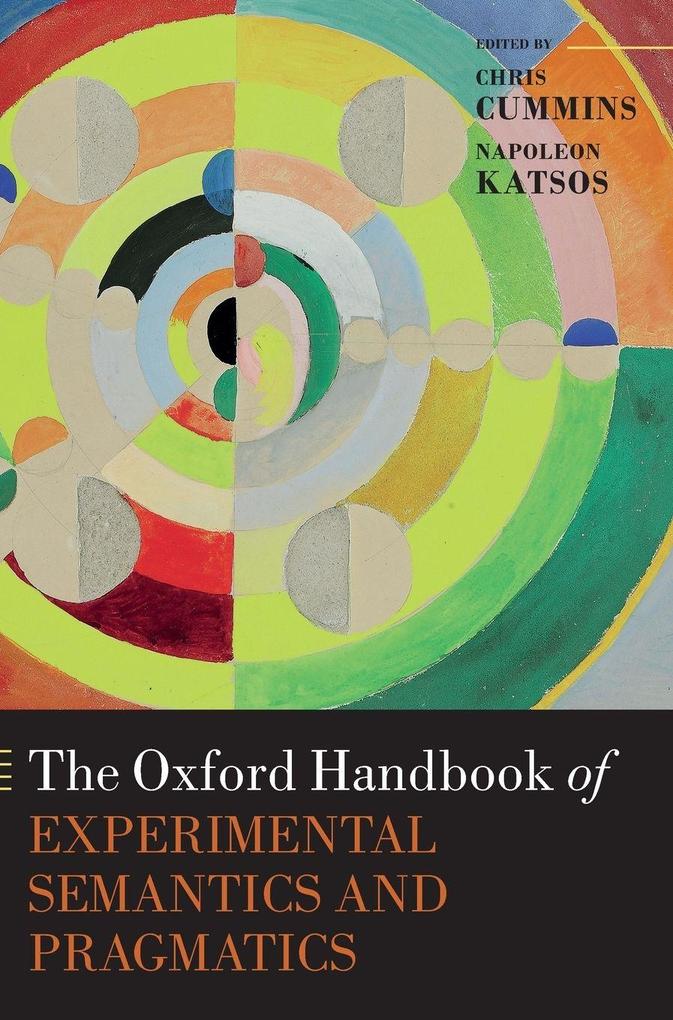
This handbook is the first to explore the growing field of experimental semantics and pragmatics. Following an introduction from the editors, the chapters in this volume offer an up-to-date account of research in the field spanning 31 different topics, as well as identifying questions and methods for future research.
This handbook is the first to explore the growing field of experimental semantics and pragmatics. In the past 20 years, experimental data has become a major source of evidence for building theories of language meaning and use, encompassing a wide range of topics and methods. Following an introduction from the editors, the chapters in this volume offer an up-to-date account of research in the field spanning 31 different topics, including scalar implicatures, presuppositions, counterfactuals, quantification, metaphor, prosody, and politeness, as well as exploring how and why a particular experimental method is suitable for addressing a given theoretical debate. The volume's forward-looking approach also seeks to actively identify questions and methods that could be fruitfully combined in future experimental research. Written in a clear and accessible style, this handbook will appeal to students and scholars from advanced undergraduate level upwards in a range of fields, including semantics and pragmatics, philosophy of language, psycholinguistics, computational linguistics, cognitive science, and neuroscience.
Inhaltsverzeichnis
- 1: Chris Cummins and Napoleon Katsos: Introduction
- 2: Dimitrios Skordos and David Barner: Language comprehension, inference, and alternatives
- 3: Judith Degen and Michael K. Tanenhaus: Constraint-based pragmatic processing
- 4: Richard Breheny: Scalar implicatures
- 5: Sherry Yong Chen and E. Matthew Husband: Event (de)composition
- 6: Florian Schwarz: Presuppositions, projection, and accommodation
- 7: Myrto Grigoroglou and Anna Papafragou: Spatial terms
- 8: Heather Ferguson: Counterfactuals
- 9: Kristen Syrett: Distributivity
- 10: Dimitra Lazaridou-Chatzigoga: Genericity
- 11: Rick Nouwen, Stavroula Alexandropoulou, and Yaron McNabb: Modified numerals
- 12: Ye Tian and Richard Breheny: Negation
- 13: Lyn Tieu and Jacopo Romoli: Plurality
- 14: Adrian Brasoveanu and Jakub Dotläil: Quantification
- 15: Patricia J. Brooks and Olga Parshina: Quantifier spreading
- 16: Stephanie Solt: Adjective meaning and scales
- 17: Nicola Spotorno and Ira Noveck: Ironic utterances
- 18: Nausicaa Pouscoulous and Giulio Dulcinati: Metaphor
- 19: Petra B. Schumacher: Metonymy
- 20: Sam Alxatib and Uli Sauerland: Vagueness
- 21: Marie Juanchich, Miroslav Sirota, and Jean-François Bonnefon: Verbal uncertainty
- 22: Hugh Rabagliati and Mahesh Srinivasan: Word senses
- 23: Kristen Syrett: Antecedent-contained deletion
- 24: Edgar Onea: Exhaustivity in it-clefts
- 25: Christina S. Kim: Focus
- 26: Ming Xiang: Negative Polarity Items
- 27: Hannah Rohde: Pronouns
- 28: Catherine Davies and Jennifer E. Arnold: Reference and informativeness
- 29: Judith Tonhauser: Prosody and meaning
- 30: Thomas Holtgraves: Politeness
- 31: Paula Rubio Fernández: Theory of Mind
- 32: J. P. de Ruiter: Turn-taking
















![The [Oxford] Handbook of the History of Education](/_next/image?url=https%3A%2F%2Fmedia2.ebook.de%2Fshop%2Fcoverscans%2F373%2F37304882_9780199340033_xl.jpg&w=3840&q=75)