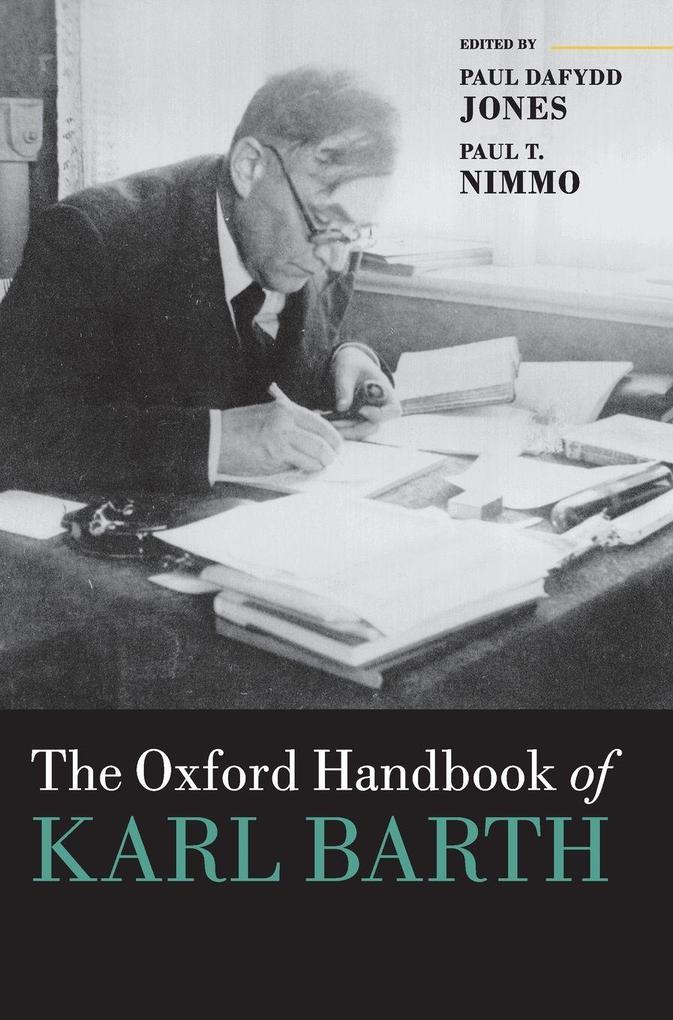
Karl Barth (1886-1968) is generally acknowledged to be the most important European Protestant theologian of the twentieth century, a figure whose importance for Christian thought compares with that of Augustine, Thomas Aquinas, John Calvin, Martin Luther, and Friedrich Schleiermacher. Author of the Epistle to the Romans, the multi-volume Church Dogmatics, and a wide range of other works - theological, exegetical, historical, political, pastoral, and homiletic - Barth has had significant and perduring influence on the contemporary study of theology and on the life of contemporary churches. In the last few decades, his work has been at the centre of some of the most important interpretative, critical, and constructive developments in in the fields of Christian theology, philosophy of religion, and religious studies. The Oxford Handbook of Karl Barth is the most expansive guide to Barth's work published to date. Comprising over forty original chapters, each of which is written by an expert in the field, the Handbook provides rich analysis of Barth's life and context, advances penetrating interpretations of the key elements of his thought, and opens and charts new paths for critical and constructive reflection. In the process, it seeks to illuminate the complex and challenging world of Barth's theology, to engage with it from multiple perspectives, and to communicate something of the joyful nature of theology as Barth conceived it. It will serve as an indispensable resource for undergraduates, postgraduates, academics, and general readers for years to come.
Inhaltsverzeichnis
- List of Abbreviations
- Introduction
- Part 1: Contextualizing Barth
- Biographical
- 1: Frank Jehle: Intellectual and Personal Biography I: The Young Barth (1886 1921)
- 2: Eberhard Busch: Intellectual and Personal Biography II: Barth in Germany (1921 1935)
- 3: Hans Anton Drewes: Intellectual and Personal Biography III: Barth the Elder (1935 1968)
- Intellectual
- 4: Tom Greggs: Barth and Patristic Theology
- 5: Adam Eitel: Barth and Mediaeval Theology
- 6: Randall Zachman: Barth and Reformation Theology
- 7: Dolf (R T) te Velde: Barth and Protestant Orthodoxy
- 8: Christoph Chalamet: Barth and Liberal Protestantism
- 9: Keith Johnson: Barth and Roman Catholicism
- 10: Georg Pfleiderer: Barth and Modernity
- 11: Timothy Gorringe: Barth and Politics
- Part 2: Dogmatic Loci
- 12: Christoph Schwöbel: The Tasks of Theology
- 13: Katherine Sonderegger: God
- 14: Bruce L McCormack: Trinity
- 15: Kenneth Oakes: Revelation and Scripture
- 16: Don Wood: Exegesis
- 17: Rinse H Reeling Brouwer: Jesus Christ
- 18: Wolf Krötke: The Spirit
- 19: Matthew Bruce: Election
- 20: Mark Lindsay: Israel
- 21: David Clough: Creation
- 22: Günter Thomas: Sin and Evil
- 23: David Fergusson: Providence
- 24: Paul Dafydd Jones: Human Being
- 25: Joseph Mangina: Christian Life
- 26: Cynthia Rigby: Justification, Sanctification, Vocation
- 27: Paul T Nimmo: Church
- 28: George Hunsinger: Sacraments
- 29: John McDowell: Eschatology
- 30: Gerald McKenny: Ethics
- Part 3: Thinking after Barth
- 31: Willie Jennings: Barth and the Racial Imaginary
- 32: Derek Woodard Lehman: Barth and Modern Moral Philosophy
- 33: Faye Bodley-Dangelo: Barth and Feminist and Womanist Theology
- 34: William Werpehowski: Barth and Public Life
- 35: David Congdon: Barth and Hermeneutics
- 36: Angela Dienhart Hancock: Barth and Preaching
- 37: Willis Jenkins: Barth and Environmental Theology
- 38: Jessica DeCou: Barth and Culture
- 39: Randi Rashkover: Barth and Judaism
- 40: Joshua Ralston: Barth, Religion, and the Religions
- 41: Cornelis van der Kooi: Barth and Contemporary Protestant Theology
- 42: Paul Molnar: Barth and Roman Catholic Theology
- Afterword





![The [Oxford] Handbook of the History of Education](/_next/image?url=https%3A%2F%2Fmedia2.ebook.de%2Fshop%2Fcoverscans%2F373%2F37304882_9780199340033_xl.jpg&w=3840&q=75)