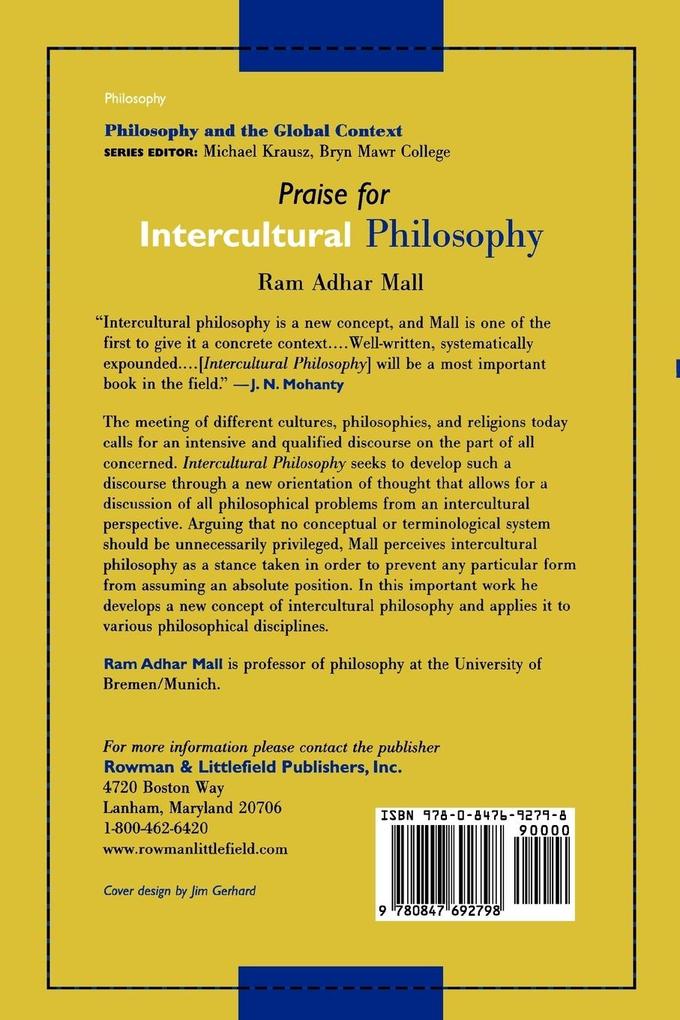
The meeting of different cultures, philosophies and religions today calls for an intensive and qualified discourse on the part of all concerned. Intercultural Philosophy seeks to develop such a discourse through a new orientation of thought that will allow for a discussion of all philosophical problems from an intercultural perspective. Arguing that no conceptual or terminological system should be unnecessarily privileged, Mall perceives intercultural philosophy as a stance taken in order to prevent any particular form from assuming an absolute position. In this important work he develops a new concept of intercultural philosophy and applies it to various philosophical disciplines.
Inhaltsverzeichnis
Part 1 Preface
Part 2 Introduction
Chapter 3 1 Intercultural Philosophy- A Conceptual Clarification
Chapter 4 2 Towards a Theory of an Analogous Hermeneutics
Chapter 5 3 Hermeneutics of the One under Different Names
Chapter 6 4 Intercultural Philosophy and Postmodernity
Chapter 7 5 An Intercultural Philosophy of Unity without Uniformity
Chapter 8 6 Two Metaphors of Time-Arrow and Cycle
Chapter 9 7 Metonymic Reflections on Shamkara's Concept of Brahman and Plato's Seventh Epistle
Chapter 10 8 The God of Phenomenology in Comparative Contrast to that of Philosophy and Theology
Chapter 11 9 The Concept of the Absolute- An Intercultural Perspective
Chapter 12 10 Europe in the Mirror of World Cultures- On the Myth of the Europeanisation of Humanity. A non-European Discovery of Europe
Part 13 Bibliography
Part 14 Index
Part 15 About the Author