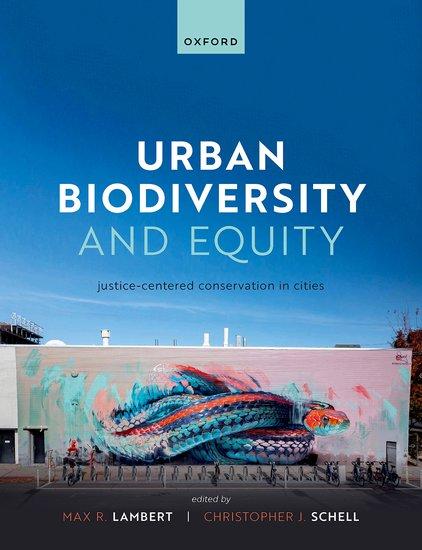
This advanced textbook moves beyond a basic scientific comprehension of urban ecosystems to understand the essential details of how scientists, policy makers, and practitioners develop solutions to effectively manage urban biodiversity. Such efforts necessitate unravelling the complex components that bolster or constrain biodiversity including human-wildlife interactions, resource availability, climate fluctuations, novel species relationships, and landscape heterogeneity. However, key to an understanding of these processes is also recognizing the tremendous social variation inherent within and across urban areas. The diversity of urban human communities fundamentally shapes how society designs, builds, and manages urban landscapes. This means that urban environmental management unavoidably must account for human social variation. Unfortunately, urban systems have a history and continued legacy of social inequality (e.g., systemic racism and classism) that govern how cities are both built and managed. This novel text not only highlights these connections, but also illustrates the interdisciplinary approaches needed for advancing a new, justice-centred approach to nature conservation.
Urban Biodiversity and Equity is suitable for graduate level students and professional researchers from both natural and social science disciplines studying the ecology, conservation, and management of urban environments and their biodiversity. It will also be of relevance and use to a broader audience of urban ecologists, urban planners, and urban wildlife practitioners.
Inhaltsverzeichnis
- 1: Max R. Lambert and Christopher J. Schell: The Imperative of Urban Conservation
- Section 1: Urban Nature's Social Fabric
- 2: Fushcia-Ann Hoover and Rachel Scarlett: Escaping the Practice of Exclusion: Conservation, Greenspace, and Urban Planning in the Age of Environmental Justice
- 3: Kelli L. Larson and Jeffrey A. Brown: Human Motivations and Constraints in Urban Conservation
- 4: Liba Pejchar and Sarah Reed: Conservation on the Urban Fringe: Sustaining Biodiversity and Advancing Equity in Suburban Ecosystems
- 5: Laura Guderyahn and Mary Logalbo: Portland's Conservation Organizations: Acknowledging Racial Inequity and Responding with Community-Informed Solutions
- Section 2: Innovative Approaches for Understanding and Prioritizing Equitable Urban Conservation
- 6: Dexter Locke, J. Morgan Grove, and Steward T. A. Pickett: The Role of Urban Tree Canopies in Environmental Justice and Conserving Biodiversity
- 7: Deja J. Perkins, Lauren M. Nichols, and Robert R. Dunn: Participatory Science for Equitable Urban Biodiversity Research and Practice
- 8: Seth Magle, Mason Fidino, Liza Lehrer, Tobin Magle, and Myla Aronson: Conservation Through Multi-City Ecological Networks
- 9: Kevin Avilés-Rodriguez, Kimberly Hughes, Jonathan L. Richardson, and Jason Munshi-South: Molecular Methods Through an Urban Social-Ecological Focus
- 10: Kaberi Kar Gupta, Madhusudan Khatti, Vidisha Kulkarni, Hari Prakash J. Ramesh, Harshitha C. Kumar, Kesang Bhutia, Soumya Kori, Rajeev Bacchu, and Arun P. Visweswaran: Urban Flagship Umbrella Species and Slender Lorises as an Example for Urban Conservation
- 11: (Lauren A. Stanton, Christine Wilkinson, Lisa Angeloni, Sarah Benson-Amram, Christopher J. Schell, and Julie K. Young: Animal Behavior, Cognition, and Human-Wildlife Interactions in Urban Areas
- Section 3: Emergent Urban Planning and Management Frameworks for Addressing Societal and Conservation Goals
- 12: Kaylee A. Byers, Maureen H. Murray, and Joanne E. Nelson: Urban Places Create Unique Health Spaces for Wildlife, People, and the Environment
- 13: Erica Spotswood, Max Lambert, Selena Pang, and Jonathan Young: Developing a Toolbox for Urban Biodiversity Conservation
- 14: Bronwen Stanford, Kelly Ikyanan, Robin Grossinger, Erin Beller, Mathew Benjamin, J. Letitia Grenier, Micaela Bazo, Nicole Heller, Myla Aronson, Alexander Felson, Peter Groffman, and Erica Spotswood: Making Nature's City: An Applied Science Framework to Guide Evaluation and Planning for Urban Biodiversity Conservation
- Conclusions
- 15: Christopher J. Schell, Nyeema C. Harris, Simone Des Roches, Travis Gallo, and Max Lambert: Biodiversity for the People: Future Directions for Urban Biodiversity Conservation