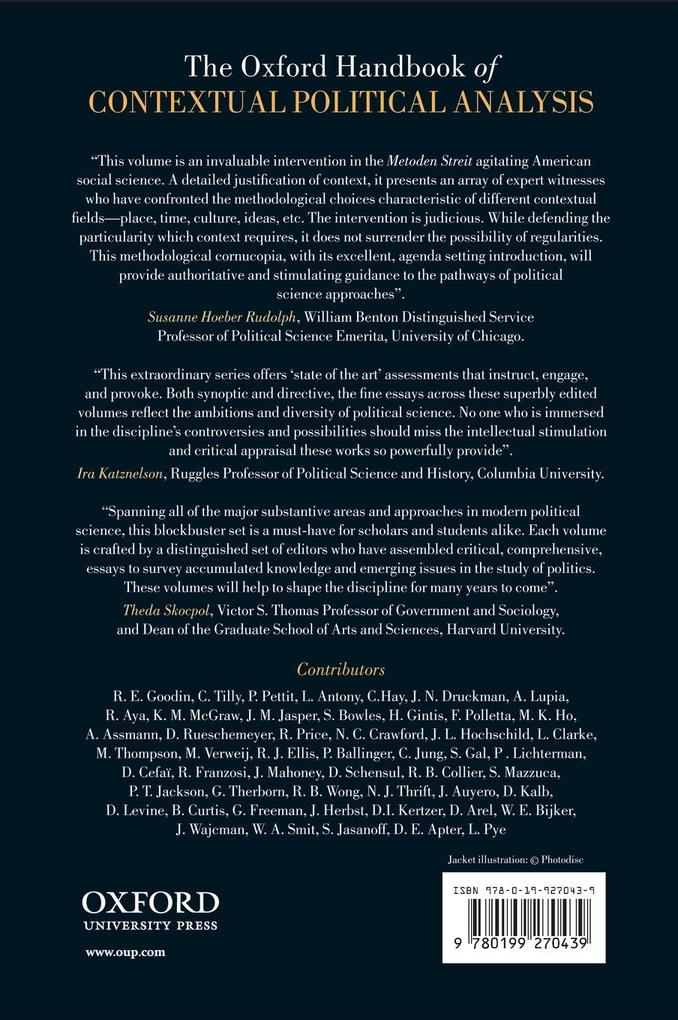
Oxford Handbooks of Political Science are the essential guide to the state of political science today. With engaging contributions from 51 major international scholars, the Oxford Handbook of Contextual Political Analysis provides the key point of reference for anyone working in political science and beyond.
The Oxford Handbooks of Political Science is a ten-volume set of reference books offering authoritative and engaging critical overviews of the state of political science. Each volume focuses on a particular part of the discipline, with volumes on Public Policy, Political Theory, Political Economy, Contextual Political Analysis, Comparative Politics, International Relations, Law and Politics, Political Behavior, Political Institutions, and Political
Methodology. The project as a whole is under the General Editorship of Robert E. Goodin, with each volume being edited by a distinguished international group of specialists in their respective fields. The books set out not just to report on the discipline, but to shape it. The series will be an indispensable point of
reference for anyone working in political science and adjacent disciplines.
The Oxford Handbook of Contextual Political Analysis sets out to synthesize and critique for the first time those approaches to political science that offer a more fine-grained qualitative analysis of the political world. The work in the volume has a common aim in being sensitive to the thoughts of contextual nuances that disappear from large-scale quantitative modelling or explanations based on abstract, general, universal laws of human behavior. It shows that 'context matters' in a
great many ways: philosophical context matters; psychological context matters; cultural and historical contexts matter; place, population, and technology all matter. By showcasing scholars who specialize in the analysis of all these contexts side-by-side, the Oxford Handbook of Contextual Political Analysis
shows how political scientists can take those crucial contextual factors systematically into account.
Inhaltsverzeichnis
- Part I. Introduction
- 1: Charles Tilly and Robert E. Goodin: It Depends
- Part II. Philosophy Matters
- 2: Philip Pettit: Why and How Philosophy Matters
- 3: Louise Antony: The Socialization of Epistemology
- 4: Colin Hay: Political Ontology
- 5: James N. Druckman and Arthur Lupia: Mind, Will, and Choice
- 6: Rod Aya: Theory, Fact, Logic
- Part III. Psychology Matters
- 7: Kathleen M. McGraw: Why and How Psychology Matters
- 8: James M. Jasper: Motivation and Emotion
- 9: Samuel Bowles and Herbert Gintis: Social Preferences, Homo Economicus, and Zoon Politikon
- 10: Francesca Polletta and M. Kai Ho: Frames and Their Consequences
- 11: Aleida Assmann: Memory, Individual and Collective
- Part IV. Ideas Matter
- 12: Dietrich Rueschemeyer: Why and How Ideas Matter
- 13: Richard Price: Detecting Ideas and Their Effects
- 14: Neta C. Crawford: How Previous Ideas Affect Later Ideas
- 15: Jennifer L. Hochschild: How Ideas Affect Actions
- 16: Lee Clarke: Mistaken Ideas and Their Effects
- Part V. Culture Matters
- 17: Michael Thompson, Marco Verweij, and Richard J. Ellis: Why And How Culture Matters
- 18: Pamela Ballinger: How to Detect Culture and its Effects
- 19: Courtney Jung: Race, Ethnicity, Religion
- 20: Susan Gal: Language, Its Stakes and Its Effects
- 21: Paul Lichterman and Daniel Cefaï: The Idea of Political Culture
- Part VI. History Matters
- 22: Charles Tilly: Why and How History Matters
- 23: Roberto Franzosi: Historical Knowledge and Evidence
- 24: James Mahoney and Daniel Schensul: Historical Context and Path Dependence
- 25: Ruth Berins Collier and Sebastián Mazzuca: Does History Repeat?
- 26: Patrick Thaddeus Jackson: The Present as History
- Part VII. Place Matters
- 27: Göran Therborn: Why and How Place Matters
- 28: R. Bin Wong: Detecting the Significance of Place
- 29: Nigel J. Thrift: Space, Place, and Time
- 30: Javier Auyero: Spaces and Places as Sites and Objects of Politics
- 31: Don Kalb: Uses of Local Knowledge
- Part VIII. Population Matters
- 32: David Levine: Why and How Population Matters
- 33: Bruce Curtis: The Politics of Demography
- 34: Gary P. Freeman: Politics and Mass Immigration
- 35: Jeffrey Herbst: Population Change, Urbanization, and Political Consolidation
- 36: David I. Kertzer and Dominique Arel: Population Composition as an Object of Political Struggle
- Part IX. Technology Matters
- 37: Wiebe E. Bijker: Why and How Technology Matters
- 38: Judy Wacjman: The Gendered Politics of Technology
- 39: Wim A. Smit: Military Technologies and Politics
- 40: Sheila Jasanoff: Technology as a Site and Object of Politics
- Part X. Old and New
- 41: David E. Apter: Duchamp's Urinal: Who Says What's Rational When Things Get Tough?
- 42: Lucian Pye: The Behavioral Revolution and the Remaking of Comparative Politics