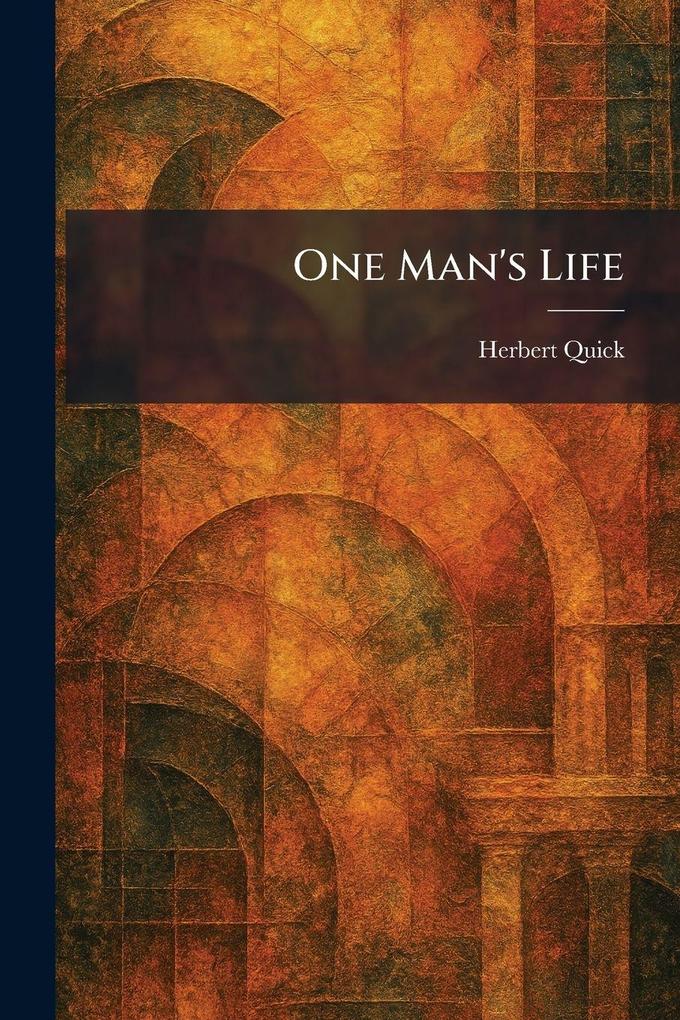
"One Man's Life" is the compelling autobiography of Herbert Quick, a renowned figure who witnessed and recorded the dramatic transformation of the American heartland. Born in a log cabin in Iowa during the mid-nineteenth century, Quick offers a vivid, first-hand account of the vanishing frontier and the emergence of a settled agrarian society. Through his personal journey, readers gain an intimate perspective on the hardships and triumphs of pioneer life, the evolution of local politics, and the development of a literary career deeply rooted in the soil of the Midwest.
The narrative captures the spirit of an era defined by rapid change, documenting the essence of the prairies before they were fully tamed by industrialization. Quick's prose is both nostalgic and analytical, providing valuable historical insight into the social and economic forces that shaped the United States during a pivotal century. "One Man's Life" serves not only as a record of an individual's growth from a farm boy to a prominent author and public servant but also as a vital historical document reflecting the collective experience of the generation that built the American West.
This work has been selected by scholars as being culturally important, and is part of the knowledge base of civilization as we know it. This work was reproduced from the original artifact, and remains as true to the original work as possible. Therefore, you may see the original copyright references, library stamps (as most of these works have been housed in our most important libraries around the world), and other notations in the work.
This work is in the public domain in the United States of America, and possibly other nations. Within the United States, you may freely copy and distribute this work, as no entity (individual or corporate) has a copyright on the body of the work.
As a reproduction of a historical artifact, this work may contain missing or blurred pages, poor pictures, errant marks, etc. Scholars believe, and we concur, that this work is important enough to be preserved, reproduced, and made generally available to the public. We appreciate your support of the preservation process, and thank you for being an important part of keeping this knowledge alive and relevant.