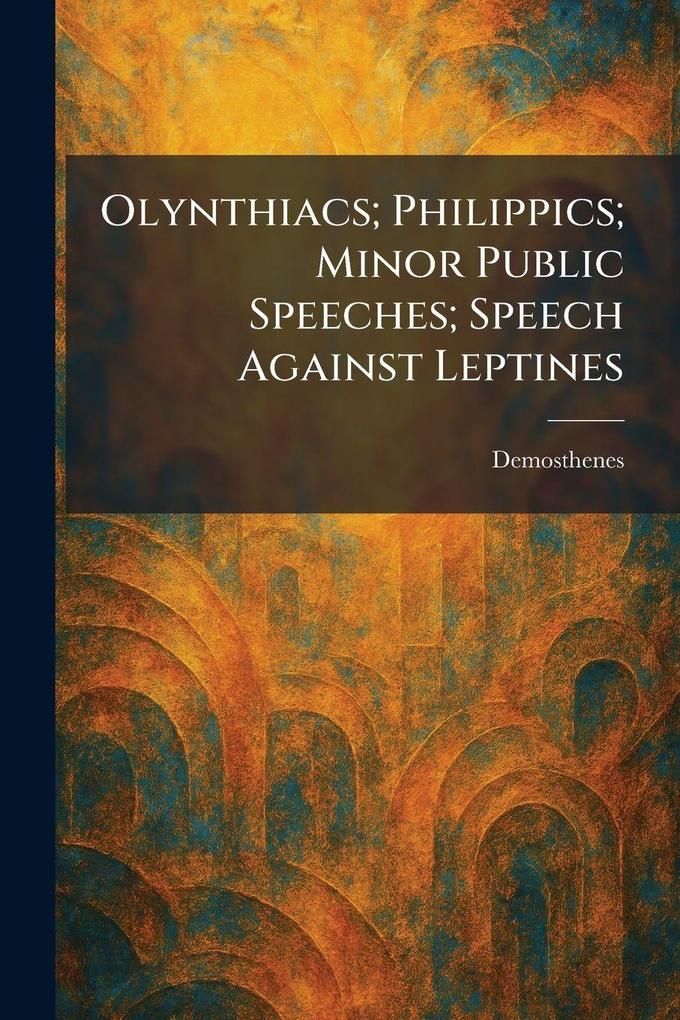
"Olynthiacs; Philippics; Minor Public Speeches; Speech Against Leptines" is a definitive collection of the orations of Demosthenes, widely regarded as the greatest orator of ancient Greece. This volume contains some of the most influential political speeches in Western history, including the "Olynthiacs" and the "Philippics", which document Demosthenes' passionate efforts to rouse the citizens of Athens against the growing power of Philip II of Macedon. These works are not only masterpieces of rhetorical technique but also vital historical records of the political tensions and military challenges facing the Greek city-states during the fourth century BC.
Beyond the famous warnings against Macedonian expansion, the collection includes several minor public speeches and the significant "Speech Against Leptines", which addresses legal and economic policy within the Athenian state. Throughout these texts, Demosthenes displays a profound commitment to democratic ideals and civic responsibility. His mastery of language, logical structure, and emotional appeal continues to serve as a foundational model for public speaking and political theory. This collection offers readers a direct window into the heart of Athenian democracy and the intellectual vigor of classical Greek thought.
This work has been selected by scholars as being culturally important, and is part of the knowledge base of civilization as we know it. This work was reproduced from the original artifact, and remains as true to the original work as possible. Therefore, you may see the original copyright references, library stamps (as most of these works have been housed in our most important libraries around the world), and other notations in the work.
This work is in the public domain in the United States of America, and possibly other nations. Within the United States, you may freely copy and distribute this work, as no entity (individual or corporate) has a copyright on the body of the work.
As a reproduction of a historical artifact, this work may contain missing or blurred pages, poor pictures, errant marks, etc. Scholars believe, and we concur, that this work is important enough to be preserved, reproduced, and made generally available to the public. We appreciate your support of the preservation process, and thank you for being an important part of keeping this knowledge alive and relevant.